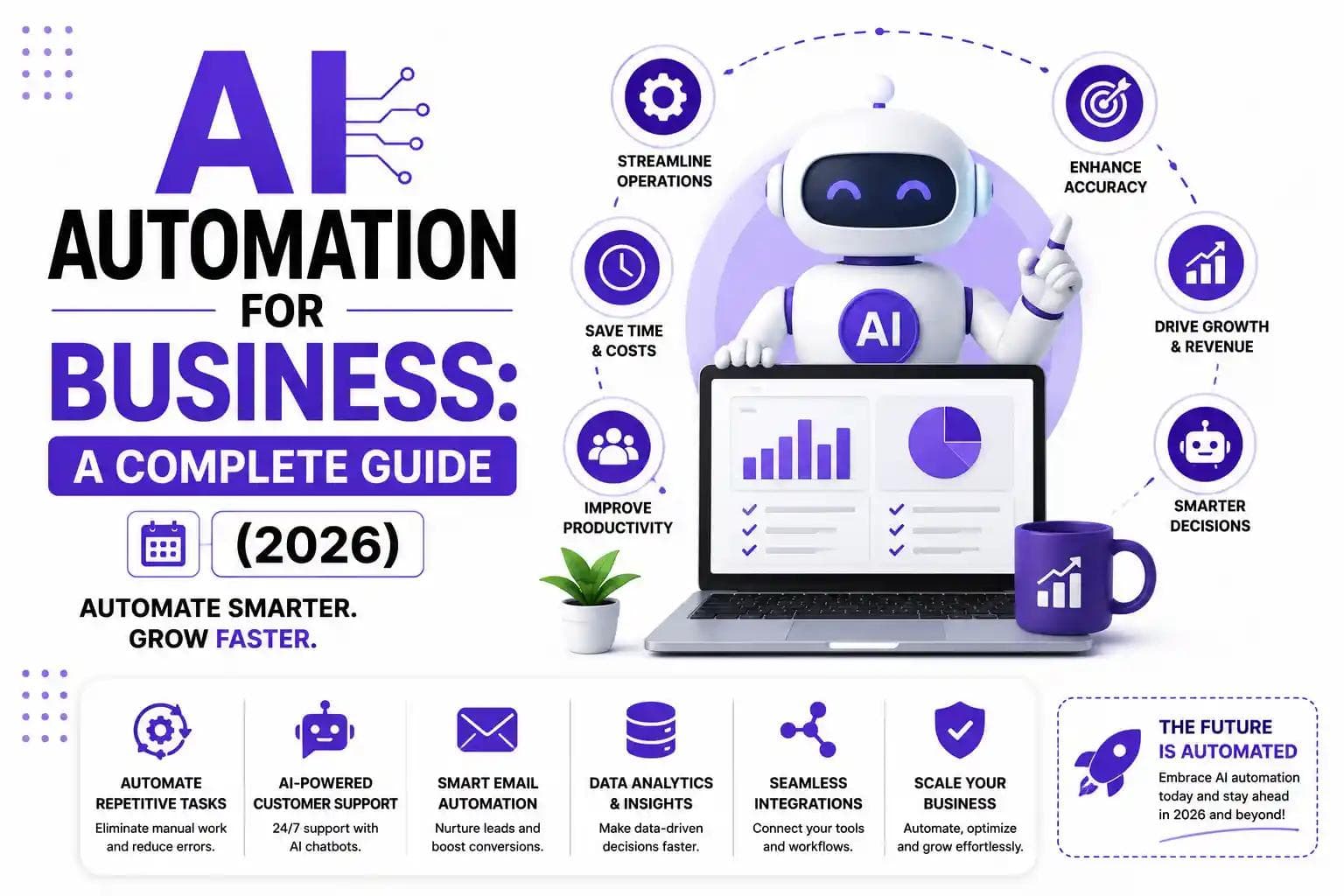
The businesses that automate today will dominate tomorrow. Here is everything you need to know.
If you have ever felt like your team spends too much time on repetitive tasks — sending the same emails, entering data manually, following up on leads, or scheduling meetings — you are not alone. Business owners across Pakistan and around the world are waking up to one powerful truth: AI automation is no longer a luxury. It is a survival skill.
In this complete guide, you will learn exactly what AI automation for business means, how it works, which tools to use, and how Pakistani entrepreneurs in Islamabad, Karachi, and Lahore are already using it to save time, cut costs, and grow faster. Whether you are a complete beginner or ready to hire an AI automation consultant, this guide has you covered.
What Is AI Automation for Business?
AI automation for business means using artificial intelligence to perform tasks that humans normally do manually — things like responding to customer emails, generating reports, qualifying sales leads, processing invoices, or managing social media content.
It is the combination of two powerful forces: automation (doing things without human intervention) and artificial intelligence (machines that can learn, reason, and make decisions). Together, they create what experts call intelligent process automation or cognitive automation.
Think of it this way. Traditional automation is like a light switch — it does one thing on command. AI automation is like a smart home system — it learns your habits, predicts what you need, and takes action before you even ask.
According to McKinsey, around 60% of all business occupations have at least 30% of their activities that could be automated with today's AI technology. That number is only growing.
AI Automation vs Traditional Business Automation: What Is the Difference?
Many business owners confuse robotic process automation (RPA) with AI automation. Here is a simple breakdown:
Traditional / RPA Automation:
- Follows fixed, rule-based instructions
- Cannot handle exceptions or unstructured data
- Works well for repetitive, structured tasks like copy-paste data entry
- Does not learn or improve over time
AI Automation:
- Uses machine learning, natural language processing, and deep learning
- Can handle unstructured data like emails, PDFs, images, and voice
- Learns from patterns and improves its accuracy over time
- Can make decisions, predict outcomes, and generate content
The difference between RPA and AI automation is essentially the difference between a calculator and a brain. RPA follows rules. AI understands context.
Modern businesses are now moving toward hyperautomation — a term coined by Gartner — which combines RPA, AI, machine learning, and process mining to automate as many business processes as possible, end to end.
Why AI Automation Matters Especially in Pakistan in 2026
Pakistan's digital economy is growing fast. With over 130 million internet users, a young tech-savvy population, and a booming freelance sector, Pakistani businesses are in a prime position to benefit from AI automation.
Here is why it matters right now:
- Labor costs are rising — automating repetitive tasks keeps operational costs low
- Competition is increasing — businesses using AI tools move faster and serve customers better
- Remote and freelance economy is booming — AI automation allows one person to do the work of ten
- International clients now expect AI-ready teams — agencies in Islamabad, Karachi, and Lahore are losing clients to competitors who offer AI-powered services
Cities like Islamabad and Lahore are seeing a surge in demand for AI automation services. Karachi, as Pakistan's commercial hub, has dozens of startups and established firms now investing in business process automation to stay competitive.
If you run a business — whether it is an e-commerce store, a digital agency, a law firm, an accounting practice, or a healthcare clinic — AI automation for Pakistani businesses is not optional anymore. It is your biggest competitive advantage.
Which Business Processes Can Be Automated with AI?
This is the question every business owner asks first. The answer might surprise you. Almost every department in your business has processes that can be automated with AI.
Marketing Automation AI
- Generating and scheduling social media content
- Personalizing email campaigns based on user behavior
- AI lead generation and lead scoring
- Running and optimizing Google Ads and Facebook Ads automatically
- AI content automation for blogs, captions, and ad copy
Sales Automation AI
- Automated follow-up emails and SMS sequences
- AI-powered CRM updates and pipeline management
- Chatbot qualification of inbound leads
- Predictive analytics to forecast sales
- AI scheduling tools for booking demos and calls
Customer Service Automation
- AI chatbots handling FAQs 24/7
- Automated ticket routing and prioritization
- Sentiment analysis on customer messages
- Voice AI for call center automation
- AI customer support automation for small business that cannot afford a large team
HR Automation AI
- Automated resume screening software
- Interview scheduling
- Onboarding document processing
- Payroll automation
- Employee performance analytics
Finance and Accounting Automation
- AI invoice processing
- Automated accounts payable and receivable
- Expense report automation
- Fraud detection using machine learning
- Financial forecasting with predictive analytics
Operations and Admin
- Document automation AI for contracts, proposals, and reports
- AI data entry automation
- AI email automation for sorting, responding, and flagging
- AI scheduling tools for team calendars
- Workflow automation across departments
If you are running an e-commerce business, you can explore how tools like Shopify integrate with AI — check out this helpful Shopify vs WooCommerce comparison for 2026 to understand which platform supports better automation.
Best AI Automation Tools for Business in 2026
Here are the most powerful AI automation tools that businesses — including small businesses in Pakistan — are using right now:
No-Code and Low-Code Automation Platforms
- Zapier AI — connects thousands of apps and automates workflows without writing any code. Perfect for small businesses and freelancers.
- Make.com automation (formerly Integromat) — more advanced than Zapier, ideal for complex multi-step workflows
- n8n workflows — open source, self-hostable, great for developers and technical teams
- Pabbly Connect — affordable Zapier alternative popular among Pakistani businesses
AI Chatbot Automation
- ChatGPT automation via OpenAI API — build custom AI assistants for customer service, sales, and internal operations
- ManyChat — Facebook and Instagram chatbot automation for marketing
- Tidio — AI customer service chatbot for websites
- Voiceflow — build voice and chat AI agents without coding
CRM and Sales Automation
- HubSpot — all-in-one CRM with built-in AI automation for sales and marketing
- GoHighLevel — popular with agencies in Pakistan for client management and automation
- Salesforce AI — enterprise-grade with Einstein AI for predictive analytics
AI Content and Marketing Automation
- Jasper AI — AI content automation for blogs, ads, and social media
- Copy.ai — fast content generation for marketing teams
- Canva AI — design automation for social media graphics
AI Analytics and Reporting
- Google Analytics 4 with AI insights — learn more in the Google Analytics 4 guide for beginners 2026
- Power BI — AI analytics dashboard for business intelligence
- Tableau — data visualization with machine learning integration
Document and Workflow Automation
- Notion AI — meeting notes, task summaries, and knowledge management
- DocuSign — automated contract signing and document routing
- Microsoft Power Automate — deep integration with Microsoft 365 for enterprise workflow automation
How to Implement AI Automation in Your Business: Step-by-Step
Many business owners know they need AI automation but do not know where to start. Here is a practical, beginner-friendly roadmap.
Step 1: Audit Your Current Processes
Write down every repetitive task your team does each week. Look for tasks that are rule-based, time-consuming, and prone to human error. These are your prime automation candidates.
Step 2: Prioritize by ROI
Not every task is worth automating first. Focus on the processes that consume the most time or cost the most money. AI automation ROI for small businesses is highest when you target high-volume, low-complexity tasks first.
Step 3: Choose the Right Tools
Based on your priorities, select tools from the list above. If you are non-technical, start with no-code AI automation platforms like Zapier or Make.com. If you need custom solutions, consider hiring an AI automation consultant.
Step 4: Build and Test
Start small. Automate one workflow at a time. Test it thoroughly before scaling. A common mistake is trying to automate everything at once and ending up with a broken, confusing system.
Step 5: Train Your Team
AI automation does not replace your team — it empowers them. Train your staff to work alongside AI tools. This is where an AI automation course becomes incredibly valuable.
Step 6: Monitor and Optimize
Use your AI analytics dashboard to track performance. Automation workflows need regular maintenance as your business and tools evolve.
For businesses also building their digital infrastructure, understanding website development in Pakistan in 2026 is an important parallel step — your website is the foundation all your automation tools connect to.
AI Automation for Different Industries
AI Automation for E-commerce Business
E-commerce is one of the biggest beneficiaries of AI automation. From automated product descriptions and personalized recommendations to abandoned cart email sequences and AI-powered inventory management — online stores that automate grow significantly faster.
Tools like Shopify paired with Klaviyo, ChatGPT API, and Zapier can handle everything from order confirmation emails to customer win-back campaigns automatically.
AI Automation for Healthcare Business
Healthcare businesses in Pakistan are using AI automation for appointment scheduling, patient follow-ups, automated billing, and medical document processing. AI-powered chatbots are handling basic triage questions and routing patients to the right specialists.
AI Automation for Real Estate Business
Real estate agents in Lahore, Karachi, and Islamabad are using AI tools for automated lead follow-up, property description generation, virtual tour scheduling, and CRM management. AI automation saves real estate agents an average of 10 to 15 hours per week.
AI Automation for Law Firms
Document automation AI is a game-changer for legal practices. Contract drafting, clause extraction, legal research, and client intake forms can all be automated. Law firms using AI automation cut document preparation time by up to 70%.
AI Automation for Accounting Firms
AI invoice processing, automated bank reconciliation, expense categorization, and financial report generation are transforming accounting practices in Pakistan. Tools like QuickBooks AI and Xero automation are making this accessible even for small firms.
AI Automation and Digital Marketing: A Powerful Combination
If you run a digital marketing agency or manage marketing for your business, combining AI automation with your marketing strategy creates extraordinary results.
AI can automate your entire content calendar, generate SEO-optimized blog posts, schedule and post to social media, run A/B tests on ad creatives, and send personalized email sequences — all without human intervention after the initial setup.
This is exactly why understanding SEO alongside AI automation gives you a massive advantage. Read the SEO 2026 Google Ranking Guide to see how AI content automation integrates with modern search engine optimization.
For a full picture of digital marketing combined with AI tools, the Digital Marketing Guide for Pakistan 2026 is an excellent companion resource.
AI Agents: The Next Level of Business Automation
In 2025 and 2026, the conversation has shifted from simple workflow automation to AI agents — autonomous software programs that can plan, decide, and take actions to achieve a goal.
What Is an AI Agent?
An AI agent is a program that perceives its environment, makes decisions based on goals, and takes actions to achieve those goals — often without human involvement. It uses AI models like large language models (LLMs) to reason, plan multi-step tasks, and use tools like web browsers, code interpreters, and APIs.
Types of AI Agents in Business
- Simple reflex agents — respond to specific triggers (e.g., auto-reply bots)
- Model-based agents — maintain a model of the world to make better decisions
- Goal-based agents — plan actions to achieve a specific business goal
- Learning agents — improve over time based on feedback and data
- Multi-agent systems — multiple AI agents working together on complex tasks
Real-World AI Agent Examples for Business
- An AI agent that monitors your inbox, identifies urgent client messages, drafts responses, and schedules follow-up tasks in your CRM
- A trading agent AI that monitors market signals and executes transactions based on predefined strategy
- An AI agent that researches competitors, writes a summary report, and sends it to your team every Monday morning
- A customer service AI agent that handles the full lifecycle of a support ticket — from intake to resolution — without human involvement
AI agents represent the next frontier of intelligent automation solutions. Businesses that deploy them now will have a significant head start.
AI Automation and Cybersecurity: What You Need to Know
As you automate more of your business, data security becomes critical. AI automation involves connecting multiple tools, sharing API keys, and processing sensitive customer data.
Key security practices for AI-automated businesses:
- Always use OAuth authentication rather than storing raw passwords in automation tools
- Regularly audit your Zapier/Make.com connections and remove unused workflows
- Encrypt sensitive data before passing it through automation pipelines
- Use role-based access control so only authorized team members can edit workflows
For businesses in Pakistan managing client data, understanding the fundamentals of digital security is non-negotiable. The Network Security Fundamentals for Business 2026 guide covers the essentials you need to know before scaling your automation.
How Much Does AI Automation Cost?
This is one of the most common questions from Pakistani business owners. The honest answer: it depends on what you automate and how.
DIY with No-Code Tools:
- Zapier free plan: PKR 0/month (limited tasks)
- Zapier Starter: approximately PKR 5,000–8,000/month
- Make.com: approximately PKR 3,000–6,000/month
- Total for a basic automated business: PKR 10,000–20,000/month
Hiring an AI Automation Agency in Pakistan:
- Small project (1-3 workflows): PKR 30,000–80,000 one-time
- Full business automation setup: PKR 150,000–500,000+
- Monthly retainer with an AI automation agency: PKR 50,000–200,000/month
AI Automation Course Investment:
- Online international courses (Coursera, Udemy): PKR 5,000–25,000
- Local AI automation course in Islamabad/Karachi/Lahore: PKR 15,000–60,000
- IDTS Digital Advanced Course: Competitively priced with real-world project training
The ROI of AI automation almost always exceeds the cost within 3 to 6 months for businesses that implement it strategically. Businesses report saving 15 to 30 hours per week per employee after full implementation.
AI Automation in Pakistan: The Growing Demand
Pakistan is one of the fastest-growing digital markets in Asia. Here is what is happening on the ground:
Islamabad: Government tech initiatives, IT parks, and a concentration of software houses are driving demand for AI automation services in Islamabad. Companies are hiring AI automation consultants and building in-house automation teams.
Karachi: As Pakistan's financial and commercial capital, Karachi leads in business process automation adoption. Banks, e-commerce companies, and large retail businesses are investing heavily in AI automation services in Karachi.
Lahore: With a thriving startup ecosystem and a large freelance community, Lahore is seeing explosive growth in demand for AI automation courses and AI automation agencies. Young entrepreneurs in Lahore are building AI automation agencies serving international clients.
Rawalpindi: Close proximity to Islamabad means Rawalpindi businesses benefit from the same tech ecosystem. AI automation in Rawalpindi is growing, particularly in education, retail, and services.
The best AI automation companies in Pakistan are no longer just serving local clients — they are competing for international projects from the US, UK, and Gulf markets.
How to Learn AI Automation: Free and Paid Resources
If you want to build AI automation skills yourself, here are the best paths:
Free Resources to Learn AI Automation
- Google's free AI courses — Google offers excellent free AI fundamentals courses at grow.google
- Coursera AI courses (audit for free) — courses by Andrew Ng and DeepLearning.ai are world-class
- YouTube — channels like Liam Ottley, Nicholas Renotte, and AI Jason cover AI automation tutorials in detail
- Make.com Academy — free official training for Make.com automation
- Zapier University — free official Zapier training
Paid Courses for AI Automation
- IDTS Digital Advanced AI Automation Course — designed specifically for Pakistani professionals and business owners, covering real-world tools, live projects, and business applications
- Udemy AI automation courses — affordable with lifetime access
- IBM AI courses on Coursera — great for professional certification
For non-technical professionals, the best starting point is a no-code AI automation course that teaches you Zapier, Make.com, and ChatGPT API integrations without requiring programming knowledge.
If you are also interested in understanding machine learning concepts at a non-technical level, the Machine Learning Basics for Non-Tech Guide 2026 is a perfect companion read.
For those interested in building AI-powered web applications, reviewing the Full Stack Web Development Roadmap 2026 will show you how coding skills and AI automation combine.
Why Choose IDTS Digital for AI Automation Training and Services?
IDTS Digital is one of Pakistan's leading digital training and services institutes, with a track record of helping hundreds of professionals and businesses in Islamabad, Karachi, and Lahore build real digital skills.
Here is what makes IDTS Digital different:
For AI Automation Training:
- Curriculum built around real business use cases — not just theory
- Hands-on projects using Zapier, Make.com, ChatGPT API, and AI agents
- Instructors with active industry experience in AI automation projects
- Small batch sizes for personalized attention
- Post-course support and community access
- Certification recognized by industry partners
For AI Automation Services:
- Full-service AI automation agency in Islamabad serving businesses across Pakistan
- Custom workflow automation, AI chatbot development, CRM automation, and more
- Transparent pricing with clear ROI projections
- Ongoing support and optimization after deployment
You can explore the full range of IDTS Digital courses and IDTS Digital services to find exactly what your business needs.
If you are also building your freelancing career alongside automation skills, check out the How to Start Freelancing in Pakistan 2026 guide which shows you how AI automation skills translate directly into high-paying freelance income.
The Future of AI Automation for Business
The trajectory is clear. Here is where AI automation is heading over the next three to five years:
Hyperautomation becomes standard — businesses will automate entire departments, not just individual tasks. The combination of AI, RPA, machine learning, and process mining will eliminate most routine cognitive work.
AI agents replace software teams — instead of hiring five people to manage different tools, businesses will deploy AI agent systems that coordinate across platforms autonomously.
Generative AI transforms content operations — marketing, legal, HR, and finance departments will use generative AI to produce first drafts of everything from contracts to reports to ad campaigns.
Predictive automation takes over — systems will not just react to triggers; they will predict what needs to happen next and act proactively. AI decision making will move from descriptive to prescriptive.
Pakistan becomes a global AI automation hub — with competitive pricing, English proficiency, and a young tech talent pool, Pakistan has a real opportunity to become a leading provider of AI automation services internationally.
The businesses and professionals who invest in AI automation skills and infrastructure today will be the market leaders of 2028 and beyond. This is not hype — it is the same trajectory we saw with websites in 2000, social media in 2010, and smartphones in 2015.
AI Automation Success Stories: Real Results from Real Businesses
E-commerce store in Karachi: A clothing brand automated their order confirmation emails, abandoned cart follow-ups, customer review requests, and inventory alerts using Zapier and Klaviyo. Result: 23% increase in repeat purchases, 15 hours saved per week.
Digital marketing agency in Lahore: Automated client reporting, social media scheduling, and lead follow-up using Make.com and ChatGPT API. Result: Agency onboarded three new clients without hiring additional staff.
Accounting firm in Islamabad: Implemented AI invoice processing and automated bank reconciliation. Result: Invoice processing time reduced from 4 hours to 20 minutes per day.
Real estate company in Rawalpindi: Deployed an AI chatbot for lead qualification on their website. Result: 40% of leads now pre-qualified without any human involvement, allowing agents to focus on serious buyers only.
These results are not exceptional — they are typical for businesses that implement AI automation correctly. The AI automation ROI for small businesses is remarkably consistent across industries.
Frequently Asked Questions About AI Automation for Business
What is AI automation for business?
AI automation for business is the use of artificial intelligence technologies — including machine learning, natural language processing, and AI agents — to perform business tasks automatically, without continuous human input. It covers everything from email automation and chatbots to full workflow automation and intelligent decision-making systems.
How does AI automation work?
AI automation works by combining triggers, conditions, and actions. A trigger (like a new customer filling a form) activates a workflow, AI processes the data (classifying, generating, or deciding), and then an action occurs (sending an email, updating a CRM, generating a report). Advanced systems use large language models and AI agents to handle complex, multi-step tasks.
What are the benefits of AI automation for business?
The main benefits include saving time on repetitive tasks, reducing human error, cutting operational costs, scaling operations without hiring more staff, improving customer response times, and generating data-driven insights for better decision making. Businesses typically save 15 to 30 hours per week after implementing AI automation.
Is AI automation good for small businesses?
Yes, especially now. No-code AI automation tools like Zapier, Make.com, and ChatGPT integrations make it possible for any small business to automate without a technical team. The cost is low — often less than PKR 10,000 per month — and the return on investment is typically achieved within three to six months.
What is the difference between AI and RPA?
RPA (Robotic Process Automation) follows rigid, rule-based instructions and can only handle structured, predictable data. AI automation uses machine learning and natural language processing to handle unstructured data, make decisions, learn from patterns, and improve over time. Modern businesses use both together — often called intelligent process automation.
How much does AI automation cost in Pakistan?
Basic AI automation using no-code tools costs approximately PKR 5,000 to 20,000 per month. Hiring an AI automation agency for a custom project ranges from PKR 30,000 to 500,000+ depending on complexity. An AI automation course in Pakistan typically costs between PKR 15,000 and 60,000, which is usually the most cost-effective starting point for business owners.
Can AI automation replace employees?
AI automation replaces tasks, not people. Routine, repetitive tasks are automated so that human employees can focus on creative, strategic, and relationship-driven work. The World Economic Forum estimates that AI will create more jobs than it eliminates by 2030, but the nature of those jobs will change significantly. Employees who know how to work with AI tools will be far more valuable than those who do not.
What are the best AI automation tools for small business?
The best tools for small businesses starting with AI automation are Zapier (for connecting apps), Make.com (for complex workflows), ChatGPT API (for intelligent text processing), ManyChat (for social media chatbots), and HubSpot (for CRM and marketing automation). All have free tiers or affordable starter plans.
What is hyperautomation?
Hyperautomation, a term introduced by Gartner, refers to the combination of multiple automation technologies — RPA, AI, machine learning, process mining, and analytics — to automate as many business processes as possible. It is the end goal of digital transformation AI strategy for enterprises.
How do I start AI automation in my business?
Start by auditing your repetitive tasks, identify the highest-ROI candidates for automation, choose a no-code tool like Zapier or Make.com, automate one workflow at a time, and test thoroughly before scaling. Taking an AI automation course first significantly shortens the learning curve and helps you avoid costly mistakes.
Conclusion: Your AI Automation Journey Starts Now
We are living through one of the most significant shifts in business history. AI automation for business is not a trend — it is the new operating system of the modern economy. Whether you run a startup in Islamabad, a retail business in Karachi, an agency in Lahore, or a service firm in Rawalpindi, AI automation gives you the power to work smarter, serve customers better, and compete with anyone in the world.
The businesses that act now will set the pace. The ones that wait will spend years catching up.
You have just read one of the most comprehensive guides to AI automation available for Pakistani business owners. Now it is time to act.
Ready to take the next step?
👉 Book your seat in the Advanced AI Automation Course at IDTS Digital — Pakistan's most practical, business-focused AI automation training program. Whether you are in Islamabad, Karachi, Lahore, or anywhere in Pakistan, you can learn the exact tools and workflows used by top businesses and automation agencies worldwide.
Explore IDTS Digital Courses | View IDTS Digital Services | Contact IDTS Digital
Do not just watch the AI revolution happen. Lead it.
This article is part of the IDTS Digital knowledge hub — Pakistan's trusted source for digital skills, AI training, and business automation services. Explore more at idtsdigital.com.