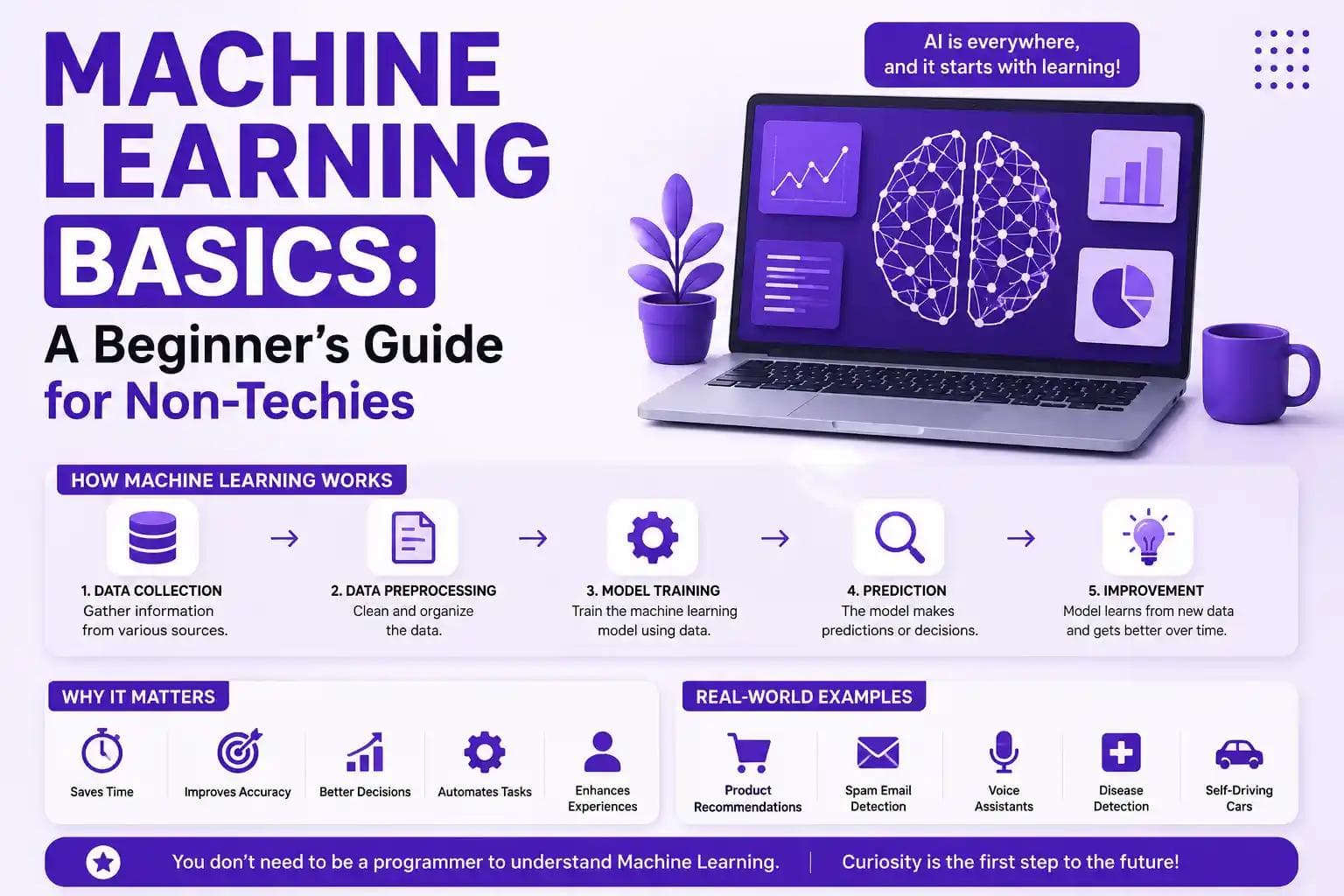
Have you ever wondered how Netflix knows exactly what show you want to watch next? Or how your phone unlocks just by looking at your face? That is machine learning quietly working in the background of your everyday life. If you have always felt that machine learning is only for hardcore programmers or PhD holders, this guide is going to change your mind completely. This is your beginner-friendly, plain-English introduction to machine learning — explained simply, practically, and without boring technical jargon. Whether you are a student in Karachi, a working professional in Lahore, or a curious learner in Islamabad, by the end of this article, you will understand what machine learning is, why it matters, and how you can start learning it today.
What Is Machine Learning?
Machine learning is a branch of artificial intelligence that allows computers to learn from data and improve their performance over time — without being explicitly programmed for every task.
In plain language: instead of a programmer writing step-by-step instructions for every situation, a machine learning model studies patterns in data and figures things out on its own.
Think of it this way. If you teach a child what a cat looks like by showing them 1,000 pictures of cats, eventually that child can identify a cat they have never seen before. Machine learning works the same way. You feed the system data, it finds patterns, and it learns to make decisions.
Machine learning definition for beginners: Machine learning is the science of getting computers to act without being explicitly programmed, by using data and algorithms to imitate the way humans learn.
Google, Coursera, and IBM all define machine learning as one of the most transformative technologies of the 21st century — and for good reason.
Machine Learning vs Artificial Intelligence: What's the Difference?
This is one of the most common questions beginners ask.
Artificial intelligence (AI) is the broader concept — it refers to any technique that enables machines to mimic human intelligence. Machine learning is a subset of AI. It is the specific method by which machines actually learn from data.
To put it simply:
- AI is the goal (a smart machine)
- Machine learning is one way to achieve that goal (by learning from data)
- Deep learning is a subset of machine learning that uses neural networks with many layers
So when someone says "AI and machine learning," they usually mean systems that use ML techniques to appear intelligent. All machine learning is AI, but not all AI is machine learning.
If you are interested in understanding the broader digital landscape, check out this insightful read on Digital Marketing vs Traditional Marketing 2026 — because AI and ML are now reshaping marketing itself.
How Does Machine Learning Work? (Step by Step)
Here is a simple breakdown of how machine learning works in practice:
Step 1 — Collect Data The process starts with data. This could be images, text, numbers, user behaviour, or anything measurable. The more quality data, the better the model learns.
Step 2 — Prepare the Data (Data Preprocessing) Raw data is messy. It needs to be cleaned, formatted, and organised. This step is called data preprocessing, and it is arguably the most time-consuming part of any ML project.
Step 3 — Choose an Algorithm Depending on the problem, you choose an algorithm — like linear regression, decision trees, or a neural network.
Step 4 — Train the Model You feed the prepared data into the algorithm. The model learns by finding patterns and adjusting itself through a process called training.
Step 5 — Test and Evaluate The model is then tested on new data it has never seen before. You measure its accuracy. If it performs poorly, you go back and improve it. Concepts like overfitting, underfitting, bias, and variance all come into play here.
Step 6 — Deploy and Use Once the model is accurate enough, it is deployed in a real product — like a spam filter in your email or a recommendation engine in a shopping app.
The 3 Types of Machine Learning (Explained Simply)
Understanding the types of machine learning is essential for any beginner. Here they are:
1. Supervised Learning In supervised learning, the model is trained on labelled data — data where the correct answers are already provided. Think of it like learning with an answer key. The model learns to map inputs to outputs. Examples: email spam detection, house price prediction, image classification.
2. Unsupervised Learning Here, the model is given data without labels and must find patterns on its own. Clustering algorithms are commonly used in unsupervised learning. Examples: customer segmentation, anomaly detection, topic modelling.
3. Reinforcement Learning In this type, an agent learns by interacting with an environment and receiving rewards or penalties. It is the method used to train game-playing AI and robotics. Examples: self-driving cars, game-playing bots like AlphaGo, recommendation systems.
Real-World Examples of Machine Learning in Daily Life
Machine learning is not just a laboratory concept. It is already running inside the apps and services you use every day:
- YouTube and Netflix use ML-powered recommendation engines to suggest content based on your viewing history
- Google Search uses natural language processing (NLP) to understand what you are actually asking, not just the keywords you type
- Fraud Detection in your bank uses machine learning to flag suspicious transactions in real time
- Voice Assistants like Siri, Google Assistant, and Amazon Alexa are powered by ML models that understand speech
- Healthcare Diagnostics — ML models can now detect cancer in medical images with accuracy matching or exceeding doctors
- Spam Filters in Gmail use ML to keep your inbox clean
- Facebook and Instagram feeds use ML to show you content you are most likely to engage with
These are not futuristic possibilities. They are happening right now, in Pakistan and globally.
If you are curious how businesses are using data-driven decisions powered by machine learning, this article is a must-read: How Businesses Can Leverage Data for Smarter Decisions
Machine Learning Tools and Technologies Beginners Should Know
You do not need to learn everything at once. Here are the most beginner-friendly tools and technologies in the ML ecosystem:
Python — The most popular programming language for machine learning. It is beginner-friendly, widely taught, and supported by powerful libraries.
Scikit-learn — A beginner-friendly Python library for building machine learning models. Perfect for classification, regression, and clustering tasks.
TensorFlow — An open-source deep learning framework developed by Google. Used for building neural networks.
Keras — A high-level API that runs on top of TensorFlow. Makes it easier to build deep learning models.
PyTorch — Another deep learning framework, widely used in research and academia.
Jupyter Notebook — An interactive coding environment where you write, test, and visualize code in real time. Essential for data science and ML work.
Kaggle — A platform with free datasets, competitions, and beginner courses. One of the best places to practice ML skills.
Google Colab — A free, cloud-based Jupyter Notebook environment. No installation needed. Perfect for beginners in Pakistan who want to start without spending anything.
Can you learn machine learning without coding? Yes, partially. Tools like Google AutoML, Microsoft Azure AI, and AWS SageMaker offer no-code/low-code ML capabilities. But if you want serious career opportunities, learning Python basics is strongly recommended.
Machine Learning and Automation: A Powerful Combination
One of the most exciting applications of machine learning is automation. When ML meets automation, the results are transformative for businesses.
What is automation in machine learning? Automation in ML means using machine learning models to automatically perform tasks that previously required human judgment — like sorting emails, approving loan applications, or detecting defects in a factory production line.
Types of automation powered by ML:
- Robotic Process Automation (RPA) — Automating repetitive digital tasks like data entry
- Intelligent Automation — Combining RPA with AI/ML for smarter, adaptive workflows
- Marketing Automation — Using ML to personalise email campaigns, run ads, and segment audiences
- Workflow Automation — Automating business processes using tools like Microsoft Power Automate and Zapier
Businesses across Pakistan are now investing in automation services to cut costs and increase efficiency. If you want to understand AI automation tools from a business perspective, explore AI Chatbot & Automation Services by IDTS Digital.
Also, if you are a business owner looking to automate your customer support, this case study is highly relevant: AI Chatbot for Customer Support in Pakistan
Machine Learning in Pakistan: Scope, Jobs, and Demand in 2026
Pakistan is experiencing a massive digital transformation. From startups in Lahore's tech corridors to freelancers in Rawalpindi and IT companies in Karachi, machine learning is becoming one of the most sought-after skills in the country.
Is machine learning in demand in Pakistan? Absolutely. According to industry reports, demand for AI and ML professionals in Pakistan has grown by over 60% in the past two years. Companies in fintech, healthcare, e-commerce, and telecom are actively hiring ML engineers and data scientists.
Machine learning engineer salary in Pakistan: A junior ML engineer in Pakistan earns between PKR 80,000 to PKR 150,000 per month. Senior ML engineers and data scientists can earn PKR 250,000 to PKR 500,000+ monthly. Freelancers working on international projects via platforms like Upwork and Fiverr often earn $30–$80 per hour.
Career opportunities after learning ML:
- Machine Learning Engineer
- Data Scientist
- AI Engineer
- NLP Engineer
- Computer Vision Specialist
- Data Analyst
- Automation Engineer
If you are looking to enter the freelancing world with your ML skills, start here: How to Start Freelancing in Pakistan 2026
Also read: Data Analytics Career in Pakistan — 2026 Guide
How to Learn Machine Learning From Scratch in Pakistan (2026 Roadmap)
Step 1: Build Your Math Foundation Focus on linear algebra, statistics, and probability. You do not need to be a mathematician, but basic understanding is essential.
Step 2: Learn Python Python is the gateway to ML. Learn the basics — variables, loops, functions, and data structures. Then move to data science libraries like NumPy and Pandas.
Step 3: Study Machine Learning Fundamentals Start with the Google Machine Learning Crash Course — it is free, beginner-friendly, and taught by Google's own ML team.
Step 4: Learn Scikit-learn and TensorFlow Practice building models. Start with simple classification and regression problems on Kaggle datasets.
Step 5: Work on Real Projects Build a portfolio. Projects like house price prediction, sentiment analysis, or image classification look great to employers and clients.
Step 6: Enrol in a Structured Course Self-study is great, but a guided, mentor-supported course accelerates everything. That is where IDTS Digital comes in.
Why Choose IDTS Digital for Your Machine Learning & AI Course?
IDTS Digital — the Institute of Digital Training and Services — is one of Pakistan's emerging digital education platforms, offering practical, industry-focused training in AI, machine learning, automation, digital marketing, and more.
Here is why students across Islamabad, Lahore, Karachi, and Rawalpindi are choosing IDTS Digital:
- Practical, project-based learning — not just theory
- Expert instructors with real industry experience
- Courses available online and in-person across major Pakistani cities
- Affordable fees with flexible payment options
- Certificate on completion recognised by employers
- Career guidance and freelancing support included
- Courses covering AI, ML, data science, automation, digital marketing, and more
Explore all available courses here: IDTS Digital Courses
Want to see what services IDTS Digital offers to businesses? Visit: Our Services
If you are serious about building a career in tech, also read: Best Digital Marketing Course in Pakistan
Free Resources to Learn Machine Learning (Best Online Options)
You can start learning machine learning for free right now. Here are the best resources:
- Google Machine Learning Crash Course — Free, beginner-friendly, practical
- Coursera — Machine Learning Specialization by Andrew Ng — The most popular ML course in the world. Audit for free
- Kaggle Learn — Free micro-courses on ML, Python, and data science with hands-on practice
- fast.ai — Practical deep learning for coders. Free and extremely well-rated
- IBM Cognitive Class — Free data science and ML courses with certificates
- YouTube — Channels like Sentdex, 3Blue1Brown, and StatQuest with Josh Starmer are exceptional for visual learners
For domain hosting when you are ready to build and deploy your first ML web project, grab special discounted hosting via this trusted referral: Hostinger Pakistan — Special Discount
Machine Learning Applications in Key Industries
Healthcare ML models are being used to detect diseases from medical images, predict patient outcomes, and personalise treatments. In Pakistan, hospitals in Karachi and Lahore are beginning to explore ML-powered diagnostic tools.
Finance and Banking Banks use ML for fraud detection, credit scoring, and algorithmic trading. If you want to see how data is being used in financial decisions, read: How Businesses Can Leverage Data for Smarter Decisions
E-commerce and Retail Amazon and Daraz use recommendation engines, dynamic pricing, and demand forecasting powered by machine learning.
Education Personalised learning platforms adapt content to each student's pace using ML. EdTech in Pakistan is growing fast.
Digital Marketing ML powers programmatic advertising, customer segmentation, predictive analytics, and chatbots. For marketing professionals, understanding AI is no longer optional. Learn more: SEO 2026 Google Ranking Guide
Also explore: Social Media Marketing Strategies for Small Business
The Future of Machine Learning in Pakistan
The future is genuinely exciting. Here is what is coming in the next few years:
- Generative AI (like ChatGPT, Claude AI, and Gemini) will become standard tools in every industry
- AI-powered automation will replace repetitive jobs but create new high-value roles
- Pakistan's IT export targets include a strong focus on AI and ML services
- Freelancing in AI is already one of the fastest-growing income streams for Pakistani youth
- No-code ML tools will make machine learning accessible to non-programmers in marketing, healthcare, and education
Pakistan has a young, tech-hungry population. Those who start learning machine learning today will lead the industry in 2026 and beyond.
If you are building your first website to showcase your ML projects, check out: Build a No-Code Professional Website in 2026
Also, learn how to write a winning Fiverr proposal to get your first ML freelance client: How to Write a Winning Fiverr Proposal
Frequently Asked Questions (FAQs) About Machine Learning
Q1: What is machine learning in simple terms? Machine learning is a way for computers to learn from data and experience rather than following fixed instructions. It allows systems to improve their performance automatically over time.
Q2: Is machine learning the same as artificial intelligence? No. AI is the broader field that includes any technique making machines act intelligently. Machine learning is a specific subset of AI that focuses on learning from data.
Q3: Can a non-programmer learn machine learning? Yes. While Python knowledge helps, there are no-code ML tools like Google AutoML, Microsoft Azure AI, and AWS SageMaker that allow beginners to build ML models without writing code.
Q4: How long does it take to learn machine learning? With consistent learning (1–2 hours daily), a complete beginner can grasp the fundamentals in 3–6 months. Getting job-ready typically takes 6–12 months of structured study and project work.
Q5: What programming language is used in machine learning? Python is the dominant language for machine learning, thanks to libraries like Scikit-learn, TensorFlow, Keras, and PyTorch. R is also used, especially in academic and statistical research.
Q6: What is the salary of a machine learning engineer in Pakistan? Junior ML engineers in Pakistan earn PKR 80,000–150,000 per month. Senior professionals and freelancers working internationally can earn significantly more, often $30–$80 per hour on platforms like Upwork.
Q7: What is automation in machine learning? Automation in ML means using trained models to automatically perform tasks like data classification, fraud detection, or content personalisation without ongoing human intervention. Explore AI Automation Services at IDTS Digital.
Q8: How is machine learning different from deep learning? Machine learning is the broader field. Deep learning is a subset that uses multi-layered neural networks to solve complex problems like image recognition and natural language processing. Deep learning requires more data and computing power.
Conclusion: Your Machine Learning Journey Starts Today
Machine learning is not reserved for scientists or tech giants anymore. It is a skill that students, professionals, freelancers, and business owners in Pakistan can learn, apply, and profit from right now.
You do not need a degree. You do not need to be a programmer. You just need the right guidance, the right resources, and the right mindset.
From understanding supervised and unsupervised learning to building your first ML model, from exploring automation services to landing your first AI freelancing project — every journey starts with a single step.
Ready to take that step?
Book your seat in the Advanced Digital & AI Course offered by IDTS Digital — Pakistan's growing hub for practical, career-focused tech education. Whether you are in Islamabad, Lahore, Karachi, or Rawalpindi, there is a learning path designed for you.
📩 Contact us today: 🌐 Explore all our services: 📚 Browse all courses:
The future belongs to those who learn. Start today.