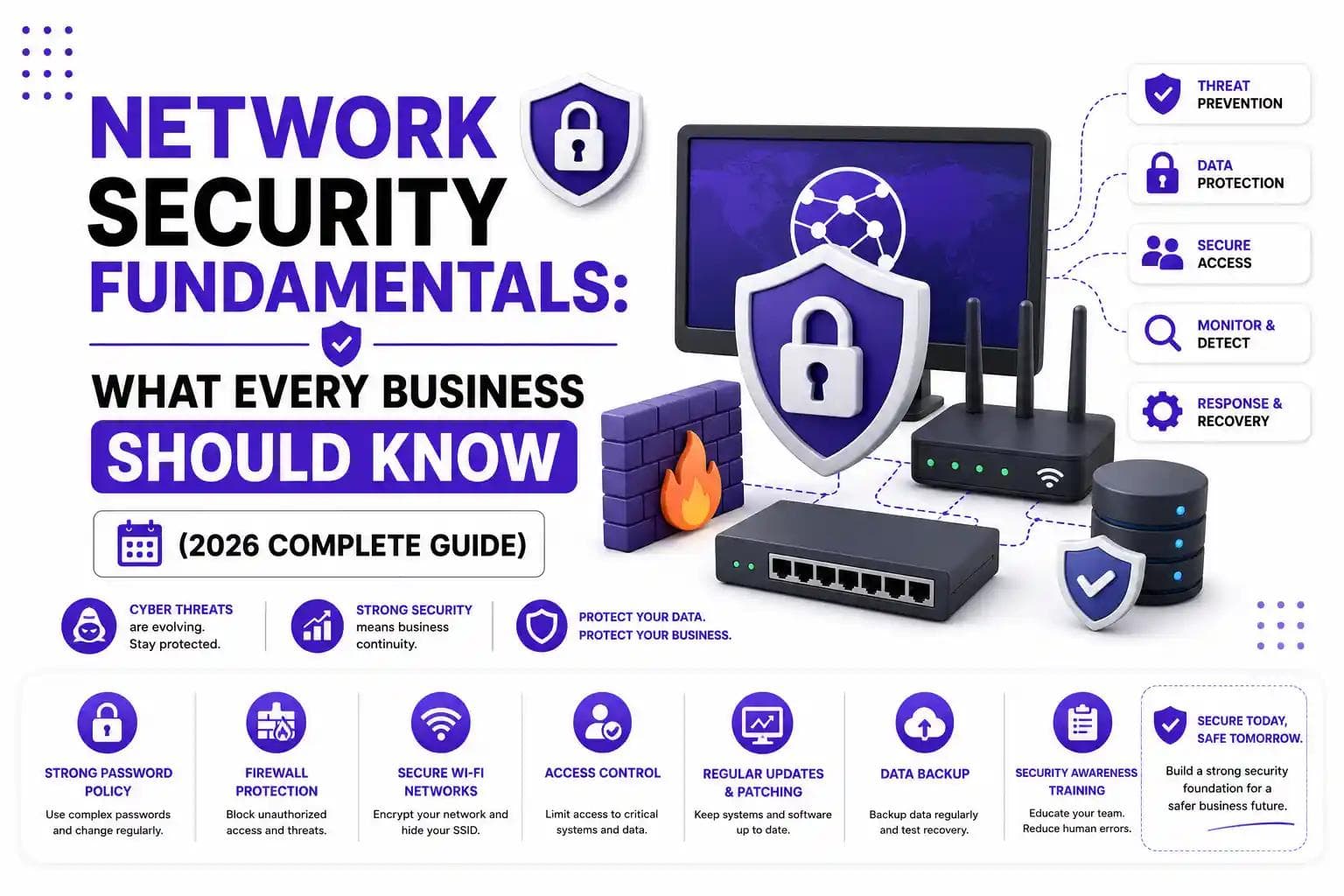
Every 39 seconds, a cyberattack hits somewhere in the world. Small businesses, large enterprises, startups — nobody is immune. Yet most business owners still treat network security as an afterthought, something to deal with "later." The problem? Later usually arrives in the form of a data breach, a ransomware demand, or a destroyed reputation
This guide covers everything you need to know about network security fundamentals — from what it actually means, to the tools that protect your business, to practical steps you can take today. Whether you are a non-technical business owner or an IT professional brushing up on essentials, this is the one article you need to read fully.
What Is Network Security? (And Why It Matters More Than Ever)
Network security is the practice of protecting a computer network and all its data, devices, and users from unauthorized access, misuse, cyberattacks, and data breaches. It combines hardware, software, policies, and human behavior to create a layered shield around your business infrastructure.
Think of it this way: your office building has locks on the doors, CCTV cameras, a security guard, and a visitor log. Network security does exactly the same thing — but for your digital infrastructure.
The definition goes deeper than just "keep hackers out." True network security is built on the CIA Triad:
- Confidentiality — Only authorized people can access sensitive data
- Integrity — Data cannot be altered or tampered with without detection
- Availability — Systems and data are always accessible to the people who need them
When any one of these three pillars breaks down, your business is vulnerable — to financial loss, legal liability, and reputational damage.
According to IBM's Cost of a Data Breach Report, the average global cost of a data breach in 2024 reached $4.88 million. For small businesses, even a fraction of that figure can be devastating. In Pakistan, where digital adoption is growing rapidly, businesses are increasingly becoming targets precisely because cybersecurity awareness still lags behind the pace of digital growth.
Why Network Security Is Critical for Businesses in 2026
The threat landscape has changed dramatically. Cybercriminals are no longer lone hackers sitting in dark rooms — they are organized, well-funded criminal enterprises. AI-powered cyber threats now allow attackers to automate phishing campaigns, brute-force passwords, and identify vulnerabilities at machine speed.
Here is why every business — including yours — must take network security seriously right now:
Remote and hybrid work has exploded the attack surface. When employees connect from home Wi-Fi, coffee shops, or mobile hotspots, every one of those connection points is a potential vulnerability.
Ransomware attacks are skyrocketing. In 2024, ransomware attacks increased by over 68% year-on-year. Attackers now specifically target small and medium businesses because they know these organizations often lack proper defenses.
Supply chain cybersecurity threats are growing. Hackers increasingly compromise a smaller vendor to get access to a larger target. If you work with enterprise clients, your security posture directly affects their security — and your contracts.
Regulatory compliance is no longer optional. GDPR, HIPAA, PCI DSS, and SOC 2 requirements are all tightening. A single compliance failure can result in fines that dwarf the cost of proper security investment.
Cyberattacks in Pakistan are rising fast. Local businesses — from e-commerce stores to financial institutions — have faced high-profile breaches in recent years. The NADRA data controversy, Meezan Bank digital threats, and Careem's data breach were all wake-up calls that cybersecurity is a Pakistan-specific concern, not just a Western problem.
Types of Network Security Every Business Must Understand
Understanding what tools and technologies exist is the first step toward building a strong defense. Here are the core types of network security that form a complete business security framework.
1. Firewall Protection
A firewall is your first line of defense. It monitors incoming and outgoing network traffic and blocks anything that does not meet your defined security rules. Think of it as the bouncer at the door of your digital office.
Modern businesses use both hardware firewalls (physical devices) and software firewalls. Next-generation firewalls (NGFW) go further by inspecting the content of traffic, not just its origin — blocking malware, phishing attempts, and unauthorized applications in real time.
2. VPN for Business (Virtual Private Network)
A business VPN encrypts all internet traffic between your employees and your company servers. This is especially critical for remote work scenarios. Without a VPN, data sent over public Wi-Fi is essentially readable by anyone on the same network.
A VPN is not a complete security solution on its own — but it is an essential layer, particularly for teams working remotely or traveling.
3. Intrusion Detection and Prevention Systems (IDS/IPS)
An intrusion detection system monitors your network for suspicious activity and alerts your team when something unusual happens. An intrusion prevention system goes one step further — it automatically blocks the threat in real time.
Together, IDS and IPS form the watchdog layer of your network security architecture.
4. Endpoint Security
Every laptop, phone, tablet, and smart device connected to your network is an endpoint — and every endpoint is a potential entry point for attackers. Endpoint security solutions protect these devices through antivirus software, anti-malware tools, device management policies, and behavioral monitoring.
With IoT security for business becoming more complex every year, endpoint protection has never been more important.
5. Data Encryption
Encryption converts your data into unreadable code that can only be decoded with the correct key. AES-256 encryption is the current gold standard — used by governments, banks, and leading enterprises worldwide.
Encryption protects data both in transit (moving across the network) and at rest (stored on servers or devices). Without encryption, stolen data is immediately readable by attackers.
6. Multi-Factor Authentication (MFA)
Multi-factor authentication requires users to verify their identity using two or more methods — typically a password plus a one-time code sent to their phone. MFA stops over 99% of automated credential attacks, according to Microsoft research.
Every business email account, cloud service, and admin dashboard should have MFA enabled. It is one of the simplest and most effective security measures available.
7. Zero Trust Network Architecture
Zero trust is a modern security philosophy built on one principle: never trust, always verify. Instead of assuming everyone inside the network is safe, zero trust requires continuous verification of every user and device — regardless of whether they are inside or outside the corporate network.
Zero trust architecture for SMBs is increasingly accessible, with platforms like Microsoft Azure AD, Cloudflare Zero Trust, and Google BeyondCorp offering scalable solutions.
8. Network Segmentation
Network segmentation divides your network into separate zones. If a hacker breaches one segment — say, the guest Wi-Fi — they cannot automatically access your financial systems or customer database. It limits blast radius dramatically.
9. DNS Security
DNS (Domain Name System) security filters malicious websites before they even load. By blocking traffic to known phishing domains and malware distribution sites at the DNS level, you stop threats before they reach individual devices.
10. Cloud Security
As more businesses move to cloud infrastructure, cloud-native security solutions have become essential. This includes cloud access security brokers (CASB), cloud workload protection, and ensuring your cloud provider meets compliance standards like ISO 27001 and SOC 2.
The Biggest Network Security Threats Facing Businesses Today
Knowing your enemy is half the battle. Here are the most dangerous cyber threats businesses face in 2026.
Phishing Attacks remain the number one entry point for cybercriminals. A convincing email, a fake login page, a WhatsApp message pretending to be from your bank — phishing attacks trick employees into handing over credentials or downloading malware. Deepfake phishing attacks are a terrifying new evolution: AI-generated voice or video clones of real people are now being used to authorize fraudulent wire transfers.
Ransomware encrypts your entire business network and demands payment for the decryption key. Attacks on healthcare systems, manufacturing companies, and local government organizations have paralyzed operations for weeks. Prevention requires a combination of regular backups, patch management, email filtering, and endpoint security.
Malware includes viruses, spyware, trojans, and worms. Each type behaves differently but shares one goal: causing harm, stealing data, or giving attackers persistent access to your systems.
DDoS Attacks (Distributed Denial of Service) flood your website or network with fake traffic until it collapses under the load. E-commerce businesses during peak sales periods and financial services companies are frequent targets.
Insider Threats come from current or former employees who — intentionally or accidentally — expose sensitive data. A disgruntled employee sharing login credentials, or an unaware staff member clicking a phishing link, are both insider threat scenarios.
Supply Chain Attacks target your software vendors or third-party service providers as a backdoor into your systems. The SolarWinds attack of 2020 compromised thousands of organizations globally through a single software update.
Network Security Best Practices: A Practical Checklist for Businesses
Regardless of your business size or budget, these network security best practices should form the foundation of your security posture.
Access Control
- Implement role-based access control (RBAC) — employees only access what they need
- Enable multi-factor authentication on all critical systems
- Immediately revoke access when employees leave the company
- Enforce strong password policies (minimum 12 characters, no dictionary words)
Network Infrastructure
- Keep all software, firmware, and operating systems fully patched
- Separate guest Wi-Fi from your internal business network
- Use a VPN for all remote access
- Implement network segmentation for critical systems
- Deploy next-generation firewall protection
Data Protection
- Encrypt all sensitive data at rest and in transit
- Perform automated, encrypted backups daily — store copies offsite or in secure cloud storage
- Define and enforce a data retention and deletion policy
- Conduct regular vulnerability assessments and penetration testing
People and Process
- Train all employees on security awareness — phishing simulations are highly effective
- Create a written network security policy
- Develop and test an incident response plan before you need it
- Conduct regular security audits
- Consider cybersecurity insurance to cover breach-related costs
Network Security Framework: Which Standard Should Your Business Follow?
Several globally recognized frameworks provide structured guidance for building a network security program.
NIST Cybersecurity Framework — Developed by the US National Institute of Standards and Technology, NIST CSF is widely considered the gold standard for business cybersecurity. It organizes security activities into five functions: Identify, Protect, Detect, Respond, and Recover.
ISO 27001 — An international standard for information security management systems (ISMS). ISO 27001 certification signals to clients and partners that your business takes data security seriously.
CIS Controls — The Center for Internet Security's 18 Critical Security Controls provide a prioritized, practical action list — ideal for small to medium businesses starting to build their security posture.
GDPR and Local Compliance — If you handle data from EU citizens, GDPR compliance is legally mandatory. Pakistan's Personal Data Protection Bill (PDPB) is moving toward implementation — businesses should begin preparing now.
For businesses in healthcare, PCI DSS (payment card security) and HIPAA compliance add sector-specific requirements on top of these general frameworks.
How Much Does Business Network Security Cost?
This is one of the most common questions — and the honest answer is: it depends. But here is a realistic breakdown:
Small Business (1–25 employees): Basic firewall + antivirus + MFA + VPN + backup solution: $200–$800/month using cloud-managed tools and SaaS security platforms.
Medium Business (25–250 employees): Adding endpoint detection, SIEM monitoring, employee training, and annual penetration testing: $2,000–$8,000/month.
Enterprise-Grade Security: Full security operations center (SOC), 24/7 monitoring, incident response team, advanced threat intelligence: $15,000+/month or managed in-house.
The real question is not "how much does security cost?" — it is "how much would a breach cost?" The answer is almost always more. Investing in affordable network security solutions for small business upfront is far cheaper than recovering from an attack.
Network Security for Remote Work Employees
Remote and hybrid workforces create unique security challenges. Here is how to protect your business without disrupting productivity.
- Require VPN use for all connections to company resources
- Enforce device management policies — company devices should have encryption, remote wipe capability, and endpoint security installed
- Use cloud-based collaboration tools with strong built-in security (Microsoft 365, Google Workspace) rather than unsecured file sharing
- Train remote employees specifically on home Wi-Fi security, phishing risks, and safe video conferencing practices
- Implement zero trust access — verify identity and device health before granting access, every time
For businesses with growing digital teams, understanding how technology intersects with business operations is critical. Our guide on IT Industry Key Strategies for Business Growth explores how to align your IT infrastructure with business goals effectively.
Network Security and Digital Business Growth in Pakistan
Pakistan's digital economy is growing at an extraordinary pace. With freelancers, e-commerce businesses, SaaS startups, and digital agencies scaling rapidly, cybersecurity is no longer a concern only for banks and government departments.
If you are building a business online in Pakistan — whether through freelancing, digital services, or e-commerce — your reputation is your most valuable asset. A single data breach can destroy years of client trust overnight.
Businesses that invest in cybersecurity foundations also tend to attract higher-value clients. International clients increasingly require vendors to demonstrate security compliance before signing contracts. If you are building a career or business in Pakistan's growing tech sector, understanding network security is not optional — it is a competitive advantage.
For those looking to expand their digital skills beyond security, explore IDTS Digital's guide on How to Start Freelancing in Pakistan 2026 and learn how to build a secure, professional digital presence that attracts global clients.
Signs Your Business Network Has Been Hacked
Knowing the warning signs of a breach can significantly reduce damage. Watch for these red flags:
- Unusual slowness or crashes on your network or devices
- Unexpected login alerts or account lockouts
- Files that have been encrypted or renamed
- Unknown programs running in the background
- Unusual outbound network traffic at odd hours
- Customers reporting phishing emails appearing to come from your domain
- Suspicious transactions or unauthorized access to financial accounts
If you notice any of these signs, disconnect affected devices from the network immediately, contact your IT security team or managed security provider, and initiate your incident response plan.
What Is a Network Security Audit and Do You Need One?
A network security audit is a comprehensive evaluation of your entire security infrastructure — policies, tools, configurations, access controls, and employee practices. It identifies vulnerabilities before attackers can exploit them.
A professional security audit typically includes:
- Network topology mapping and asset inventory
- Firewall and configuration review
- Vulnerability scanning and penetration testing
- Access control and privilege review
- Compliance gap analysis (GDPR, PCI DSS, ISO 27001)
- Incident response plan evaluation
- Detailed findings report with prioritized remediation steps
Every business should conduct at least one full security audit per year. High-risk industries (finance, healthcare, e-commerce) should audit quarterly.
The Role of Employee Training in Network Security
Technology alone cannot protect your business. Humans are consistently identified as the weakest link in cybersecurity — and also the most powerful defense when properly trained.
A comprehensive security awareness training program should cover:
- How to identify phishing emails and suspicious links
- Safe password practices and the use of password managers
- Social engineering tactics and how to respond
- Reporting procedures for suspicious activity
- Safe use of personal devices and public Wi-Fi
- Data handling and classification policies
Running regular phishing simulations — sending fake phishing emails to employees and tracking who clicks — is one of the most effective ways to build security muscle memory across your organization.
For businesses investing in team development, IDTS Digital's Digital Marketing Guide Pakistan 2026 also covers how to build digitally literate teams that understand online risks alongside online opportunities.
Future of Network Security: Trends to Watch in 2026 and Beyond
The cybersecurity landscape is evolving faster than ever. Here are the trends that will define the next phase of business network security:
AI-powered threat detection is making security tools smarter — automatically identifying anomalous behavior patterns that human analysts would miss.
Generative AI security risks are a double-edged sword. The same AI tools that help defenders also help attackers craft more convincing phishing campaigns and automate vulnerability discovery.
Zero trust will become the default architecture as perimeter-based security becomes obsolete in cloud-first, remote-work environments.
IoT security will grow more critical as smart offices, connected manufacturing equipment, and IoT devices multiply the potential attack surface exponentially.
Cybersecurity insurance requirements will tighten — insurers are now requiring documented security controls, regular audits, and MFA as prerequisites for coverage.
Businesses that invest in building cybersecurity competency today are positioning themselves not just for safety — but for sustainable competitive advantage.
Why Choose IDTS Digital for Your Cybersecurity Education?
At IDTS Digital, we have helped hundreds of students and business professionals in Pakistan build real, practical skills in cybersecurity, digital marketing, web development, and data analytics.
Our courses are designed by industry practitioners — not just academics. Every module is hands-on, practical, and aligned with what the job market and business world actually demand in 2026 and beyond.
Whether you are a business owner who wants to understand your own security risks, an IT professional looking to specialize in cybersecurity, or a student building a career in ethical hacking and network security — IDTS Digital has a course pathway for you.
Explore our full Advanced IT Courses and Services at IDTS Digital and take the first step toward protecting your business and growing your career.
For those interested in the technical side of cybersecurity, our Ethical Hacking for Beginners 2026 Guide is the perfect complement to this fundamentals article — covering penetration testing, vulnerability assessment tools, and how ethical hackers think.
Frequently Asked Questions (FAQ)
What is network security and why is it important for businesses? Network security is the set of technologies, policies, and practices that protect a business's computer network from unauthorized access, cyberattacks, and data breaches. It is important because a single breach can result in financial loss, legal liability, reputational damage, and operational downtime — all of which can be business-ending for small companies.
What is the difference between network security and cybersecurity? Network security is a subset of cybersecurity. Cybersecurity covers the protection of all digital assets — including data, applications, and devices. Network security focuses specifically on protecting the network infrastructure — routers, switches, firewalls, and the data moving across them.
What is zero trust network security? Zero trust is a security model that requires every user and device to be verified before being granted access to any resource — regardless of whether they are inside or outside the corporate network. It operates on the principle of "never trust, always verify" and is considered best practice for modern business environments.
How can small businesses afford cybersecurity? Small businesses can build strong security without enterprise budgets by prioritizing high-impact, low-cost measures: enabling multi-factor authentication everywhere, using a business VPN, deploying a next-generation firewall, maintaining regular software patches, and training employees to recognize phishing attacks. Cloud-based managed security services also offer affordable, scalable options for smaller organizations.
How often should a business update its network security? Software patches and security updates should be applied as soon as they are released — ideally within 24–72 hours for critical vulnerabilities. Full security audits should be conducted at least annually. Employee security awareness training should be ongoing, with simulations and refresher sessions at least quarterly.
What should a network security policy include? A solid network security policy should cover acceptable use of company systems, password and authentication requirements, data classification and handling procedures, remote access rules, incident reporting procedures, consequences for policy violations, and regular review schedules to keep the policy current.
Is a VPN enough to secure a business network? No. A VPN is an important layer of security — particularly for remote access — but it is not sufficient on its own. A complete business network security strategy requires firewalls, endpoint security, multi-factor authentication, data encryption, regular patching, employee training, and an incident response plan working together.
Conclusion: Network Security Is a Business Investment, Not a Cost
Every business that operates digitally — which in 2026 means virtually every business — faces real cybersecurity risks. Network security is not a technical problem to hand off to IT and forget. It is a strategic business function that protects your revenue, your reputation, your clients, and your future.
The good news is that strong network security does not require an enormous budget or an army of experts. It requires the right knowledge, the right tools, and a consistent commitment to security hygiene across your entire organization.
Start with the fundamentals covered in this guide. Implement multi-factor authentication, deploy a firewall, train your team, and create a written security policy. Then build from there.
Ready to take your digital skills to the next level? Book a seat in the Advanced Digital Course at IDTS Digital and learn from industry professionals who have real-world experience protecting businesses in Pakistan and beyond. Whether your goal is to build a career in cybersecurity, protect your own business, or add high-value skills to your freelancing profile — IDTS Digital is your launchpad.
Also explore:
- How Businesses Can Leverage Data for Smarter Decisions
- Data Analytics Career Pakistan 2026 Guide
- Machine Learning Basics Non-Tech Guide 2026
Published by IDTS Digital — Pakistan's leading digital skills and IT services platform. For inquiries about cybersecurity courses, digital training, or IT services, contact us here.