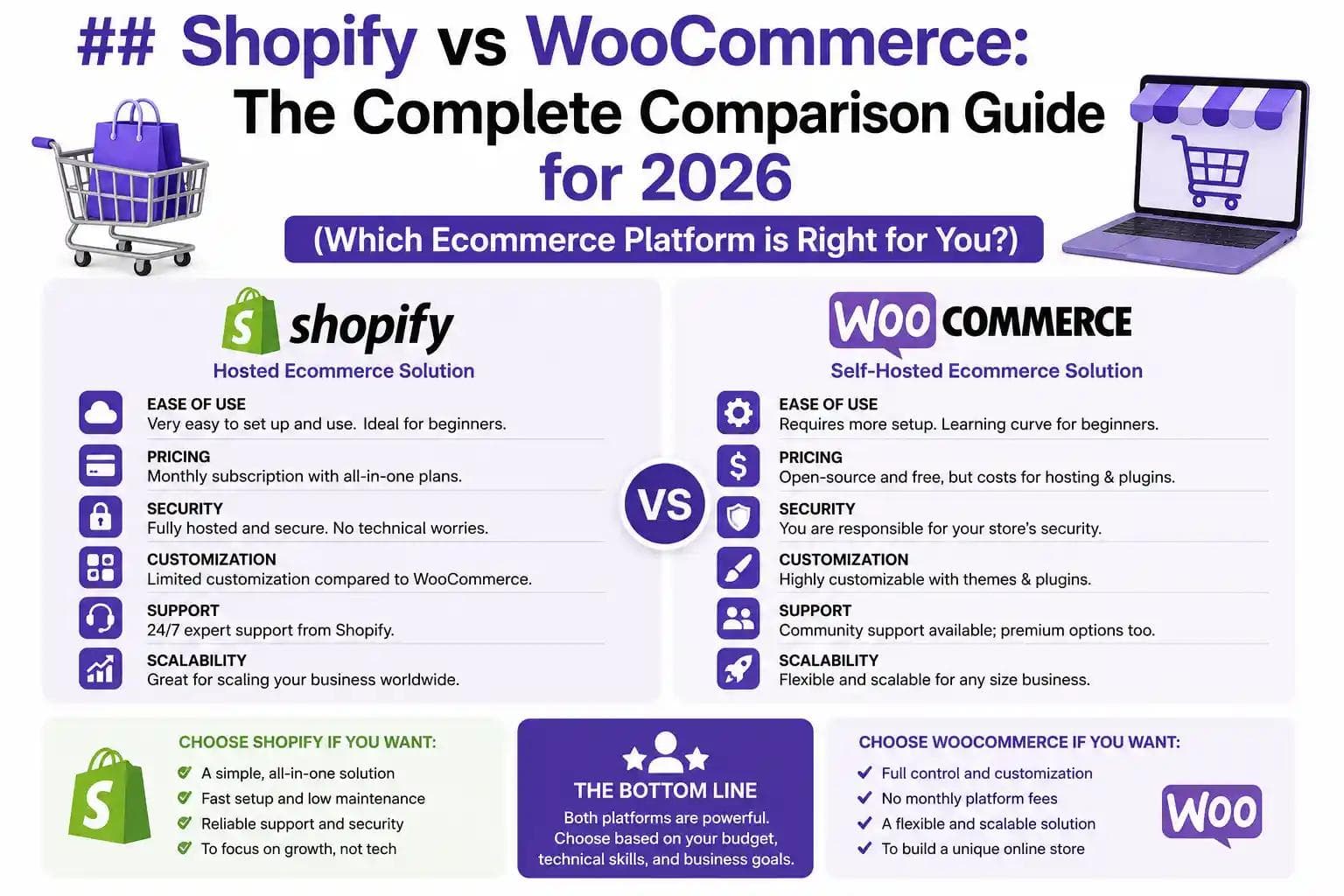
If you've been searching for the best ecommerce platform in 2026, you've almost certainly landed on the same two names everyone keeps talking about — Shopify and WooCommerce. Together, they power more than 50% of all online stores globally, and for good reason. But here's the truth: they are fundamentally different tools built for different types of people, businesses, and budgets.
This isn't just another shallow comparison article. This is your complete, human-written, expert-backed guide that covers everything — from pricing and SEO to performance, payment gateways, and even which platform works best specifically in Pakistan (Islamabad, Lahore, and Karachi). Whether you're a beginner, a freelancer, a startup founder, or an experienced WordPress developer, this guide will help you make the smartest decision for your online store in 2026.
Let's get into it.
What Is Shopify? (And Why Millions of Sellers Love It)
Shopify Inc. is a fully hosted, SaaS ecommerce platform launched in 2006 and headquartered in Ottawa, Canada. When we say "hosted," we mean Shopify takes care of everything behind the scenes — the server, security, software updates, and uptime. You just focus on selling.
Think of Shopify like renting a fully furnished shop in a premium mall. You walk in, set up your products, and start selling. You don't worry about the electricity, the building maintenance, or the security system — it's all included in your monthly subscription.
Shopify by the numbers (2025–2026):
- Powers over 4.4 million online stores worldwide
- Available in 175 countries
- Processes billions of dollars in sales every year
- Offers 8,000+ apps in the Shopify App Store
- Monthly plans range from $39 to $399+ (Shopify Plus starts at $2,300/month for enterprise)
Shopify is genuinely one of the most beginner-friendly ecommerce platforms on the planet. If you have zero coding knowledge and want to launch an online store this weekend, Shopify makes that possible.
What Is WooCommerce? (And Why Developers Swear By It)
WooCommerce is an open-source ecommerce plugin built for WordPress, developed and maintained by Automattic — the same company behind WordPress.com. It was first released in 2011 and has since grown to become the most widely installed ecommerce solution in the world.
Unlike Shopify, WooCommerce is self-hosted. You need your own domain, web hosting, and a WordPress installation before WooCommerce even comes into the picture. Once those are set up, WooCommerce transforms your WordPress site into a fully functional digital storefront.
Using our mall analogy — WooCommerce is like buying your own plot of land and building your shop from scratch. More work upfront, but you own everything and can build it exactly how you want.
WooCommerce by the numbers:
- Powers 29%+ of all ecommerce websites globally
- 5+ million active installations
- 1,000s of free and premium WooCommerce extensions
- The WooCommerce plugin itself is 100% free
- Works with any WordPress hosting provider
For businesses in Pakistan that already use WordPress for their website, or for those who want complete data ownership and maximum customization, WooCommerce is an incredibly powerful choice.
Shopify vs WooCommerce: Head-to-Head Comparison 2026
Let's break this down category by category so you can see exactly where each platform wins — and where it falls short.
1. Ease of Use — Which Platform Is Easier for Beginners?
Shopify wins here, clearly.
Shopify's dashboard is clean, intuitive, and designed for non-technical users. You can add products, set up payment gateways, choose a theme, and launch your store without touching a single line of code. Everything lives in one unified store management dashboard.
WooCommerce, on the other hand, requires you to manage WordPress, hosting, plugins, updates, and security separately. There's a steeper learning curve. You'll need to understand how WordPress works, how to install and configure plugins, and how to manage a self-hosted environment.
Verdict: If you're a beginner with no technical background, Shopify is the easier, faster path to launching your first online store. WooCommerce rewards patience — once you understand WordPress, it becomes a powerful no-code ecommerce platform with virtually unlimited flexibility.
2. Shopify vs WooCommerce Pricing — What Does It Really Cost?
This is where things get interesting, and where many comparison articles get it wrong.
Shopify Pricing Plans (2026):
- Starter: $5/month (buy button only, no full store)
- Basic Shopify: $39/month
- Shopify: $105/month
- Advanced Shopify: $399/month
- Shopify Plus (Enterprise): Starting at $2,300/month
On top of the monthly subscription, Shopify charges transaction fees (0.5%–2%) if you use a third-party payment gateway instead of Shopify Payments. These fees can add up significantly at scale.
WooCommerce Pricing (True Cost Breakdown):
- WooCommerce plugin: Free
- WordPress hosting: $3–$30/month (budget to mid-range; Hostinger Pakistan plans start very affordably — get a special discounted offer on hosting here)
- Domain name: ~$10–$15/year
- Premium WooCommerce theme: $40–$100 (one-time)
- Essential WooCommerce plugins: $0–$300/year depending on needs
- SSL certificate: Often included free with hosting
Total annual cost comparison:
- Shopify (Basic): ~$468/year + transaction fees
- WooCommerce (well-equipped): ~$150–$500/year with no ongoing transaction fees
WooCommerce can be significantly cheaper — especially for Pakistani entrepreneurs and small businesses where every rupee counts. However, you do need to budget for hosting, security, and maintenance time.
Verdict: WooCommerce wins on total cost of ownership — especially for budget-conscious sellers in Pakistan. Shopify offers more predictable monthly costs but charges transaction fees that bite into your margins.
3. Shopify vs WooCommerce for SEO — Which Platform Ranks Better?
SEO is the lifeblood of any ecommerce business. So which platform is better for ecommerce SEO optimization in 2026?
WooCommerce SEO advantages:
- Full control over your website structure, URL slugs, and site architecture
- Native integration with powerful WooCommerce SEO plugins like Yoast SEO and Rank Math
- Complete access to robots.txt, .htaccess, schema markup, and structured data
- Ability to optimize site speed deeply (critical for Core Web Vitals)
- Open-source flexibility means technical SEO has no limits
Shopify SEO advantages:
- Built-in SEO features (editable title tags, meta descriptions, alt text)
- Auto-generated sitemaps
- Clean URL structure for products and collections
- Fast hosting infrastructure (Shopify's CDN is excellent)
- Shopify SEO features are improving with every update
However, Shopify has historically had limitations — like forced URL structures (/collections/, /products/), difficulty editing robots.txt (though this has improved on Shopify Plus), and limited control over canonical tags.
For businesses serious about ranking on Google — especially for competitive ecommerce keywords — WooCommerce with proper on-page SEO using Rank Math or Yoast gives you far more granular control. Check out our complete guide on SEO in 2026: The Ultimate Google Ranking Guide to understand how to combine platform choice with a winning SEO strategy.
Verdict: WooCommerce is the better SEO ecommerce platform for advanced users who want full technical control. Shopify is solid for beginners and handles the SEO basics well.
4. Shopify vs WooCommerce for Dropshipping
Dropshipping is one of the biggest use cases for both platforms. Which one handles it better?
Shopify for dropshipping:
- Shopify was practically built with dropshipping in mind
- Massive ecosystem of dropshipping apps (DSers, Zendrop, AutoDS — all as Shopify Oberlo alternatives since Oberlo was discontinued)
- Easy supplier integration with AliExpress, CJ Dropshipping, and more
- Automated order fulfillment workflows
- Clean, conversion-optimized themes for product pages
WooCommerce for dropshipping:
- WooCommerce supports dropshipping through plugins like AliDropship and WooDropship
- More manual setup required
- Full control over the store experience
- No transaction fees, which helps margins on lower-ticket dropshipping items
For absolute beginners starting a dropshipping business quickly, Shopify has the edge. For experienced sellers who want to maximize profit margins and own their store completely, WooCommerce dropshipping is a strong option.
Verdict: Shopify edges out WooCommerce for dropshipping ease-of-use. WooCommerce wins on long-term margin control.
5. Themes and Design — Shopify Themes vs WooCommerce Themes
Your store's design directly impacts conversion rates. Let's compare.
Shopify themes:
- 100+ free and paid themes in the Shopify Theme Store
- All themes are mobile-responsive by default
- Professional, polished designs
- Premium themes cost $150–$400 one-time
- Limited deep customization without coding (or Shopify's new Dawn theme editor)
WooCommerce themes:
- Thousands of free and premium WordPress/WooCommerce themes
- Full design flexibility with page builders like Elementor WooCommerce or Divi WooCommerce theme
- Premium themes typically $40–$100
- Developers can build completely custom designs with zero restrictions
If you want a beautiful store with minimal effort, Shopify themes are excellent. If you want pixel-perfect custom design control, WooCommerce with Elementor is unmatched.
6. Payment Gateways — Especially for Pakistan
This section is critical for Pakistani ecommerce businesses. Not all payment gateways work in Pakistan, and both platforms handle this differently.
Shopify in Pakistan:
- Shopify Payments is not available in Pakistan (as of 2026)
- Pakistani sellers must use third-party gateways: PayFast, 2Checkout, Stripe (via international setup), or PayPal
- This means Shopify charges transaction fees (0.5%–2%) on every sale
- JazzCash and EasyPaisa integrations exist via third-party apps but require workarounds
WooCommerce in Pakistan:
- Supports JazzCash WooCommerce integration natively via official plugins
- EasyPaisa payment integration WooCommerce works seamlessly
- Stripe, PayPal, bank transfers — all fully supported
- No built-in transaction fees from WooCommerce itself
- Complete control over the checkout process
For Pakistani ecommerce businesses in Islamabad, Lahore, and Karachi, WooCommerce has a clear advantage in the payment gateway space. The ability to integrate local payment methods like JazzCash and EasyPaisa without workarounds — and without transaction fees — makes it the smarter choice for the Pakistani market.
7. Scalability — Which Platform Grows with Your Business?
Shopify scalability:
- Extremely easy to scale — Shopify handles all server management
- Shopify Plus for enterprise brands doing millions in revenue
- No technical knowledge needed to handle traffic spikes
- Performance is consistent regardless of store size
WooCommerce scalability:
- WooCommerce can handle large stores — but scaling requires technical investment
- You'll need managed cloud hosting (WP Engine, Kinsta, or Cloudways) as traffic grows
- Requires proper caching (WP Rocket), CDN setup, and database optimization
- With the right infrastructure, WooCommerce can power enterprise-level ecommerce
Check out our article on WordPress Speed Optimization in 2026 to learn how to keep a WooCommerce store blazing fast even at scale.
Verdict: Shopify is easier to scale without technical knowledge. WooCommerce can absolutely scale to enterprise level — it just requires more technical investment.
8. Security — Which Platform Is More Secure?
Shopify security:
- Fully managed security — SSL, PCI compliance, DDoS protection all included
- Shopify handles all security patches and updates automatically
- Zero configuration required from the store owner
WooCommerce security:
- Security is YOUR responsibility as the store owner
- Requires regular WordPress and plugin updates
- Needs security plugins (Wordfence, Sucuri) and backups
- A poorly maintained WooCommerce store can be vulnerable
For non-technical users, Shopify's managed security is a major benefit. WooCommerce security is fully achievable — but it requires discipline and the right hosting environment.
Shopify vs WooCommerce in Pakistan — The Complete Local Perspective
Running an online business in Pakistan in 2026 comes with unique challenges and opportunities. Here's what you specifically need to know:
Why WooCommerce is often the better choice for Pakistani businesses:
- Cost in PKR is dramatically lower. Shopify's $39–$399/month pricing feels expensive when converted to Pakistani rupees. A full WooCommerce setup with quality hosting can cost a fraction of that annually. Get affordable hosting through Hostinger Pakistan with a special discount.
- Local payment gateways work better. JazzCash, EasyPaisa, and local bank transfer integrations are seamless with WooCommerce.
- WordPress expertise is abundant in Pakistan. Finding a skilled WordPress developer in Islamabad, Lahore, or Karachi is easy and affordable. Shopify developers are less common locally.
- You own your data. With WooCommerce, your customer data, product data, and business data live on your own hosting server — not locked inside a foreign SaaS platform.
- WordPress website development services are widely available across Pakistan through agencies like IDTS Digital.
When Shopify makes sense for Pakistani sellers:
- You're selling internationally (to US, UK, Europe) and need Shopify's global payment infrastructure
- You want to start fast without technical setup
- You're running a dropshipping store targeting Western markets
- You have the budget for the monthly subscription + transaction fees
For a deeper understanding of the full website development landscape in Pakistan, read our guide: Website Development in Pakistan 2026 — Complete Guide.
Shopify vs WooCommerce: Complete Pros and Cons
Shopify Pros
- Extremely easy to set up and use
- All-in-one hosted solution (no server management)
- Excellent uptime and performance
- 24/7 customer support
- Great for beginners and non-technical users
- Strong dropshipping app ecosystem
- Mobile-optimized by default
Shopify Cons
- Monthly subscription costs add up
- Transaction fees when not using Shopify Payments (unavailable in Pakistan)
- Limited ownership — Shopify can suspend your store
- Less flexibility for deep customization
- URL structure and some SEO elements are restricted
- Expensive at scale (Shopify Plus)
WooCommerce Pros
- Free plugin — you only pay for hosting and extras
- Complete ownership of your store and data
- Unlimited customization and flexibility
- Superior SEO control
- Massive library of WooCommerce plugins and extensions
- Works perfectly with local Pakistani payment gateways
- Developer-friendly with REST API and hooks
- No transaction fees
WooCommerce Cons
- Steeper learning curve
- You manage your own hosting, security, and updates
- Scaling requires technical knowledge
- Performance depends on your hosting quality
- Requires ongoing maintenance
WooCommerce vs Shopify: Which Should YOU Choose?
Here's the honest answer: there is no universal winner. The right platform depends on YOU — your goals, budget, technical skills, and target market.
Choose Shopify if:
- You're a complete beginner with no technical background
- You want to launch fast (within hours, not days)
- You're running a dropshipping business for international markets
- Budget is not a concern and you prefer predictable monthly costs
- You want Shopify to handle all security and maintenance for you
Choose WooCommerce if:
- You already have or want a WordPress website
- You're targeting Pakistani customers and need local payment gateways (JazzCash, EasyPaisa)
- Budget is a priority — you want to minimize monthly costs
- You want full ownership and control of your ecommerce store
- You're serious about long-term SEO and technical optimization
- You need deep customization for a unique store experience
- You have access to WordPress development support (IDTS Digital can help)
How to Build a WooCommerce Store in Pakistan — Step by Step
Ready to launch your WooCommerce ecommerce store? Here's exactly how to get started:
Step 1: Get a Domain Name Choose a memorable, brand-relevant .com or .pk domain. Namecheap and Hostinger both offer great domain registration. Get a special discounted offer on hosting and domain from Hostinger Pakistan here.
Step 2: Get Reliable WordPress Hosting For WooCommerce in Pakistan, you need hosting that's fast, secure, and affordable. Hostinger's WordPress plans are excellent value and include free SSL. Use our referral link for the best discount available.
Step 3: Install WordPress Most hosting providers offer one-click WordPress installation. It takes under 5 minutes.
Step 4: Install and Configure WooCommerce Go to Plugins → Add New → search "WooCommerce" → Install → Activate. Follow the setup wizard.
Step 5: Choose a WooCommerce Theme Astra, OceanWP, and Storefront are excellent free choices. For premium design, Flatsome and Woodmart are industry favorites.
Step 6: Add Your Products Add product images, descriptions, prices, and inventory details.
Step 7: Set Up Payment Gateways Install JazzCash, EasyPaisa, or bank transfer plugins for Pakistani customers. Add Stripe or PayPal for international buyers.
Step 8: Configure Shipping Set up flat-rate, free, or weight-based shipping zones for Pakistan and internationally.
Step 9: Optimize for SEO Install Rank Math or Yoast SEO, optimize product pages, add schema markup, and connect Google Search Console. Read our complete SEO guide for 2026 for a deep dive.
Step 10: Launch and Market Your Store Go live and start driving traffic through SEO, social media marketing, and paid advertising. Our guide on Social Media Marketing Strategies for Small Business will help you hit the ground running.
Want to build your store without any coding? We also have a dedicated guide: How to Build a No-Code Professional Website in 2026.
How to Build a Shopify Store in Pakistan — Quick Start
Step 1: Go to Shopify.com and start a free trial (3 days free, then $1/month for 3 months on select plans).
Step 2: Choose a Shopify theme from the Theme Store. Dawn is the default free theme and performs well.
Step 3: Add products, set up collections, and write compelling product descriptions.
Step 4: Configure a third-party payment gateway (since Shopify Payments isn't available in Pakistan). Options include 2Checkout or bank transfer.
Step 5: Set up shipping rates and zones.
Step 6: Connect your custom domain.
Step 7: Install essential Shopify apps — email marketing, review apps, upsell tools.
Step 8: Launch and market! Consider reading our comparison of Google Ads vs Facebook Ads in 2026 to decide how to run paid ads for your new store.
Ecommerce Platform Market Share 2026 — Where Shopify and WooCommerce Stand
Understanding the market landscape helps you make a confident decision. According to BuiltWith and W3Techs data:
- WooCommerce powers approximately 29% of all ecommerce websites globally — the largest share of any single platform
- Shopify powers approximately 20% of ecommerce websites globally — the fastest growing major platform
- Together, they account for nearly half the world's online stores
- Other major platforms: BigCommerce, Magento, Wix, Squarespace, PrestaShop
WooCommerce's dominance is largely due to the massive existing WordPress ecosystem — over 40% of all websites on the internet run on WordPress. WooCommerce is a natural extension of that. Shopify, on the other hand, has grown explosively in the direct-to-consumer and dropshipping space.
In Pakistan specifically, WordPress and WooCommerce have far greater penetration — driven by local developer expertise, lower costs, and better support for Pakistani payment methods.
Ecommerce in Pakistan — Opportunities and Future Outlook 2026
The Pakistani ecommerce industry is growing at a tremendous pace. With over 120 million internet users, a young digital-native population, and platforms like Daraz accelerating consumer acceptance of online shopping, there has never been a better time to launch an online store in Pakistan.
Key trends shaping ecommerce in Pakistan in 2026:
- JazzCash and EasyPaisa digital wallet adoption surging
- Mobile commerce (m-commerce) now dominant — over 70% of Pakistani online purchases happen on mobile
- Growing demand for local D2C brands bypassing traditional retail
- Freelancers and digital agencies building WooCommerce stores for Pakistani SMEs
- Social commerce (WhatsApp Business, Instagram Shopping) growing rapidly
For Pakistani entrepreneurs, WooCommerce represents the most accessible, cost-effective, and flexible path to launching and growing an ecommerce business. The combination of affordable hosting, free WooCommerce plugin, local payment gateway support, and available local WordPress talent makes it the platform of choice for the local market.
If you're learning digital skills alongside building your store, check out How to Start Freelancing in Pakistan 2026 and our guide on Digital Marketing in Pakistan 2026.
WordPress Website Development Services in Pakistan
Whether you're building a WooCommerce store or a full WordPress business website, having expert support makes a huge difference. At IDTS Digital, we offer professional WordPress Website Development Services across Pakistan — including Islamabad, Lahore, and Karachi.
Our services include:
- Custom WordPress and WooCommerce store development
- WooCommerce plugin setup and configuration
- JazzCash and EasyPaisa payment integration
- WordPress speed optimization and SEO setup
- Theme customization and Elementor page building
- Ongoing maintenance and security management
We also offer comprehensive Web Development Services covering everything from simple business websites to complex ecommerce platforms.
Looking for a full digital transformation? Explore our complete range of Digital Marketing Services, SEO Services, and AI Chatbot Services designed specifically for Pakistani businesses.
Website Development Course in Pakistan — Learn to Build Online Stores
If you want to build your own WooCommerce or Shopify store — or start a career as a web developer — IDTS Digital offers industry-leading courses in Pakistan.
Our WordPress Website Development Course covers:
- WordPress fundamentals and ecosystem
- WooCommerce setup and ecommerce configuration
- Theme customization with Elementor
- Payment gateway integration (JazzCash, EasyPaisa, Stripe)
- SEO optimization for ecommerce
- Store speed optimization
- Going live and managing your store
Available in Islamabad, with online options for students in Lahore, Karachi, and across Pakistan. Courses are taught in Urdu and English.
Explore all courses at IDTS Digital →
We also recommend checking out reputable external learning platforms like Coursera's Web Development courses for supplementary learning alongside your IDTS Digital enrollment.
Frequently Asked Questions (FAQ): Shopify vs WooCommerce
Is Shopify better than WooCommerce?
Neither platform is universally better. Shopify is better for beginners who want a fully managed, easy-to-use ecommerce platform without technical setup. WooCommerce is better for those who want full ownership, maximum flexibility, superior SEO control, and lower long-term costs — especially for businesses in Pakistan.
Is WooCommerce free to use?
Yes, the WooCommerce plugin itself is completely free. However, you will need to pay for web hosting (starting from around $3–$10/month), a domain name, and any premium plugins or themes you choose to use. Get discounted hosting in Pakistan at Hostinger with this special offer.
How much does Shopify cost per month in Pakistan?
Shopify's Basic plan costs $39/month (approximately PKR 10,000–11,000/month at current rates). The standard plan is $105/month. Note that Shopify Payments is not available in Pakistan, so additional transaction fees (0.5%–2% per sale) apply when using third-party payment gateways.
Which platform is better for SEO — Shopify or WooCommerce?
WooCommerce (with WordPress) offers superior technical SEO capabilities. You get full control over URL structure, robots.txt, schema markup, canonical tags, and advanced on-page optimization through plugins like Rank Math and Yoast SEO. Shopify is solid for basic SEO but has certain structural limitations that more advanced SEOs find restrictive.
Which ecommerce platform is best for Pakistan?
For most Pakistani businesses, WooCommerce is the better choice. It supports local payment gateways like JazzCash and EasyPaisa natively, costs significantly less in PKR, and there is abundant WordPress development talent available across Pakistan. For sellers targeting international markets with dropshipping, Shopify is a strong alternative.
Does Shopify charge transaction fees?
Yes. If you use a third-party payment gateway (required in Pakistan since Shopify Payments is unavailable), Shopify charges transaction fees of 2% on the Basic plan, 1% on the standard plan, and 0.5% on the Advanced plan. WooCommerce does not charge any transaction fees of its own.
Can WooCommerce handle large stores?
Absolutely. With proper managed hosting, caching (WP Rocket), a CDN, and a well-optimized database, WooCommerce can power enterprise-level ecommerce stores with thousands of products and high traffic volumes. Stores like Weber and Singer run WooCommerce at scale.
Is Shopify good for beginners?
Yes — Shopify is one of the most beginner-friendly online store builders available. You can have a fully functional store live within a few hours with no coding knowledge required.
What happens to my store if I cancel Shopify?
If you cancel your Shopify subscription, your store will be deactivated and you will lose access to it. Your store data is stored on Shopify's servers, not your own. This is one of the key reasons why many business owners prefer WooCommerce — you own your store completely and it lives on your own hosting server.
Can WooCommerce use Stripe and PayPal?
Yes. WooCommerce has official plugins for both Stripe and PayPal, as well as support for dozens of other international and local payment gateways. This makes it extremely flexible for both local Pakistani payments (JazzCash, EasyPaisa) and international transactions.
Final Verdict: Shopify vs WooCommerce 2026
After covering pricing, SEO, design, payment gateways, scalability, security, and Pakistan-specific considerations — here's the bottom line:
WooCommerce is the winner for most Pakistani businesses that want full ownership, local payment gateway support, lower costs, and powerful SEO capabilities. It rewards those willing to invest a little time learning the platform — and the results are worth it.
Shopify is the winner for beginners and international dropshippers who want to launch fast, avoid technical headaches, and scale quickly without managing a server.
The good news? Both platforms are excellent, and there's never been a better time to start an online store — whether you're in Islamabad, Lahore, Karachi, or anywhere else in Pakistan.
Ready to Build Your Online Store? IDTS Digital Can Help
Whether you've chosen Shopify or WooCommerce, IDTS Digital is Pakistan's trusted partner for ecommerce website development, digital marketing, and IT training.
Our ecommerce services include:
- WordPress & WooCommerce Development
- Full Web Development Services
- SEO Services for Ecommerce
- Digital Marketing for Online Stores
- AI Chatbot Integration for automated customer support
Our training programs include:
- WordPress Website Development Course (Urdu & English)
- Digital Marketing Course
- SEO Course
- Freelancing for Beginners
📌 Book Your Seat in Our Advanced Digital Course at IDTS Digital Today →
📌 Contact IDTS Digital for a Free Consultation →
📌 Get Special Discounted Hosting for Your Ecommerce Store via Hostinger Pakistan →