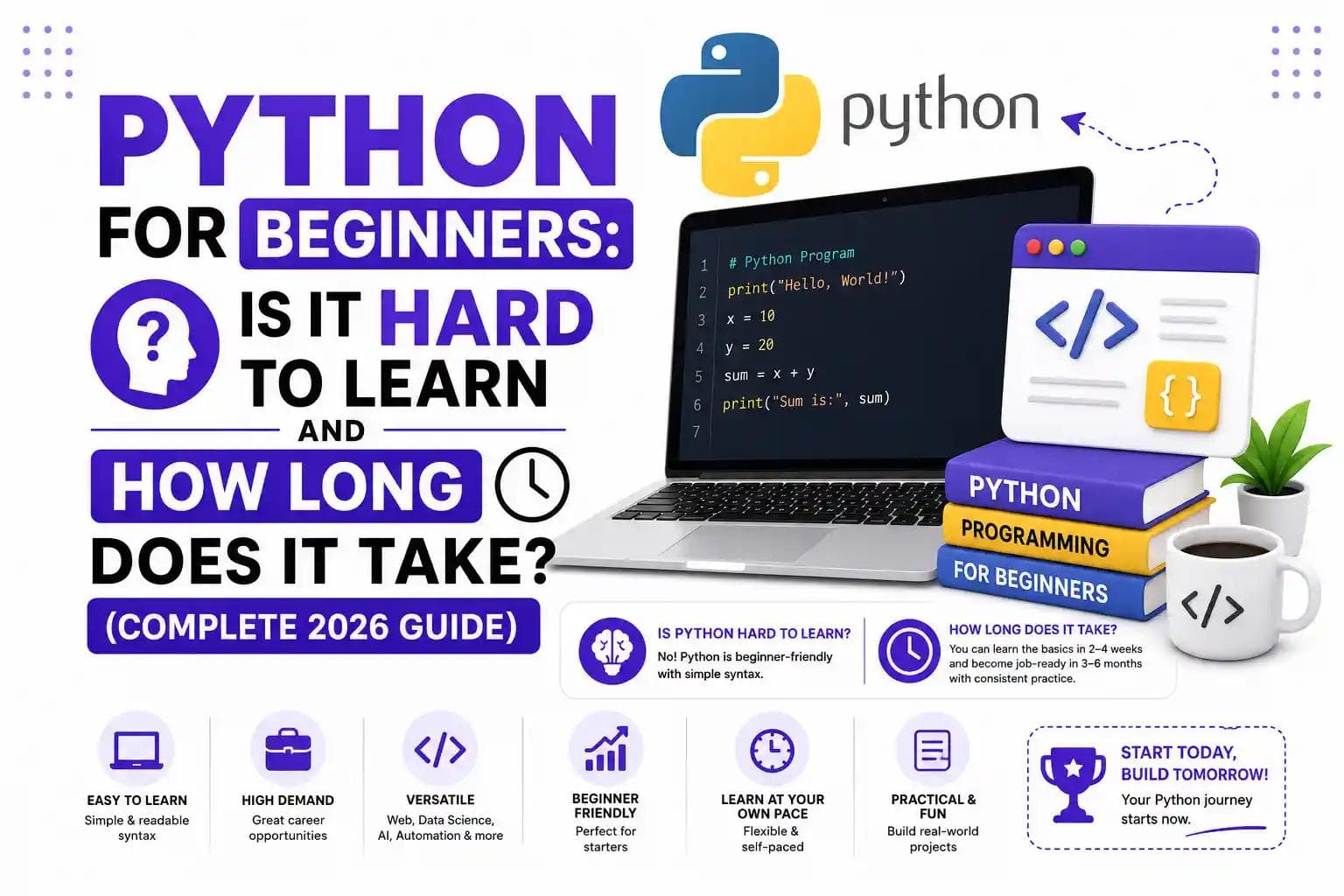
If you've ever typed "is Python hard to learn" into Google at midnight, you're not alone. Millions of people around the world — students, working professionals, freelancers, and career switchers — ask this exact question every single day. And the honest answer? Python is one of the most beginner-friendly programming languages ever created. But like anything worth learning, it does require time, consistency, and the right roadmap.
This pillar guide will answer every question you have about learning Python from scratch — how long it takes, how hard it really is, what you need to know before starting, which resources are best, and how Python can transform your career in 2026 — whether you're based in Pakistan, India, the UK, or anywhere else in the world.
Let's get into it.
What Is Python and Why Is Everyone Talking About It?
Python is a high-level, open-source programming language created by Guido van Rossum and first released in 1991. It was designed with one core philosophy: code should be readable, simple, and human-like. That's why Python's syntax looks almost like plain English compared to languages like C++ or Java.
Today, Python powers some of the biggest technologies in the world. Google uses it. NASA uses it. Netflix uses it for recommendation algorithms. Instagram's backend runs largely on Python. And in 2025–2026, Python is the number one most popular programming language in the world according to the TIOBE Index and Stack Overflow Developer Survey.
Here's what Python is used for in the real world:
- Data science and data analysis
- Machine learning and artificial intelligence
- Web development (using Django and Flask frameworks)
- Automation and scripting
- Cybersecurity and ethical hacking
- Finance and algorithmic trading
- Game development
- Scientific research and academia
If you're wondering whether Python is worth learning in 2026 — the answer is an emphatic yes. The demand for Python developers, data scientists, and automation engineers is growing faster than companies can hire. And the best part? You don't need a computer science degree to learn it.
Is Python Hard to Learn for Beginners?
This is the biggest question most beginners ask, and it deserves a direct, honest answer.
No. Python is not hard to learn — especially compared to other programming languages. It is widely considered the easiest first programming language for beginners, and there are very real reasons why.
Why Python Is Easy for Beginners
1. Clean, readable syntax
Python doesn't use curly braces or complicated punctuation rules like Java or C++. A simple program to print "Hello World" in Python is just one line:
print("Hello, World!")
That's it. No semicolons. No class declarations. No import statements just to print text. Python was designed to remove unnecessary complexity.
2. Python reads like English
When you write a Python script, it feels like writing instructions in plain language. This makes it psychologically easier to stay motivated when you're just starting out.
3. Huge beginner-friendly community
Python has one of the largest programming communities in the world. Whether you post on Stack Overflow, Reddit's r/learnpython, or join a Discord server, you will always find someone willing to help you debug your first for loop.
4. Forgiving error messages
Python's error messages are relatively descriptive and easy to understand, which means debugging is less frustrating for beginners.
5. Tons of free resources
From Codecademy to Coursera, from YouTube tutorials to free books like "Automate the Boring Stuff with Python" by Al Sweigart (available free at automatetheboringstuff.com), the learning ecosystem for Python is unmatched.
What Makes Python Challenging
Being honest matters here. Python is easy to start but has depth you'll respect the deeper you go.
- Object-oriented programming (OOP) concepts like classes, inheritance, and polymorphism take time to click
- Libraries like NumPy, Pandas, and TensorFlow have steep learning curves of their own
- Transitioning from writing basic scripts to building full applications requires real-world project practice
- Python's flexibility can actually confuse beginners — there are often 10 ways to do the same thing
The key insight is this: Python's difficulty level scales with what you want to do with it. If you just want to automate repetitive tasks or do basic data analysis, you can get productive in a few weeks. If you want to build neural networks or full-stack web apps, expect a journey of several months to a year.
How Long Does It Take to Learn Python?
This is the second-most-asked question, and the answer varies depending on your goal, your background, and how many hours per day you're putting in.
Here's a realistic Python learning timeline broken down by goal:
Python Learning Timeline for Beginners (2026)
Python Basics (2–6 weeks)
- Variables and data types
- Loops and conditional statements
- Functions and modules
- Python syntax and indentation
- Basic input/output and file handling
- Simple python programs and exercises
If you practice 1–2 hours per day, you can confidently understand Python basics within 3–4 weeks.
Intermediate Python (2–4 months)
- Object-oriented programming in Python
- Python libraries (os, sys, re, datetime)
- Error handling and exceptions
- List comprehensions and generators
- Working with APIs
- Basic projects like calculators, to-do apps, web scrapers
Python for a Specific Career Path (3–12 months)
The timeline really depends on what you're building toward:
- Python for data science: 4–6 months to job-ready level
- Python for web development (Django/Flask): 4–8 months
- Python for machine learning: 6–12 months
- Python for automation: 2–4 months
- Python for ethical hacking: 4–8 months
How Long to Learn Python With No Experience?
If you have zero coding background, realistically expect 4–6 months of consistent practice before you feel comfortable writing real scripts independently. That means:
- 1 hour of learning per day
- Building at least one mini-project per week
- Reading other people's code (GitHub is your best friend)
- Actually running code — not just reading it
A common mistake beginners make is reading tutorials passively without actually typing code. Python is a doing language. You learn it by writing it.
Can You Learn Python in 30 Days?
Yes and no. In 30 days, with 2–3 hours of daily practice, you can absolutely learn Python basics — syntax, variables, loops, functions, and simple projects. But you won't be job-ready in 30 days. Anyone selling you a "Python mastery in 30 days" course is overselling. Use 30-day challenges as momentum builders, not as end goals.
Can You Learn Python in 3 Months?
Absolutely. Three months of disciplined, structured learning is enough to:
- Write clean, working Python scripts
- Understand OOP fundamentals
- Build 3–5 portfolio projects
- Be ready for junior-level Python jobs or freelance work
Three months is actually the sweet spot for most motivated beginners.
What Should a Complete Beginner Learn First in Python?
Before you jump into advanced libraries or try to build an AI chatbot on day three, here's the step-by-step beginner roadmap that actually works.
Step 1: Set Up Your Environment
Install Python from python.org (it's completely free). Then choose a Python IDE for beginners. The best options in 2026 are:
- VS Code — lightweight, powerful, free, and used by professionals
- PyCharm — feature-rich, great for larger projects
- Jupyter Notebook — perfect for data science and learning interactively
- Thonny — built specifically for beginners, great for absolute starters
You can also run Python code online without installing anything, using platforms like replit.com or Google Colab.
Step 2: Learn Core Python Basics
Start with these fundamentals in order:
- Variables and data types (strings, integers, floats, booleans)
- Operators (arithmetic, comparison, logical)
- Control flow (if/elif/else statements)
- Loops (for loops, while loops)
- Functions and scope
- Lists, tuples, dictionaries, and sets
- File handling (reading and writing files)
- Python error handling (try/except blocks)
- Modules and pip install
- Basic object-oriented programming in Python (classes and objects)
Step 3: Build Mini Projects
After covering the basics, the fastest way to learn is by building things. Start small:
- A simple calculator
- A number guessing game
- A to-do list app
- A weather app using an API
- A basic web scraper with BeautifulSoup
Real-world projects cement knowledge better than any tutorial. Every project you build teaches you something a course cannot.
Step 4: Pick Your Specialization
Once you know Python basics, you need to choose a direction. Python use cases are broad, so focusing early saves time:
- Data Science path: Learn NumPy, Pandas, Matplotlib, and then Scikit-learn. If this direction interests you, also explore our deep-dive on Machine Learning Basics for Non-Tech People at IDTS Digital
- Web Development path: Learn Django or Flask, then HTML/CSS basics, then databases. For a broader web context, read the Full Stack Web Development Roadmap 2026 at IDTS Digital
- Automation path: Learn os, subprocess, Selenium, and scheduling with cron jobs
- Cybersecurity path: Learn networking basics alongside Python scripting. A great companion read is Network Security Fundamentals for Business 2026 at IDTS Digital
- AI & Automation path: Explore how Python integrates with AI tools by checking out the AI Business Automation Guide 2026 at IDTS Digital
Python vs Other Languages: Is Python Really the Easiest?
This is a fair question. Let's compare Python honestly.
Python vs JavaScript for Beginners
JavaScript is the language of the web. It runs in browsers and is essential for front-end development. Python, however, is considered easier for absolute beginners because its syntax is cleaner and its use cases are more straightforward to start with. If your goal is data science, machine learning, or automation, Python wins clearly. If your goal is purely web front-end development, JavaScript makes more sense. Many developers eventually learn both.
Python vs Java for Beginners
Java is verbose. A basic "Hello World" program in Java requires writing a class, a main method, and using a System.out.println statement — all just to print a single line. Python does it in one line. Java is powerful and widely used in enterprise software, but it has a much steeper beginner learning curve. For learning programming fundamentals, Python is the better first language.
Python vs C++ for Beginners
C++ is a systems programming language known for speed and power. It's also significantly more complex than Python, requiring manual memory management and a deep understanding of low-level programming concepts. Nobody recommends C++ as a first programming language anymore — unless you're specifically targeting game engines or embedded systems. Python is far more beginner-friendly.
Bottom line: Among all mainstream programming languages today, Python has the lowest difficulty level for beginners while still being powerful enough for professional, real-world applications.
Best Free Resources to Learn Python in 2026
You do not need to spend money to start learning Python. The internet is flooded with high-quality, completely free resources.
Best Free Online Platforms
Python on Codecademy — codecademy.com offers an interactive Python course that teaches through coding exercises in the browser. Ideal for absolute beginners.
Python on Coursera — The University of Michigan's "Python for Everybody" specialization on Coursera is one of the most popular programming courses ever created. You can audit it for free.
Python on edX — MIT's "Introduction to Computer Science Using Python" is available free on edX and is genuinely one of the best introductory CS courses in the world.
Python on Khan Academy — Good for younger learners and those who prefer a slower, structured pace.
freeCodeCamp — YouTube channel and website with comprehensive free Python courses, including a famous 12-hour full Python course on YouTube.
Automate the Boring Stuff with Python — Al Sweigart's legendary book, available completely free online at automatetheboringstuff.com. Perfect for learning practical, real-world Python.
Python Official Documentation — python.org/doc/ is surprisingly readable and often overlooked by beginners. Get comfortable with it early.
Best YouTube Channels for Python Beginners
- Corey Schafer — known for incredibly clear, professional Python tutorials
- Tech With Tim — beginner to advanced Python projects
- Sentdex — Python for data science and machine learning
- Programming with Mosh — high-quality, fast-paced beginner courses
Best Paid Courses (Worth the Investment)
- Python Bootcamp on Udemy by Jose Portilla — consistently one of the best-rated programming courses on the platform, often available for under $15 during sales
- Python for Data Science and Machine Learning Bootcamp on Udemy — same instructor, goes deeper into data science tools
- Google's Python Class — free at developers.google.com/edu/python, created for people with some programming experience
Learning Python in Pakistan: Opportunities and Resources
Pakistan's tech industry is growing at a remarkable pace. Cities like Karachi, Lahore, and Islamabad have active developer communities, coding bootcamps, and a growing freelance ecosystem on platforms like Upwork and Fiverr.
For anyone learning Python in Pakistan, here's what the landscape looks like in 2026:
Local opportunities:
- Python training institutes in Lahore, Karachi, and Islamabad are expanding
- NAVTTC offers subsidized IT courses including Python programming
- Virtual University (VU) provides structured Python courses online
- The freelance market for Python developers on platforms like Upwork and Fiverr is accessible from day one after gaining basic skills
Why Python is especially valuable in Pakistan:
- Lower competition in the market compared to oversaturated skills like graphic design
- High earning potential in data science and machine learning remotely
- Python for automation enables freelancers to offer unique services
- Growing startup culture in cities like Islamabad is creating local Python developer jobs
If you're in Pakistan and serious about building a tech career, Python is one of the highest ROI skills you can invest time in right now. At IDTS Digital, we've built courses specifically designed for Pakistani students and working professionals who want to break into the digital economy. Explore the best digital marketing and tech courses in Pakistan at IDTS Digital to see what career paths are open to you.
For freelancers specifically, learning Python to offer automation services can be a game-changer. Read our complete guide on how to earn money online as a freelancer in Pakistan in 2026 to understand how digital skills translate into income.
Python Career Path: What Jobs Can You Get?
This is where Python gets truly exciting. Python is no longer just a "nice to have" skill — it's a core requirement for some of the highest-paying jobs in the tech industry.
Python Jobs and Salaries in 2026
Data Scientist One of the most sought-after roles globally. Data scientists use Python daily for data analysis, visualization, and building predictive models. Average salary globally: $95,000–$140,000/year. In Pakistan: PKR 80,000–250,000/month for senior roles.
Machine Learning Engineer ML engineers build the algorithms and systems behind AI products. Python (with TensorFlow, PyTorch, and Scikit-learn) is the primary tool. Global average: $110,000–$160,000/year.
Python Web Developer (Django/Flask) Backend web developers using Python frameworks are in steady demand. Companies prefer Django for larger applications and Flask for microservices. Global average: $70,000–$110,000/year.
Automation Engineer / DevOps Python is the scripting language of choice for automation, CI/CD pipelines, and cloud infrastructure management. Many DevOps roles list Python as essential.
Data Analyst Entry-level data analysts using Python for data cleaning and reporting can find jobs even with 3–6 months of Python experience. This is often the fastest path from learning to employment.
Cybersecurity Analyst Python is used heavily in ethical hacking, penetration testing, and writing security scripts. Combined with networking knowledge, this is a lucrative and growing niche.
Freelance Python Developer Platforms like Upwork, Fiverr, and Toptal have consistent demand for Python freelancers offering automation scripts, web scrapers, data pipelines, bots, and Django websites.
Python developer jobs are available remotely, in-house, part-time, and as freelance contracts — giving you genuine flexibility in how you build your career.
Do You Need Math to Learn Python?
This is one of the most common fears beginners have, and it's worth addressing clearly.
For most Python applications — web development, automation, scripting, and basic data analysis — you do not need advanced math. Basic arithmetic and logical thinking are enough.
For data science and machine learning, you will eventually need to understand:
- Linear algebra (vectors and matrices)
- Statistics and probability (mean, standard deviation, distributions)
- Calculus basics (mainly for understanding how neural networks train)
But here's the key: you do not need to master these before starting Python. You can start programming today and pick up the math alongside the coding as you go. Many self-taught programmers learned the math they needed only when they hit specific problems that required it. That's a perfectly valid approach.
Is Python Worth Learning in 2026?
Absolutely yes. Here are the concrete reasons:
AI and machine learning are everywhere. Python is the primary language of AI development. As businesses adopt AI tools at an accelerating pace — and the AI business automation revolution is well underway — Python skills have never been more valuable.
Data is the new oil. Every business, from startups to corporations, needs people who can collect, clean, analyze, and interpret data. Python is the tool of choice for data science and analytics roles globally.
Automation demand is skyrocketing. From automating Excel spreadsheets to building enterprise-level workflow automation, Python scripting is a skill companies are actively paying for.
Remote work is mainstream. Python jobs are among the most remote-friendly in tech. You can learn Python in Lahore and work for a company in New York without ever leaving home.
The community keeps growing. Python's developer community, libraries, and tooling are expanding every year. Choosing Python means choosing a language with a long, healthy future ahead of it.
How to Learn Python Fast: Practical Tips That Actually Work
If you want to compress your learning timeline and get results faster, here are the strategies that work:
1. Code every single day. Even 30 minutes of daily practice beats 4 hours once a week. Consistency builds neural pathways.
2. Build before you feel ready. Most beginners wait until they "know enough" before starting a project. That moment never comes. Start building simple projects immediately after learning each concept.
3. Read other people's code. GitHub is full of Python projects. Pick one in your interest area, clone it, and try to understand what it does line by line.
4. Teach what you learn. Writing a blog post or explaining a concept to a friend forces your brain to process and retain knowledge at a deeper level.
5. Use Python for your own problems. Automate a task you actually do — rename a folder of files, send yourself a daily email, scrape a website you check manually. Personal relevance accelerates learning dramatically.
6. Join the Python community. Reddit's r/learnpython, Python Discord servers, and local meetups keep you accountable and motivated.
7. Get comfortable with error messages. Don't panic when your code breaks. Errors are not failures — they're the learning. Read the error, Google it, fix it, and move on.
Why Learn Python at IDTS Digital?
Learning Python on your own is absolutely possible. But structured guidance, a supportive community, and a curriculum designed for career outcomes can cut your learning time significantly.
At IDTS Digital, our Python and digital technology courses are built specifically for students and working professionals in Pakistan who want practical, job-market-relevant skills — not just theoretical knowledge. Our instructors bring real-world project experience, not just textbook teaching.
We cover Python from complete basics all the way to advanced applications in data science, web development, and AI automation. And we focus on one thing above all else: getting you to a point where you can build real things and earn real money with your skills.
Whether you're a complete beginner who has never written a line of code, or a working professional who wants to add Python to your skillset and pivot toward higher-paying opportunities, IDTS Digital has a path for you.
Check out our full course lineup at IDTS Digital's official courses page and explore the services we offer at IDTS Digital Services.
Python connects to almost every digital skill in demand today. Combine it with data analytics skills from our Data Analytics Career Guide for Pakistan 2026 or with web development knowledge from our Website Development Pakistan 2026 Guide and you create a truly powerful professional profile.
Frequently Asked Questions About Learning Python
Is Python hard to learn for beginners?
No. Python is consistently ranked as the easiest programming language for beginners. Its clean syntax, readable structure, and massive learning community make it the ideal first language. Most beginners can write basic working programs within their first week.
How long does it take to learn Python?
It depends on your goal. Python basics take 2–6 weeks with daily practice. Intermediate Python takes 2–4 months. Reaching a job-ready level in a specific field like data science or web development typically takes 4–8 months of consistent effort.
Can I learn Python on my own?
Yes, absolutely. Python is one of the most self-learnable languages because of the abundance of free, high-quality resources — from the official Python documentation to free courses on Coursera, edX, and YouTube. Many professional Python developers are entirely self-taught.
Is Python a good first programming language?
Python is widely considered the best first programming language in 2026. It teaches programming fundamentals without drowning beginners in syntax complexity. Once you learn Python, picking up other languages becomes significantly easier.
How many hours a day should I practice Python?
For consistent progress, 1–2 hours per day is ideal for most beginners. Quality focused practice beats long, unfocused sessions. A 60-minute session where you're actively writing code and solving problems will accelerate your learning faster than passively watching 3 hours of tutorials.
Is Python enough to get a job?
Python alone may not be enough, but Python plus a specialization almost certainly is. Python for data analysis, Python with Django for web development, Python for machine learning, or Python for automation — any of these combinations opens real, well-paying job opportunities. Employers hire for outcomes, not just language knowledge. Build projects. Create a portfolio. That's what gets you hired.
Do I need math to learn Python?
For most Python applications — web development, automation, scripting — basic math is enough. For data science and machine learning, you'll eventually need linear algebra, statistics, and basic calculus. But you don't need to learn math before starting Python. Learn it as you need it.
What age can you start learning Python?
Python is taught to students as young as 10–12 years old. There is no minimum or maximum age. "Python for Kids" resources exist for young learners, and many adults in their 40s and 50s successfully switch careers through Python. Age is not a barrier.
What jobs can I get after learning Python?
Common career paths include: data scientist, data analyst, machine learning engineer, Python web developer, automation engineer, DevOps engineer, cybersecurity analyst, and freelance Python developer. Python jobs are available locally and remotely, full-time and part-time.
What is the best free resource to learn Python?
"Automate the Boring Stuff with Python" (automatetheboringstuff.com) is free and excellent. Coursera's "Python for Everybody" (auditable for free) is outstanding for structured learning. freeCodeCamp's YouTube course is comprehensive and completely free. Python's own official documentation is also underrated as a learning resource.
Conclusion: Your Python Journey Starts Today
Python is not just a programming language — it's a career accelerator, a problem-solving tool, and in 2026, one of the most valuable technical skills you can have on your resume or freelance profile.
Is Python hard to learn? No — it's the most beginner-friendly serious programming language in existence.
How long does it take to learn Python? Anywhere from a few weeks for basics to several months for career-ready proficiency — depending entirely on how much time and focus you put in.
The only real barrier to learning Python is starting. Every professional Python developer, data scientist, and automation engineer started exactly where you are right now — staring at a blank screen, wondering if they could do it.
They could. You can too.
If you're ready to learn Python with structured guidance, real-world projects, and a community that supports your growth, book a seat in the Advanced Digital Course offered by IDTS Digital today. Visit IDTS Digital to explore courses, services, and everything you need to build a future-proof tech career.
The best time to start learning Python was yesterday. The second-best time is right now.
This article is written by the content team at IDTS Digital — a digital training and services company helping students and professionals in Pakistan and beyond build careers in tech, digital marketing, and AI. For more guides, visit our blog at IDTS Digital.