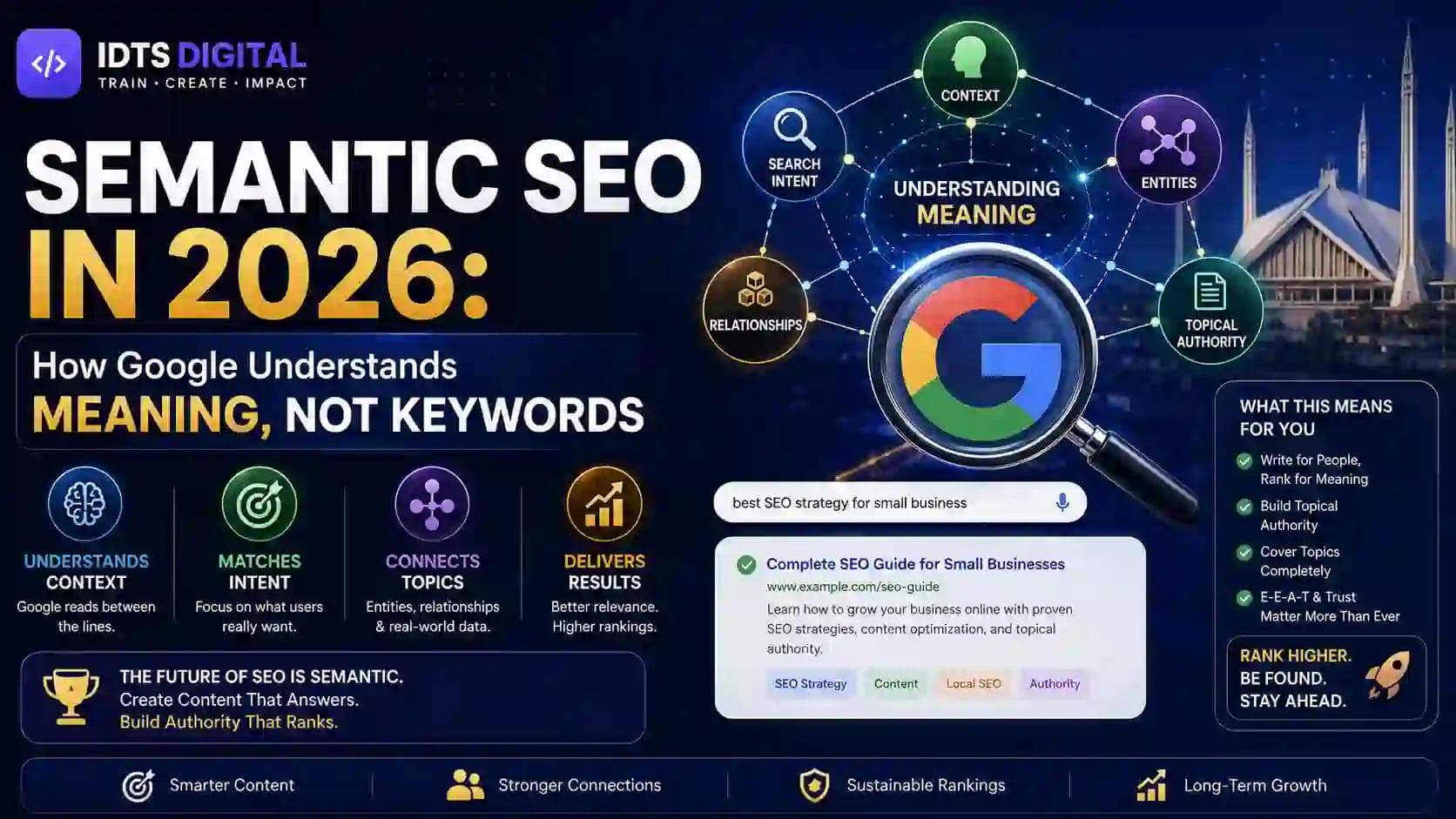
Semantic SEO in 2026: How Google Understands Meaning, Not Keywords
Search has changed. Google no longer just matches the words you type — it tries to understand what you actually mean. This shift is called semantic SEO, and in 2026 it has become the single biggest factor separating websites that rank from websites that get buried on page five.
If you've been stuffing keywords into your content and wondering why nothing ranks, this guide will show you exactly how Google reads meaning today, how AI Overviews decide which pages to quote, and how businesses — including local companies offering SEO services in Islamabad and SEO services in Rawalpindi — can build content that ranks in both classic search and AI-generated answers.
What Is Semantic SEO? (Beyond Keywords, Into Meaning)
Semantic SEO is the practice of optimizing content around topics, intent, and relationships between concepts — instead of chasing exact-match keywords. Google's algorithms now use natural language processing (NLP), entity recognition, and vector embeddings to understand what a page is about, not just what words appear on it.
In simple terms: Google used to read your page like a scanner looking for matching text. Today, it reads your page more like a human — understanding synonyms, context, related ideas, and even the intent behind a search query.
So when someone searches "best SEO company in Islamabad," Google isn't just looking for that exact phrase. It's evaluating whether your page genuinely answers questions people have about hiring an SEO agency, what results to expect, how pricing works, and whether your business is a trustworthy, real entity — not just a page with the right words on it.
Why Semantic SEO Matters More in 2026
Three major shifts have made semantic SEO non-negotiable this year:
1. AI Overviews now sit above traditional search results. Google's AI-generated answers pull from pages that demonstrate clear topical depth and directly answer user questions — not pages built around keyword density.
2. Google's Helpful Content system rewards genuine expertise. Thin, keyword-stuffed pages are actively filtered out, while comprehensive, well-structured content that reads naturally gets prioritized.
3. Voice search and conversational queries have grown. People increasingly search the way they speak — "who's the best SEO expert in Islamabad for a small business" instead of "seo expert islamabad." Semantic SEO is built to match this natural phrasing.
For businesses in Pakistan, this matters even more. Local competition for terms like SEO services, digital marketing agency Islamabad, and SEO company in Rawalpindi has grown sharply, and only sites that demonstrate real topical authority and location relevance are winning the top spots.
How Google Understands Meaning: The Technology Behind Semantic Search
Entity-Based SEO and the Knowledge Graph
Google doesn't just index keywords — it indexes entities: people, places, businesses, and concepts, and the relationships between them. This is powered by the Google Knowledge Graph, which connects your business, your services, and your location into a web of verified facts.
If your website consistently mentions "IDTS Digital," "SEO services," "Islamabad," and "Rawalpindi" together across your pages, schema markup, and Google Business Profile, Google starts to understand you as a real, trustworthy entity tied to those services and that location — not just a page that happens to rank.
NLP and the Evolution of RankBrain and BERT
Google's language models — from RankBrain to BERT and beyond — allow it to understand context, word relationships, and intent behind ambiguous queries. A search for "SEO course Islamabad" might mean someone wants to learn SEO themselves, while "SEO expert Islamabad" signals they want to hire someone. Semantic SEO means writing content that clearly signals which intent you're serving.
Vector Search and Embeddings
Modern search engines convert both queries and content into mathematical representations called embeddings. Pages with similar meaning — even without matching words — end up "close" to each other in this vector space. This is why a well-written page about "hiring a digital marketing agency in Islamabad" can rank for "SEO company near me" even without that exact phrase appearing.
Passage Ranking and Indexing
Google can now rank individual sections of a page, not just the whole document. This means a strong FAQ answer buried halfway down your article can still surface directly in search results or an AI Overview — which is exactly why structuring content with clear, direct answers under each heading matters so much in 2026.
Semantic SEO vs Traditional Keyword SEO
The old approach to SEO focused on repeating an exact keyword phrase as many times as possible. The new approach focuses on covering a topic completely, answering related questions, and using natural language.
Here's the core difference in plain terms:
"Traditional SEO asks: does this page contain the keyword? Semantic SEO asks: does this page genuinely satisfy the searcher's need, and does Google trust the source enough to show it?"
Traditional SEO optimizes for robots. Semantic SEO optimizes for meaning — which, conveniently, is also what real readers want. That's why Google's own guidance continues to emphasize writing for people first, a principle covered in depth in Google's Search Central documentation.
Key Skills, Tools & Techniques for Semantic SEO
To actually implement semantic SEO, you need a mix of strategy, technical setup, and writing skill:
- Topic clustering — grouping related subtopics under one pillar page instead of scattering thin pages across your site
- Schema markup — structured data (Article, FAQ, LocalBusiness, Service schema) that tells Google exactly what your content and business represent
- Entity optimization — consistent naming, NAP (name, address, phone) data, and Knowledge Panel signals
- Natural language writing — answering questions the way a real person would speak, not the way a keyword tool suggests
- Internal linking — connecting related pages so Google understands your site's topical structure
- User intent mapping — matching content format (guide, service page, FAQ, comparison) to what the searcher actually wants
Tools like Google Search Console, Ahrefs, SEMrush, and AI-assisted research tools help identify these patterns, but the underlying skill — understanding what a human searcher truly wants — can't be automated. This is a core focus inside the SEO Mastery course at IDTS Digital, where students learn both the technical and human sides of modern search.
How Semantic SEO Connects to AEO and GEO
Two newer disciplines have grown directly out of semantic SEO:
Answer Engine Optimization (AEO) focuses on structuring content so it can be pulled directly into featured snippets, voice assistants, and AI Overviews. This means writing short, direct, snippet-friendly answers immediately after each heading, then expanding with detail afterward.
Generative Engine Optimization (GEO) goes a step further, optimizing content specifically for AI systems like Google's AI Overviews, ChatGPT, and Perplexity — tools that summarize and synthesize information from multiple sources rather than just linking to one page. GEO rewards content that is factually precise, well-cited, and structured in clear question-and-answer blocks.
Both disciplines depend entirely on semantic SEO as their foundation. Without topical depth and clear meaning, there's nothing for an AI engine to summarize or trust. Our detailed breakdown in the 2026 SEO Playbook on AEO, GEO, and zero-click search walks through this in more depth, alongside our dedicated Generative Engine Optimization guide.
Building Topical Authority: The Pillar-Cluster Model
Google rewards websites that demonstrate depth on a subject, not just a single optimized page. This is where the pillar-cluster content model comes in.
A pillar page — like this one — covers a broad topic comprehensively. Cluster pages then go deeper into specific subtopics and link back to the pillar. For example, this article on semantic SEO connects naturally to:
- On-page SEO checklist for 2026
- Technical SEO checklist for 2026
- Local SEO guide for small businesses in 2026
- How to choose an SEO expert in Islamabad
- Complete SEO 2026 Google ranking guide
When these pages interlink naturally, Google recognizes a cluster of genuine expertise around SEO — which strengthens rankings across every page in the group, not just one.
E-E-A-T and Semantic SEO: Why Trust Signals Matter
Google's E-E-A-T framework — Experience, Expertise, Authoritativeness, and Trustworthiness — works hand in hand with semantic SEO. Meaning alone isn't enough; Google also needs to trust the source delivering that meaning.
Practical ways to build E-E-A-T into your content:
- Show real experience — reference actual client results, case studies, or hands-on work rather than generic claims
- Cite credible sources — link out to authoritative references like Google Search Central or established platforms such as IBM's overview of natural language processing when explaining technical concepts
- Keep author and business information visible — clear "About" pages, verified contact details, and consistent branding
- Update content regularly — outdated statistics and broken advice quickly erode trust signals
This combination of accurate meaning plus demonstrated trust is exactly what separates pages that rank in AI Overviews from pages that get ignored entirely.
Local Semantic SEO: Ranking for SEO Services in Islamabad & Rawalpindi
Local semantic SEO adds a geographic layer to everything above. Google now blends entity understanding with location signals — meaning a business needs more than a city name in its title tag to rank locally.
To rank for terms like SEO services in Islamabad, SEO company in Islamabad, or SEO agency near Bahria Town Islamabad, your site needs:
- Consistent NAP (Name, Address, Phone) data across your website and Google Business Profile
- LocalBusiness schema markup identifying your service areas
- Location-specific service pages (not just one generic "services" page)
- Genuine local content — client examples, area-specific case studies, and location mentions used naturally, not stuffed
- Reviews and citations from local directories
IDTS Digital has built dedicated location pages for exactly this reason, including digital marketing services in Islamabad and digital marketing services in Rawalpindi, each structured around real local intent rather than duplicated content with a swapped city name. For a deeper look at pricing expectations, our SEO services cost guide for Islamabad breaks down what businesses should realistically budget.
Why Choose IDTS Digital for SEO Services in Islamabad & Rawalpindi
Choosing the right SEO partner matters more than ever in a semantic-search world, because rankings now depend on genuine expertise, not shortcuts.
IDTS Digital approaches SEO the way Google itself now evaluates content — through topical depth, technical precision, and real entity trust-building. Our process for clients across Islamabad and Rawalpindi includes:
- Full technical SEO audits and structured data implementation
- Topic-cluster content strategy built around genuine search intent
- Local SEO setup including Google Business Profile optimization and citation building
- Transparent monthly reporting so clients see exactly what's improving and why
Whether you're a small business owner searching for an affordable SEO expert in Islamabad for a startup, or an established company looking for a full SEO company in Islamabad with monthly reporting, our SEO growth services page outlines exactly how we structure engagements. You can also explore our complete services overview or reach out directly through our contact page to discuss your goals.
Best SEO Course in Islamabad – Learn Semantic SEO the Right Way
If you'd rather learn semantic SEO yourself than outsource it, this is one of the best times in years to start. Employers and clients are actively looking for people who understand entity-based SEO, AEO, and GEO — not just outdated keyword tactics.
The SEO Mastery course at IDTS Digital is built specifically around 2026's search landscape, covering:
- Semantic keyword research and topic mapping
- Technical SEO and schema implementation
- AEO and GEO content structuring for AI Overviews
- Local SEO strategy for service-based businesses
- Real client project work for portfolio building
For readers weighing multiple institutes, our comparison piece on the best SEO course options in Islamabad and Rawalpindi breaks down what to look for — accreditation, practical project work, and instructor experience — before enrolling anywhere. You can review the full course catalog on our courses page as well.
Real-World Example: Semantic SEO in Action
Consider two businesses both offering SEO services in Rawalpindi. Business A builds a single page stuffed with the phrase "SEO services Rawalpindi" fifteen times. Business B builds a pillar page explaining what SEO services include, followed by cluster pages on local SEO, e-commerce SEO, and technical SEO — each interlinked, each answering specific questions, each backed by schema markup and genuine client examples.
In 2026's search landscape, Business B wins — not just in traditional rankings, but as the page Google's AI Overview is far more likely to summarize and cite, because it demonstrates depth, structure, and trustworthy expertise rather than repetition.
This same principle applies across industries. Our guide on local SEO strategies for Pakistani businesses shows several examples of this pattern working in retail, healthcare, and service-based sectors.
The Future of Search: What's Next After Semantic SEO
Search is moving toward a landscape where fewer clicks happen at all — users get their answers directly from AI Overviews, voice assistants, and chat-based search tools. This doesn't make SEO less important; it makes semantic depth more important than ever, because your content now needs to satisfy both human readers and AI summarization systems simultaneously.
Businesses that invest now in topical authority, structured data, and genuinely helpful content will be positioned as the trusted sources these AI systems pull from — while businesses still chasing exact-match keywords will be left behind. Our full SEO 2026 Google ranking guide covers additional forward-looking strategies worth reviewing alongside this article.
Frequently Asked Questions
What is semantic SEO and why does it matter in 2026? Semantic SEO is the practice of optimizing content around meaning, topics, and user intent rather than exact-match keywords. It matters in 2026 because Google's AI systems now rank content based on how well it satisfies a searcher's actual need, not how many times a keyword appears.
How much does SEO services cost in Islamabad? Pricing varies based on scope, but most professional SEO services in Islamabad range from basic monthly packages for small businesses to comprehensive enterprise plans. Our SEO cost guide for Islamabad breaks down typical pricing tiers in detail.
Which is the best SEO company in Rawalpindi? The best SEO company is one that demonstrates transparent reporting, technical expertise, and proven local results. IDTS Digital offers dedicated SEO services in Rawalpindi built around these principles.
Do you offer SEO courses with certification in Islamabad? Yes. The SEO Mastery course at IDTS Digital includes certification along with hands-on project work covering semantic SEO, technical SEO, and AEO/GEO strategy.
What's the difference between SEO and Generative Engine Optimization? Traditional SEO focuses on ranking in classic search results, while Generative Engine Optimization (GEO) focuses on getting content cited and summarized by AI systems like Google's AI Overviews. Semantic SEO is the shared foundation both disciplines depend on.
Can semantic SEO help my site appear in Google AI Overview? Yes. Content structured with clear, direct answers, strong topical depth, and credible sourcing is significantly more likely to be pulled into AI Overviews than thin, keyword-stuffed pages.
How long until I see SEO results with your agency? Most clients begin seeing measurable improvements within 60–90 days, with stronger compounding results by month six as topical authority and backlinks build up.
Conclusion: Start Building Real Meaning, Not Just Keywords
Semantic SEO isn't a trend — it's simply how modern search works now. Google understands entities, context, and intent, and it rewards websites that genuinely help people, structure information clearly, and build real topical authority over time.
Whether you're a business owner looking for a trusted SEO company in Islamabad, a marketer researching SEO services in Rawalpindi, or someone ready to learn these skills yourself, the path forward is the same: build depth, write for humans, and structure content for both search engines and AI systems.
Ready to put this into action? Book a seat in the SEO Mastery course at IDTS Digital, or reach out through our contact page to discuss a custom SEO strategy for your business in Islamabad or Rawalpindi.