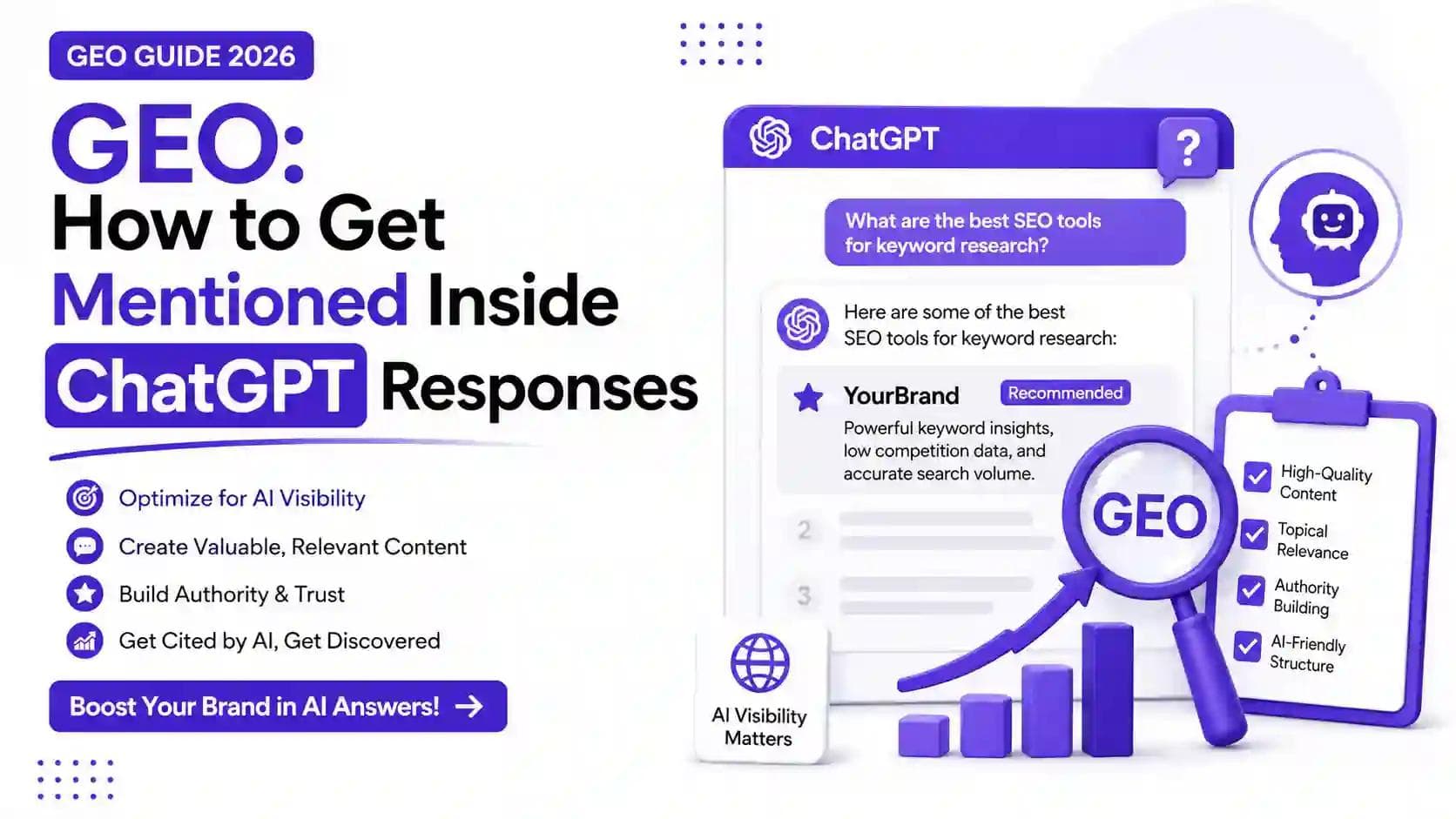
If you've ever asked ChatGPT a question and noticed it names specific brands, websites, or experts in its answer, you've seen Generative Engine Optimization (GEO) in action. GEO is the newest and fastest-growing branch of digital marketing — a set of strategies designed to help your content get discovered, understood, and cited by AI systems like ChatGPT, Google AI Overviews, Perplexity, and Gemini.
Traditional SEO taught us how to rank on Google's search results page. GEO teaches us something different: how to become the answer an AI model chooses to repeat. In this guide, we'll break down what GEO actually is, why it matters (especially for businesses and job seekers in Pakistan), the skills and tools you need, and how you can start learning this in-demand skill today — including where to get proper, structured training.
What Is Generative Engine Optimization (GEO)?
Generative Engine Optimization is the practice of structuring, writing, and promoting content so that AI-powered search tools and chatbots are more likely to reference, quote, or recommend it. Instead of optimizing purely for keyword rankings, GEO focuses on optimizing for retrieval and citation — the process large language models (LLMs) use to pull information from the web when generating a conversational answer.
Think of it this way: Google SEO gets you a spot on a results page that a human scrolls through. GEO gets you mentioned inside the answer itself, often with zero clicks required from the user to find your brand. That's why GEO is sometimes grouped together with Answer Engine Optimization (AEO) — both aim to make your content the trusted source an AI pulls from, rather than just a blue link.
How Is GEO Different From Traditional SEO?
The mechanics overlap, but the goals diverge in a few important ways:
- Traditional SEO targets search engine crawlers and ranking algorithms; success is measured by position on a search engine results page (SERP).
- GEO targets AI models and their retrieval systems; success is measured by citations, mentions, and brand visibility inside AI-generated answers.
- SEO relies heavily on backlinks and keyword density. GEO relies more heavily on clarity, structure, factual accuracy, and topical authority — because AI models are trying to summarize trustworthy information, not just match keywords.
- SEO content can rank with strong technical optimization alone. GEO content needs genuine E-E-A-T (Experience, Expertise, Authoritativeness, Trustworthiness) because AI models are trained to prefer authoritative, well-sourced material when generating answers.
In short: SEO gets you found. GEO gets you quoted.
Why GEO Matters — Especially in Pakistan
AI search adoption is accelerating everywhere, and Pakistan is no exception. Millions of students, freelancers, and small business owners across cities like Islamabad, Rawalpindi, Lahore, and Karachi now use ChatGPT and similar tools daily — for research, shopping decisions, and business advice. If your brand, service, or course isn't structured in a way AI models can understand and trust, you're invisible in this growing channel, no matter how well you rank on Google.
For Pakistani businesses and freelancers, this represents a massive opportunity:
- First-mover advantage. Very few local businesses currently optimize for GEO, meaning the competition for AI citations is far lower than traditional Google rankings.
- Freelance and remote work potential. International clients are actively searching for GEO specialists on platforms like Upwork and Fiverr, and demand is outpacing supply.
- Local search behavior is shifting. More users are asking AI chatbots questions like "best SEO course in Islamabad" instead of typing them into Google — meaning your digital presence needs to work across both systems.
Businesses that ignore GEO today risk the same fate that businesses which ignored mobile-friendly websites faced a decade ago — a slow but steady loss of visibility.
How Do AI Models Like ChatGPT Choose What to Cite?
While no AI company publishes its exact retrieval formula, patterns have become clear through testing and industry research. AI systems tend to favor content that is:
- Clearly structured — using proper headings, bullet points, and direct answers rather than long, meandering paragraphs.
- Fact-dense and specific — statistics, dates, and concrete details are easier for models to extract and quote accurately.
- Backed by authority signals — author bios, credentials, citations, and consistent publishing history all build trust.
- Semantically rich — content that thoroughly covers a topic (and related subtopics) using natural language, not robotic keyword repetition.
- Recently updated — freshness signals matter, since AI systems weigh recent, accurate information more heavily than outdated pages.
- Marked up with structured data — schema markup (like FAQ schema and Article schema) helps machines parse your content's meaning, not just its words.
This is essentially a fusion of classic on-page SEO fundamentals with a stronger emphasis on retrieval-augmented generation (RAG) — the technical process many AI tools use to pull real-time information from the web before generating a response.
Key Skills and Tools You Need for GEO
If you want to build a career or grow a business using GEO, here are the core competencies worth developing:
Essential Skills
- Semantic SEO writing — understanding search intent and topical depth, not just keyword placement.
- Structured content design — organizing information with headings, FAQs, and lists that AI can easily parse.
- Schema markup / structured data — a technical but learnable skill that significantly boosts machine-readability.
- Content authority building — earning backlinks, citations, and digital PR mentions that signal trustworthiness.
- Basic understanding of NLP and LLMs — knowing how large language models process and rank information helps you write content that aligns with how they "think."
- Analytics and tracking — measuring brand mentions and citations across AI platforms, not just traditional keyword rankings.
Useful Tools
- Google Search Console — still essential for tracking indexing and search performance.
- Schema markup generators — to implement FAQ and Article schema correctly.
- AI visibility trackers — emerging tools that monitor how often your brand appears in AI-generated answers.
- Content optimization platforms — for checking topical coverage and readability scores.
- ChatGPT, Perplexity, and Gemini themselves — testing your own content by asking these tools relevant questions is one of the simplest and most effective GEO audits you can do.
Step-by-Step Guide to GEO for Beginners
- Start with topic research, not just keyword research. Understand every question a user might ask around your subject.
- Write clear, direct answers early in your content — AI models often extract the first well-structured answer they find.
- Use question-based subheadings (H2/H3) that mirror how people actually type queries into ChatGPT.
- Add a dedicated FAQ section with schema markup — this is one of the most reliable ways to get pulled into AI Overviews and cited by ChatGPT.
- Cite credible sources and data wherever possible, and make sure your own content is citable — include author credentials and publishing dates.
- Build topical authority by publishing a cluster of related articles instead of one isolated post.
- Earn digital PR and mentions from reputable sites, since brand mentions (even without links) are increasingly used as authority signals by AI systems.
- Keep content updated. Revisit and refresh older articles regularly to maintain freshness signals.
Job Scope, Salary, and Demand for GEO Specialists
GEO is still an emerging field, which means salaries and demand vary — but the trajectory is strongly upward.
- Global demand: International agencies and enterprise brands are actively hiring GEO/AEO specialists, often blending the role with existing SEO or content marketing positions.
- Freelance opportunities: On platforms like Upwork and Fiverr, "AI search optimization" and "ChatGPT SEO" gigs are increasingly common, with rates often higher than standard SEO work due to limited specialist supply.
- Local demand in Pakistan: Digital marketing agencies in Islamabad, Rawalpindi, Lahore, and Karachi are beginning to add GEO as a service offering, creating early-career opportunities for trained specialists.
- Career pathway: Most professionals enter GEO through an existing SEO, content writing, or digital marketing background, then specialize further with dedicated training.
Because GEO combines writing, technical SEO, and an understanding of AI systems, professionals with cross-functional skills tend to be the most in demand and the best compensated.
Why Choose Idts Digital for GEO and SEO Training
Learning GEO from scattered YouTube videos and outdated blog posts can only take you so far — the field moves fast, and structured, up-to-date training makes a measurable difference. Why choose Idts Digital comes down to a few clear reasons:
- Practical, project-based learning rather than theory-only lectures.
- Instructors with real freelancing and agency experience, not just certifications.
- Курс content updated regularly to reflect changes in Google's algorithm and AI search behavior.
- A genuine focus on job and freelance readiness, not just course completion.
- Local relevance — training tailored to how Pakistani businesses and freelancers actually compete for local and international clients.
If you're based in Islamabad or Rawalpindi and searching for the best SEO course near you, this is exactly the gap Idts Digital was built to fill — practical, current, and locally accessible training in both classic SEO and emerging skills like GEO.
You can explore Advanced courses at Institute of Digital Trainings and Services to see the full curriculum, or check out the broader SEO and growth services offered for businesses that want this handled by professionals.
How to Learn GEO: Free and Paid Resources
You don't need to spend money to get started, but structured paid training will get you job-ready far faster.
Free Resources
- Google's own Search Central documentation is one of the best free resources for understanding how search engines evaluate content quality — many of the same principles apply to GEO.
- Free blog resources on the Idts Digital blog, including guides like SEO 2026: Google Ranking Guide and the On-Page SEO Checklist for 2026, are excellent starting points for building foundational knowledge.
- Testing your own content directly inside ChatGPT and Perplexity — simply asking the AI questions related to your niche and observing which sources it cites — is a completely free, hands-on GEO audit method.
Paid Resources
- A structured, mentor-led SEO Mastery course that now incorporates GEO and AEO strategies alongside traditional SEO fundamentals.
- Industry courses from platforms like Coursera, which offer verified digital marketing certifications from recognized universities and institutions — useful for building credibility alongside hands-on skills.
- One-on-one mentorship or agency internships, which expose you to live client projects — often the fastest way to build a genuinely strong GEO portfolio.
For those wanting to understand the full local market context, the blog post Best SEO Course in Islamabad & Rawalpindi breaks down what to look for when choosing a program in this region.
Real-World Examples of GEO in Action
- A local bakery with a well-structured "Frequently Asked Questions" page about delivery times and ingredients started appearing in ChatGPT's answers when users asked about bakeries in their city — simply because the content was clear, specific, and easy for the AI to extract.
- A software review blog that consistently published detailed, data-backed comparisons (rather than vague opinion pieces) began seeing its brand name mentioned by AI tools when users asked for tool recommendations, even without the highest Google ranking.
- Educational institutes publishing structured course outlines, FAQs, and instructor credentials have found themselves cited by AI chatbots when prospective students ask questions like "what's the best SEO course in Islamabad" — precisely the kind of query this article is built to answer.
The common thread across all these examples: clarity, structure, and genuine expertise consistently outperform keyword-stuffed, vague content when it comes to earning AI citations.
Content Cluster Concepts Worth Understanding
To build real topical authority for GEO, it helps to understand a few supporting concepts:
- Semantic search — search systems that understand meaning and context, not just literal keyword matches.
- Knowledge graphs — structured databases that help search engines and AI models understand relationships between entities (people, places, brands, topics).
- Zero-click search — when a user gets their answer directly from the search results or AI response without clicking through to a website, making brand visibility (even without a click) increasingly valuable.
- Retrieval-augmented generation (RAG) — the technical process that allows AI chatbots to pull in real-time or external data before generating a response, rather than relying solely on training data.
- Digital PR for AI visibility — earning mentions and citations from authoritative, high-trust websites, which increasingly influences whether AI models consider your brand credible.
Understanding these concepts — even at a basic level — helps you write content that naturally aligns with how modern search and AI systems actually work, rather than chasing outdated tactics.
Future Career Opportunities in GEO
As AI search continues to grow, GEO is expected to become a standard requirement within digital marketing roles rather than a niche specialty. Some emerging career paths include:
- GEO/AEO Specialist — a dedicated role focused entirely on AI search visibility.
- AI Content Strategist — blending content marketing with an understanding of how LLMs process and cite information.
- Technical SEO + Schema Specialist — professionals who can implement structured data at scale for enterprise clients.
- Digital PR Manager for AI Visibility — focused specifically on earning citations and mentions that boost AI trust signals.
- Freelance GEO Consultant — offering AI visibility audits and optimization services to small businesses that can't afford a full in-house team.
Given how early this field still is, professionals who build strong GEO skills now are positioning themselves for genuine long-term career advantages — much like early SEO specialists did in the 2000s.
Frequently Asked Questions
What is GEO in SEO? GEO, or Generative Engine Optimization, is the practice of optimizing content so AI tools like ChatGPT, Gemini, and Perplexity are more likely to reference or cite it when generating answers.
How is GEO different from traditional SEO? Traditional SEO focuses on ranking on search engine results pages, while GEO focuses on getting content cited or summarized directly inside AI-generated answers.
Can I get my website mentioned in ChatGPT for free? Yes. By structuring your content clearly, answering common questions directly, and building genuine topical authority, you can improve your chances of being cited without paid tools — though paid tracking tools can help measure results.
What is Answer Engine Optimization (AEO)? AEO is a closely related discipline focused specifically on optimizing content to directly answer user questions in a way that's easily extracted by both traditional search engines and AI-powered answer tools.
Is GEO the future of SEO? Most industry experts view GEO as an extension of SEO rather than a replacement — the two are expected to work together as AI-powered search continues to grow alongside traditional search engines.
What is the best SEO course in Islamabad? While several options exist, look for programs that combine hands-on projects, updated curriculum covering both SEO and GEO, and instructors with real client experience. The SEO Mastery course at Idts Digital is designed around exactly this practical, up-to-date approach.
Conclusion
Generative Engine Optimization isn't a passing trend — it's the natural next step in how search and content discovery work. As more users turn to ChatGPT, Gemini, and other AI tools for answers, businesses and professionals who understand how to earn citations inside those responses will have a significant edge over those still relying solely on traditional rankings.
Whether you're a business owner in Islamabad wanting more visibility, or a student in Rawalpindi looking to build a future-proof career, now is the time to build these skills — while competition is still low and demand is rising fast.
Ready to get started? Book a seat at the Advanced Digital Courses offered by Idts Digital and start building the skills that will keep you visible in the next generation of search.