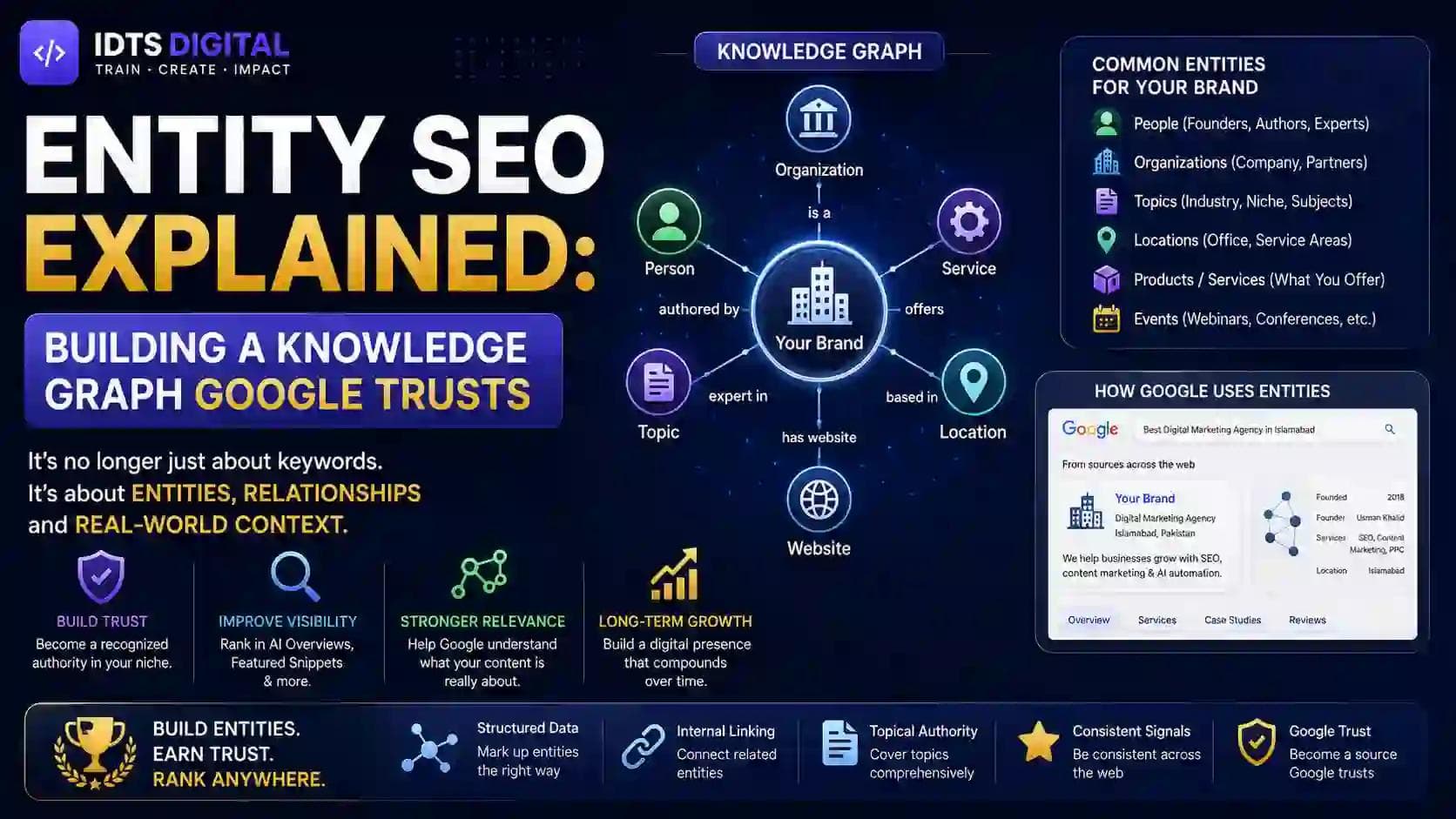
If you've been keeping an eye on search trends, you've probably noticed something: Google isn't just matching keywords anymore. It's trying to understand who you are, what your business does, and how trustworthy you actually are. This shift is called Entity SEO, and it's quietly become one of the most important ranking factors of 2026.
In simple terms, entity SEO is about helping Google recognize your business, brand, or website as a real, credible "entity" — not just a collection of pages targeting keywords. Instead of asking "does this page contain the right words," Google now asks "does this page belong to a trustworthy, well-connected source?"
In this guide, we'll break down what entity SEO really means, how Google's Knowledge Graph works, and how you can build one that search engines — and AI systems like Google's AI Overviews — genuinely trust. Whether you're a business owner searching for SEO services in Islamabad or a student exploring the best SEO course in Islamabad, this article will give you a complete, practical understanding of entity-based search.
What Is Entity SEO?
Entity SEO is the practice of optimizing your website and online presence so that search engines understand it as a distinct, real-world "entity" — a person, business, product, or organization — rather than just a webpage full of keywords.
An entity is anything that can be uniquely identified and described: a company, a place, a person, an event, or even a concept. Google stores information about these entities in something called the Knowledge Graph, a massive database of facts and relationships that helps Google understand context, not just text.
Here's a simple way to think about it: traditional SEO asks, "What words does this page contain?" Entity SEO asks, "What does this page mean, and how is it connected to everything else Google already knows?"
For example, if you run an SEO company in Islamabad, entity SEO isn't just about ranking for the phrase "SEO company in Islamabad." It's about making sure Google understands that your business is a real, established company, located in Islamabad, offering specific services, with real reviews, real backlinks from credible sources, and consistent information across the web.
Why Entity SEO Matters in 2026
Search has changed dramatically over the past few years. With the rise of semantic search, natural language processing (NLP), and AI Overviews, Google no longer relies purely on keyword matching. It relies on understanding relationships between entities.
A few reasons entity SEO has become essential:
- Google's algorithm increasingly favors topical authority over keyword density.
- AI Overviews and generative search results pull information from sources Google already trusts as authoritative entities.
- Voice search and conversational queries require Google to understand context and meaning, not just exact-match phrases.
- Local businesses — like an SEO agency Rawalpindi or a digital marketing agency Islamabad — benefit hugely from entity clarity, since Google needs to confidently associate a business with a specific location.
This matters even more for businesses operating in competitive markets like Pakistan, where hundreds of agencies compete for the same short-tail keywords such as "SEO services" or "SEO expert." Entity SEO is what separates a page that simply mentions a keyword from a brand that Google actually recognizes and recommends.
How Google's Knowledge Graph Works
Google's Knowledge Graph is essentially a giant, interconnected database of entities and their relationships. When you search for something like "Eiffel Tower," Google doesn't just show you pages with those words — it shows you a knowledge panel with facts: height, location, architect, nearby attractions. That's the Knowledge Graph in action.
Entities and Entity Relationships
Every entity in Google's system is connected to other entities. A business entity, for instance, might be connected to:
- A location entity (e.g., Islamabad or Rawalpindi)
- An industry entity (e.g., digital marketing or SEO)
- People entities (founders, team members)
- Review and reputation signals
- Related businesses or competitors
The stronger and more consistent these connections are, the more confidently Google can identify and trust your entity. This is why entity relationships matter just as much as the content on your page.
Structured Data and Schema Markup
Structured data, often implemented through Schema.org markup, is one of the clearest signals you can send to Google about your entity. It's essentially a translation layer — code that tells search engines exactly what your content means, not just what it says.
For example, adding LocalBusiness schema to your website tells Google:
- Your business name
- Your exact address and service area
- Your phone number
- Your operating hours
- Customer reviews and ratings
Adding FAQ schema, on the other hand, helps your content qualify for rich snippets and AI Overview citations, since it presents information in a clean, question-and-answer format that's easy for AI systems to extract and summarize.
If you want to go deeper into official documentation on this topic, Google's Search Central guide to structured data is an excellent authoritative resource.
Entity SEO vs Traditional SEO
A lot of people confuse entity SEO with traditional keyword-based SEO. They're related, but they're not the same thing.
Traditional SEO focuses on:
- Targeting specific keywords and keyword variations
- On-page SEO services like title tags, meta descriptions, and header optimization
- Off-page SEO services such as backlink building
- Technical SEO audit work like site speed and crawlability
Entity SEO builds on top of all of that, but adds a deeper layer:
- Establishing your brand as a recognized entity across the web
- Creating topical authority through content clusters
- Ensuring NAP consistency (Name, Address, Phone) across directories
- Earning mentions and citations from other trusted entities
- Structuring content so AI systems can easily understand and cite it
Think of traditional SEO as building a house, and entity SEO as making sure that house is registered, mapped, and recognized by the entire neighborhood — including the post office, the city council, and everyone who lives nearby.
Key Elements of a Strong Entity SEO Strategy
Building a knowledge graph that Google trusts doesn't happen overnight. It requires a structured, long-term approach. Here are the core pillars.
Topical Authority & Content Clusters
Google trusts websites that demonstrate deep expertise on a subject, not just a single well-optimized page. This is where content clusters come in — a pillar page (like this one) surrounded by supporting articles that explore related subtopics in detail.
For instance, if your pillar topic is entity SEO, your supporting cluster might include articles like a complete on-page SEO checklist, a guide to semantic SEO and search intent, or a breakdown of how AI Overviews and generative engines work. Interlinking these pages naturally signals to Google that your website has comprehensive, organized expertise on the topic — a key ingredient of topical authority.
Structured Data Markup
As mentioned earlier, structured data markup is non-negotiable in 2026. At minimum, your website should include:
- Organization schema on your homepage
- LocalBusiness schema for location-based pages
- Service schema for each offering
- FAQ schema on question-answer content
- Review/Rating schema where applicable
Google Business Profile Optimization
For any local business — whether you're offering SEO services in Islamabad or running a small clinic in Rawalpindi — your Google Business Profile is one of the strongest entity signals available. A fully optimized, regularly updated profile with accurate categories, photos, and reviews helps Google confidently place your business within the Local Pack and knowledge panels.
NAP Consistency for Local SEO
NAP stands for Name, Address, Phone number. It sounds simple, but inconsistent NAP data across directories, social media, and your website is one of the most common reasons local businesses fail to build a trusted entity profile. Make sure your business information is identical everywhere it appears online.
Backlinks & Digital PR
Backlinks still matter — but in entity SEO, it's less about quantity and more about which entities are linking to you. A single mention from a respected industry publication or a partnership listing from a recognized organization carries more entity-trust weight than dozens of low-quality directory links.
Entity SEO for Local Businesses in Islamabad & Rawalpindi
Local entity SEO is especially powerful for businesses competing in Pakistan's growing digital economy. If you're searching for SEO services in Rawalpindi or trying to establish your SEO company in Islamabad as a recognized name, here's what actually moves the needle:
- Claim and fully optimize your Google Business Profile with accurate service areas (F-10 Islamabad, Blue Area Islamabad, Bahria Town Rawalpindi, DHA Islamabad, and so on).
- Build local citations on trusted Pakistani and international directories with consistent NAP data.
- Publish location-specific content — for example, a guide on choosing the right SEO expert in Islamabad or an in-depth cost guide for SEO services in Islamabad.
- Earn genuine customer reviews, since review signals are a major trust factor in local entity recognition.
- Use local schema markup that clearly defines your service area as Islamabad, Rawalpindi, or the broader twin cities region.
Businesses that combine these tactics consistently outperform competitors relying solely on keyword-stuffed pages, because Google can clearly verify they are real, active, locally-relevant entities.
How to Build Topical Authority Step by Step
Topical authority isn't built with one article — it's built with a system. Here's a practical roadmap:
- Choose your core pillar topics. Pick 3–5 broad subjects central to your business, such as entity SEO, local SEO, or technical SEO audits.
- Map supporting subtopics. For each pillar, list 8–12 related questions or subtopics your audience searches for.
- Create a content calendar. Publish consistently rather than in bursts — Google rewards steady authority-building over time.
- Interlink strategically. Every cluster article should link back to its pillar page, and the pillar page should link out to its clusters, such as this local SEO guide for small businesses.
- Update older content. Refresh outdated statistics, links, and examples regularly — Google favors freshness for competitive topics.
- Track entity mentions. Monitor where your brand is mentioned online, even without a link, since Google increasingly recognizes unlinked brand mentions as trust signals.
Entity SEO and AI Overviews (GEO & AEO)
Generative Engine Optimization (GEO) and Answer Engine Optimization (AEO) are the natural evolution of entity SEO. AI Overviews, Google's SGE-style generative results, and other AI-powered answer engines pull information from sources they consider authoritative, well-structured, and clearly attributed to a trusted entity.
To improve your chances of appearing in AI Overviews:
- Write clear, direct answers to common questions within the first sentence or two of each section.
- Use structured headings (H2, H3) that mirror how people actually ask questions.
- Add FAQ schema so your Q&A content is machine-readable.
- Build strong entity signals so AI systems recognize your brand as a credible source, not just a page with matching keywords.
- Keep your content factually accurate and regularly updated, since AI systems are increasingly cautious about citing outdated or unverified information.
For an official perspective on how Google evaluates content quality and trust, the Google Search Quality Rater Guidelines on E-E-A-T are worth reviewing directly.
Common Mistakes in Entity SEO
Even experienced marketers make mistakes when transitioning from traditional SEO to entity-based strategies. Watch out for these:
- Inconsistent NAP data across Google Business Profile, directories, and your website.
- Keyword stuffing instead of naturally building topical depth.
- Ignoring schema markup, missing out on a free and powerful trust signal.
- Ignoring internal linking, which weakens topical authority and content clusters.
- Chasing low-quality backlinks instead of earning mentions from genuinely relevant entities.
- Publishing thin content that doesn't fully answer user questions, reducing your chances of being cited in AI Overviews.
Why Choose Idts Digital for SEO Services
If all of this feels like a lot to manage on your own, that's completely understandable — entity SEO requires technical knowledge, consistent content creation, and ongoing monitoring. This is exactly where Idts Digital comes in.
As a results-driven SEO company in Islamabad, Idts Digital combines technical SEO audits, structured data implementation, local SEO strategy, and content cluster building into one complete approach. Whether you need affordable, transparent SEO growth services or a dedicated digital marketing agency in Islamabad to manage your entire online presence, the team focuses on building real entity trust — not shortcuts that fade after the next algorithm update.
Businesses working with Idts Digital benefit from a team that understands both the technical side (schema, crawlability, Core Web Vitals) and the strategic side (topical authority, content planning, and E-E-A-T alignment) of modern SEO.
How to Learn Entity SEO (Best SEO Course in Islamabad)
If you're more interested in learning SEO yourself — whether to grow your own business or start a freelancing career — entity SEO is now a core part of any serious SEO education.
A good SEO course in Islamabad should cover:
- Foundations of on-page and off-page SEO services
- Technical SEO audits and Core Web Vitals
- Keyword research tools and semantic search principles
- Entity SEO, schema markup, and Knowledge Graph optimization
- Local SEO and Google Business Profile management
- Practical, hands-on projects rather than just theory
The SEO Mastery course at Idts Digital is built around exactly this kind of practical, up-to-date curriculum, covering everything from beginner fundamentals to advanced entity and semantic SEO strategies used by real agencies today. For those weighing their options locally, this comparison of the best SEO courses in Islamabad and Rawalpindi is a useful starting point.
Free resources are valuable too — Google's own Search Central documentation and Google Analytics Academy are excellent starting points if you want to build foundational knowledge before enrolling in a structured course.
A Real-World Example of Entity SEO in Action
Imagine two SEO agencies, both located in Islamabad, both offering similar services. Agency A has a website stuffed with the keyword "SEO services in Islamabad" on every page, but no schema markup, inconsistent contact information across directories, and thin, generic content.
Agency B has a well-structured Google Business Profile, consistent NAP data across the web, LocalBusiness and FAQ schema on every relevant page, a genuine content cluster around SEO topics, and mentions from a few respected local business directories and news sites.
Even if both agencies target the exact same keywords, Agency B is far more likely to appear in the Local Pack, earn a knowledge panel, and get cited in AI Overviews — because Google recognizes it as a real, trustworthy entity, not just a page optimized for a phrase.
The Future of Entity SEO
As AI-driven search continues to grow, entity SEO isn't going away — it's becoming the foundation of search itself. Google's algorithm updates increasingly reward websites that demonstrate genuine expertise, clear structure, and verifiable trust signals over those that simply target high-volume keywords.
For businesses and SEO professionals alike, the message is clear: building a recognizable, well-connected entity is no longer optional. It's the new baseline for ranking, being featured in AI Overviews, and staying competitive in search results for years to come.
Frequently Asked Questions
What is entity SEO? Entity SEO is the practice of optimizing your online presence so search engines recognize your business, brand, or website as a distinct, credible entity connected to Google's Knowledge Graph, rather than just a page targeting keywords.
How does Google's Knowledge Graph work? Google's Knowledge Graph is a database of real-world entities — people, places, businesses, and concepts — along with the relationships between them. It helps Google understand context and deliver more accurate, fact-based search results.
What is the difference between entity SEO and traditional SEO? Traditional SEO focuses on keywords, on-page optimization, and backlinks. Entity SEO builds on these fundamentals by establishing your brand as a recognized, trustworthy entity through structured data, topical authority, and consistent information across the web.
How much do SEO services cost in Islamabad? Pricing varies based on scope, but most professional SEO services in Islamabad range from basic monthly retainers for small businesses to comprehensive packages for larger, competitive industries. For a detailed breakdown, see this SEO services cost guide for Islamabad.
How long does SEO take to show results? Most businesses start seeing measurable improvements within three to six months, with stronger, more stable results typically appearing after six to twelve months of consistent, entity-focused SEO work.
How can I rank in Google's AI Overview? Focus on clear, direct answers to common questions, use structured FAQ and schema markup, build genuine topical authority through content clusters, and establish your brand as a well-recognized, trustworthy entity across the web.
Conclusion
Entity SEO represents a fundamental shift in how search engines evaluate websites — moving away from simple keyword matching toward genuine, verifiable trust and topical authority. Whether you're a business owner looking for reliable SEO services in Islamabad, exploring an SEO agency in Rawalpindi, or a student searching for the best SEO course in Islamabad to build a future career, understanding entity SEO is no longer optional — it's essential for long-term visibility in Google Search and AI-powered answer engines alike.
If you're ready to build an entity Google actually trusts, Idts Digital can help you get there with a complete, transparent SEO strategy — or if you'd rather learn the skills yourself, book a seat in the Advanced Digital Courses offered by Idts Digital and start building your own SEO expertise today.