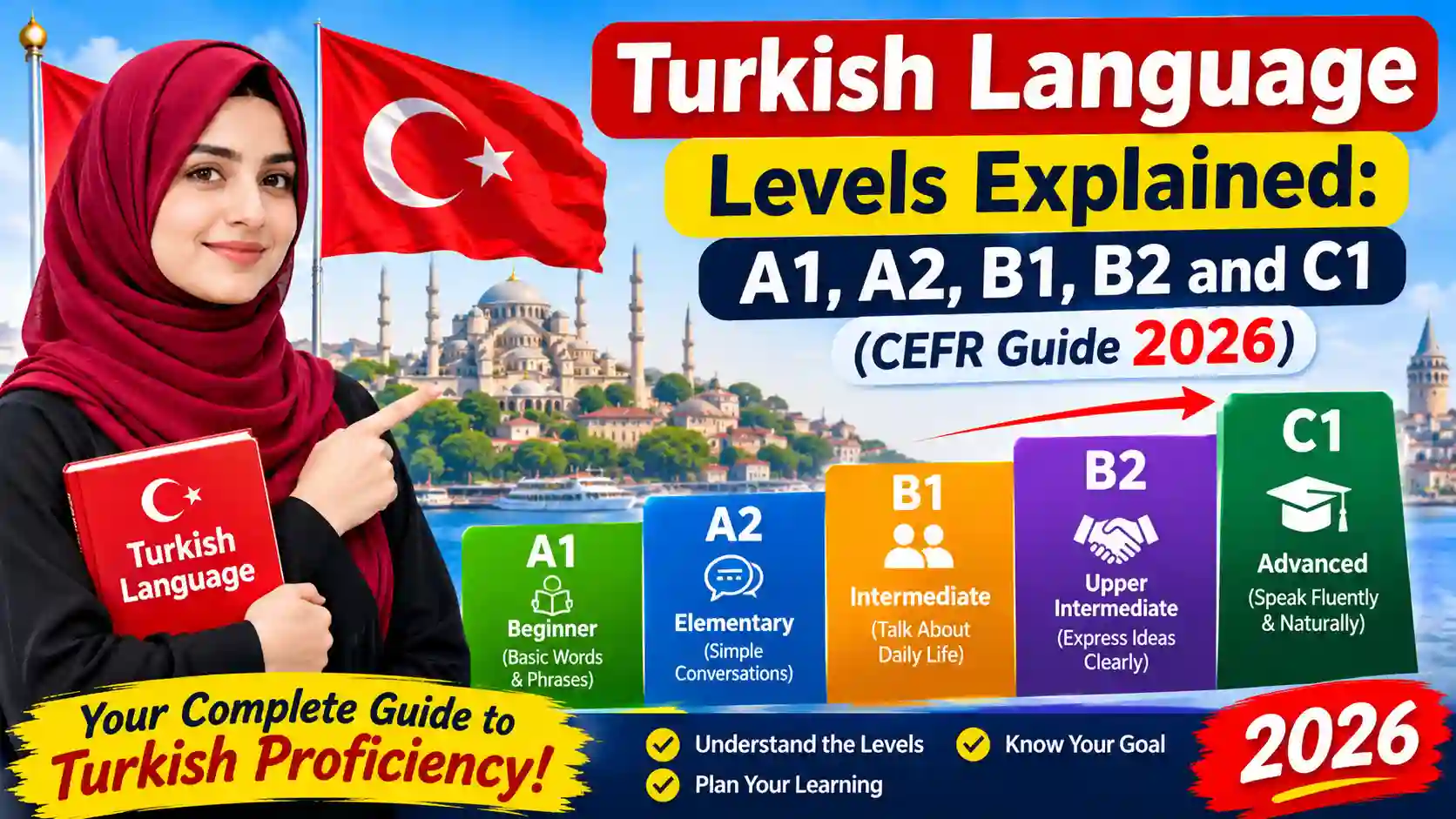
Turkish Language Levels Explained: A1, A2, B1, B2 and C1
You open a Turkish course page and see "A1," "B2," and "C1" everywhere. What do these codes actually mean? How long does each one take? And which level do you need for a university, a visa, or a job?
These labels come from the CEFR, the international framework used to measure language ability. Once you understand it, planning your Turkish journey becomes much easier.
This guide explains every Turkish language level in plain English. You will see what you can do at each stage, how long it takes, how certification works, and where to start if you are a complete beginner.
What Is CEFR? (Quick Answer)
CEFR stands for the Common European Framework of Reference for Languages. It is a six-level scale that describes how well a person can use a language. The Council of Europe created it, and schools, universities, and employers around the world now use it. You can read the official framework on the Council of Europe CEFR page.
The scale has three bands, each split in two:
- A1 and A2: Basic user
- B1 and B2: Independent user
- C1 and C2: Proficient user
Because CEFR is language-neutral, the same levels apply to Turkish, English, German, French, Spanish, and Arabic. A CEFR level B2 in Turkish means roughly the same thing as B2 in German. That is why people also search for terms like CEFR level meaning, CEFR table, and CEFR chart. They want one simple map of ability.
CEFR full form and meaning at a glance
Turkish language proficiency is divided into six levels under the CEFR framework, from A1 (Beginner) to C2 (Mastery). Each level represents your progress in understanding, speaking, reading, and writing Turkish. Beginners start with basic everyday phrases, while advanced learners can communicate fluently and express complex ideas with confidence.
Why Turkish Language Levels Matter, Especially in Pakistan
Many learners in Pakistan study Turkish for a clear goal. Some want a scholarship in Türkiye. Others want travel, trade, translation, or work with Turkish companies. Each goal needs a different level.
Knowing the levels helps you:
- Set a realistic target. "Learn Turkish" is vague. "Reach A2 in four months" is a plan.
- Choose the right course. A Turkish course for beginners should start at A1, not assume prior knowledge.
- Meet admission requirements. Many Turkish universities ask for proof of language ability, often around B2 for Turkish-taught programmes. Requirements differ by university and programme, so always check the official admission page.
- Measure progress. Levels give you milestones, which keeps motivation high.
- Communicate your skill. Employers and institutions understand CEFR levels immediately.
If your goal is study abroad, see our Study in Turkey page for guidance on applications and preparation.
Turkish Language Proficiency Levels: The Full Breakdown
Here is what each level means in practice. The descriptions follow the CEFR descriptors, adapted to Turkish.
Turkish A1 Level: Beginner
Turkish A1 level is where everyone starts. You can understand and use very familiar expressions and simple sentences.
What you can do at A1:
- Greet people and introduce yourself
- Ask and answer basic personal questions
- Count, tell the time, and name days and months
- Order simple food and drinks
- Read short signs and simple notices
Sample phrases:
- Merhaba, benim adım Ayşe. (Hello, my name is Ayşe.)
- Nasılsın? (How are you?)
- Bu ne kadar? (How much is this?)
Typical vocabulary: around 500 to 700 words.
Time needed: roughly 80 to 120 study hours. This is an estimate. Your pace, teacher, and practice habits change it.
A1 is also where you learn the alphabet. Turkish uses 29 Latin letters and spells words the way they sound, which makes the start easier than many learners expect.
Turkish A2 Level: Elementary
At A2, you move from memorised phrases to building your own simple sentences.
What you can do at A2:
- Talk about family, work, shopping, and daily routines
- Describe your home and surroundings in simple terms
- Handle short, predictable conversations
- Write short notes and simple messages
- Use the past tense and basic future expressions
Sample sentences:
- Dün arkadaşımla sinemaya gittim. (Yesterday I went to the cinema with my friend.)
- Hafta sonu ailemi ziyaret edeceğim. (I will visit my family at the weekend.)
Typical vocabulary: around 1,000 to 1,500 words.
Time needed: another 80 to 120 hours after A1.
Turkish B1 Level: Intermediate
B1 is the first "independent user" level, and it is a big step. You can deal with most situations you meet while travelling in Türkiye.
What you can do at B1:
- Hold a conversation on familiar topics
- Describe experiences, plans, hopes, and opinions
- Understand the main points of clear speech and short news items
- Write simple connected text on familiar subjects
- Explain why you hold a view in a few words
Typical vocabulary: around 2,000 to 2,500 words.
Time needed: about 150 to 200 additional hours.
At this stage, Turkish suffixes and vowel harmony stop feeling strange and start feeling natural.
Turkish B2 Level: Upper Intermediate
CEFR level B2 is the one most people aim for. It is often the practical target for study, work, and professional use.
What you can do at B2:
- Follow complex texts and most TV programmes
- Speak fluently and spontaneously with native speakers
- Write clear, detailed texts on many subjects
- Explain pros and cons of different viewpoints
- Work or study in Turkish with reasonable confidence
Typical vocabulary: around 4,000 to 5,000 words.
Time needed: about 200 to 250 additional hours.
For many learners, a B2 CEFR level is what makes Turkish genuinely useful for careers and university.
Turkish C1 Level: Advanced
CEFR C1 describes a highly capable language user.
What you can do at C1:
- Understand long, demanding texts and implied meaning
- Express ideas fluently without searching for words
- Use Turkish flexibly for academic and professional purposes
- Produce well-structured, detailed writing
Is CEFR level C1 good? Yes. C1 is considered an advanced level and is more than enough for most universities and professional roles.
Time needed: several hundred additional hours, depending on exposure and practice.
Turkish C2 Level: Mastery
C2 describes near-native comfort with nuance, humour, and idiom. Very few learners need it, but it is the top of the scale.
Turkish A1 A2 B1 B2 Levels: Comparison Table
The time required to learn Turkish depends on your study routine, practice, and learning goals. Beginners may reach A1 in around 80–120 hours, while B1 requires more consistent practice to communicate independently. Higher levels such as B2 and C1 take significantly more time, especially to develop fluency, listening comprehension, and professional communication skills. These hours are approximate estimates, not fixed requirements.
These are approximations drawn from general language-learning guidance. They are not official figures for Turkish, so treat them as planning ranges.
How Long Does It Take to Learn Turkish?
This is one of the most common questions, so here is a direct answer.
Short answer: Most motivated beginners reach A2 in about 3 to 4 months, B1 in around 6 to 9 months, and B2 in roughly 12 to 18 months, studying consistently.
Several factors change this timeline:
- Study time per day. Thirty to sixty minutes daily beats a long weekly session.
- Quality of teaching. A teacher who corrects mistakes speeds you up.
- Speaking practice. Talking aloud builds fluency faster than reading alone.
- Your background. Urdu speakers have an edge because both languages put the verb at the end and share Persian, Arabic, and Ottoman loanwords.
- Immersion. Dramas, music, and conversations with native speakers help.
For English speakers, the US Foreign Service Institute lists Turkish among the harder languages, which is a useful benchmark for expected effort. Treat that as a general guide only. Urdu speakers often find the start smoother.
Turkish Language Learning Roadmap: Step by Step
Here is a simple roadmap you can follow from zero to confident speaker.
Stage 1: Foundations (A1)
- Learn the 29-letter alphabet and special letters (ç, ş, ğ, ı, ö, ü).
- Memorise greetings, numbers, days, and months.
- Practise introducing yourself.
- Study 10 new words per day.
Stage 2: Build sentences (A2)
- Learn the present, past, and future tenses.
- Study common suffixes for place, possession, and plurals.
- Practise short dialogues about shopping, travel, and family.
- Start reading very short texts.
Stage 3: Speak with confidence (B1)
- Talk about your day, plans, and opinions.
- Watch Turkish videos with subtitles.
- Write short paragraphs and get feedback.
- Join a conversation group or find a language partner.
Stage 4: Expand and refine (B2)
- Read news articles and short stories.
- Study conditional sentences and more complex grammar.
- Practise debating and explaining ideas.
- Prepare for a formal certification exam if you need one.
Stage 5: Advanced mastery (C1)
- Read novels and academic material.
- Listen to radio and podcasts at natural speed.
- Write essays and formal emails.
- Refine style, idioms, and register.
Turkish Language Certification Levels and Tests
If you need official proof of your level, there are recognised exams. The main one is TYS, the Turkish Proficiency Exam, run by the Yunus Emre Institute. You can find details on the Yunus Emre Institute website. Turkish universities and other institutions may also run their own language centres and placement tests, often called TÖMER centres.
Typical certification path:
- Take a placement or CEFR level test. This shows where you start.
- Study toward the level you need. Choose a course aligned with CEFR.
- Sit the official exam. Register through the relevant institution.
- Receive your certificate. Keep a copy for applications.
Exam formats, dates, and fees change, so always confirm current details on the official site before you book.
CEFR test and level checker tips
Many learners search for a CEFR level test or CEFR level checker online. Free tests are useful for a rough idea, but they are not official. For formal needs, use an accredited exam.
CEFR Levels and IELTS: How They Compare
Many readers in Pakistan also want to know how CEFR relates to IELTS, since both appear in study and migration plans. The two are different tests, but organisations often map one to the other. The British Council and Cambridge both publish comparison guidance, which you can explore on the British Council English levels page.
A commonly cited approximate mapping looks like this:
IELTS bandApproximate CEFR level4.0A2 to B15.0 to 5.5B16.0 to 6.5B27.0 to 8.0C18.5 to 9.0C2
So CEFR level B2 equivalent to IELTS is roughly a band 6.0 to 6.5, and CEFR level C1 in IELTS is roughly band 7.0 to 8.0. Mappings vary by institution, and some are stricter, so check the exact requirement of the school or visa office you are dealing with.
This comparison applies to English. Turkish has its own exams, but the CEFR scale itself works the same way across languages.
Turkish for Beginners: How to Start from Zero
If you are brand new, do not feel overwhelmed. Turkish for beginners is very approachable once you break it into small steps.
Beginner-friendly study plan
- Week 1: Alphabet and pronunciation
- Week 2: Greetings, numbers, and introductions
- Week 3: Family, food, and daily objects
- Week 4: Simple questions and short dialogues
Beginner resources
Beginners often search for Turkish books for beginners, Turkish lessons for beginners, and Turkish for beginners PDF. Here are well-regarded types of material:
- Textbooks with audio. Elementary Turkish by Kurtuluş Öztopçu and colleagues is a widely used beginner course book. Teach Yourself Turkish and Essential Turkish are other popular choices. Buy from legitimate sellers rather than free pirated PDFs, which are often incomplete and unfair to authors.
- Graded readers. Turkish short stories for beginners and bilingual readers help you build reading skill.
- Exercises. Practise with workbooks or teacher-made worksheets.
- Listening. Turkish radio for beginners, slow news bulletins, and children's shows train your ear.
- Apps. Free apps like Duolingo offer daily practice.
- Teachers. A guided course gives you speaking practice and correction.
Tips for reading practice
- Start with short paragraphs and captions.
- Move to simple news headlines.
- Then try short stories written for learners.
- Underline unknown words, but do not stop at every one.
Key Skills, Tools, and Benefits of Reaching Higher Turkish Levels
Skills you build at each stage
- Listening: from slow, clear speech to natural conversation
- Speaking: from single phrases to extended discussion
- Reading: from signs to novels
- Writing: from short notes to formal documents
Useful tools
- A structured course aligned to CEFR
- A flashcard app for spaced repetition
- A good dictionary
- A notebook for tracking new words
- A language partner for conversation
Benefits
- Better chances at Turkish universities and scholarships
- Stronger career options in translation, tourism, trade, and teaching
- Easier travel and deeper cultural connection
- A cognitive boost from learning a new language
Job Scope, Salary, and Demand for Turkish Speakers
Turkish works best as a skill combined with another profession.
Where Turkish speakers find work
- Translation and interpretation
- Tourism, aviation, and hospitality
- Import-export and trade with Turkish suppliers
- Education and study-abroad counselling
- Media, subtitling, and voice work
- Freelancing in translation and content
What about pay?
Pay depends on the role, employer, and your level. Higher levels, especially B2 and above, open more professional doors. Turkish plus digital skills such as marketing, SEO, or development usually adds more value than Turkish alone. If you want to build that profile, explore our Digital Marketing course or the Freelancing Mastery course.
Why Choose IDTS Digital for Turkish Language Learning
If you are asking why choose IDTS Digital, here are the points that matter to learners:
- Level-based learning. The Turkish Language Course follows a clear step-by-step path from A1 upward.
- Urdu-friendly teaching. Concepts are explained in a language you already understand.
- Study-abroad support. Combine language learning with guidance from the Study in Turkey team.
- Career skills. Add digital skills from the full course catalogue.
- Local access. The institute serves learners in Islamabad and Rawalpindi.
For current schedules, fees, and batch timings, please contact the team directly, since these details can change.
How to Learn Turkish: Free and Paid Options
Free options
- YouTube lessons and Turkish clips
- Free language apps
- Online CEFR level tests for a rough check
- Language exchange partners
- Public library or online graded readers
Paid options
- Structured live courses with feedback
- Private tutors
- Official textbooks with audio
- Exam preparation classes
Which should you pick?
Free resources are great for building a habit. But most learners stall after a few weeks without a teacher to fix pronunciation and explain grammar. If you are serious about reaching B1 or B2, a guided course saves time.
Real-World Examples: Levels in Action
The traveller. Ayesha learns A1 before a trip to Istanbul. She orders food, asks directions, and greets shopkeepers confidently.
The scholarship applicant. Hamza studies toward B2 over a year while preparing his application for a Turkish university. He checks the exact language requirement on the university's website before applying.
The freelancer. Sana reaches B1 and begins translating short product descriptions between Urdu, English, and Turkish for online stores.
The professional. Bilal reaches C1 and works with a Turkish trading company, handling emails and calls with ease.
These are illustrative examples, but they reflect common learner paths.
Future Career Opportunities with Turkish
Pakistan and Türkiye continue to deepen ties in education, trade, and culture. That keeps demand steady for people who can bridge the two languages. Promising directions include:
- Turkish plus digital marketing
- Turkish plus e-commerce sourcing
- Turkish plus web development for localised sites
- Turkish plus SEO for multilingual content (see our SEO Mastery course)
- Turkish plus teaching for institutes and online platforms
To see what else pairs well with Turkish, read our guide to the best IT courses in Pakistan.
Frequently Asked Questions
What does CEFR stand for?
CEFR stands for the Common European Framework of Reference for Languages. It is an international scale that rates language ability from A1 (beginner) to C2 (mastery).
What are the Turkish language levels?
Turkish follows the six CEFR levels: A1, A2, B1, B2, C1, and C2. A1 and A2 are basic, B1 and B2 are independent, and C1 and C2 are proficient.
How long does it take to learn Turkish?
With consistent study, most beginners reach A2 in about 3 to 4 months and B2 in roughly 12 to 18 months. Your pace, practice, and teaching quality affect the timeline.
What level of Turkish do I need for university?
Many Turkish-taught programmes ask for around B2, but it varies by university and course. Always confirm the requirement on the official admission page.
Is CEFR level C1 good?
Yes. C1 is an advanced level. It is strong enough for most academic and professional uses.
How does B2 compare with IELTS?
CEFR B2 is roughly equal to IELTS band 6.0 to 6.5. Organisations may use slightly different mappings, so check the specific requirement.
Conclusion: Pick Your Level and Start
CEFR makes language learning clear. Instead of a vague goal, you get a map: A1 for survival, A2 for daily life, B1 for independence, B2 for real-world confidence, and C1 for advanced skill.