If you've been scrolling LinkedIn or YouTube lately, you've probably noticed one phrase popping up everywhere: AI automation. Companies want it, freelancers are cashing in on it, and job boards in Islamabad, Rawalpindi, and across Pakistan are quietly filling up with roles that didn't even exist two years ago.
But here's the honest truth — most people don't know where to start. Should you learn Python first? Do you need a computer science degree? Is n8n better than Zapier? This guide breaks down a complete AI automation course roadmap that takes you from zero experience to job-ready in 12 weeks, using the exact skills, tools, and structure that employers and clients are actually paying for right now.
What Is AI Automation?
AI automation is the practice of combining artificial intelligence with automated workflows so that repetitive, rule-based, or decision-heavy tasks happen without constant human input. Instead of a person manually copying data between apps or replying to every customer message, an automated system — often powered by AI agents — handles it instantly and accurately.
Think of it as automation's smarter sibling. Traditional automation follows fixed "if this, then that" logic. AI automation adds reasoning, language understanding, and decision-making on top, so the system can handle messier, less predictable situations — like reading an email, understanding its intent, and routing it correctly, or generating a personalized reply using a large language model (LLM).
In simple terms: automation does the task, AI decides how the task should be done.
Why AI Automation Matters in Pakistan (and Beyond)
Businesses everywhere are under pressure to do more with fewer resources, and Pakistan is no exception. From small e-commerce stores to growing digital agencies, companies are automating customer support, lead generation, invoicing, and marketing — because manual processes simply can't keep up with demand.
This shift is creating real opportunities for automation services in Islamabad and automation services in Rawalpindi, where local businesses are actively hiring freelancers, consultants, and in-house automation specialists. Twin-city entrepreneurs are increasingly searching for automation agencies near them instead of relying on outdated manual workflows, which means local talent with the right skills has a genuine edge.
At the same time, remote and freelance automation work has exploded globally. A skilled automation specialist in Rawalpindi can just as easily build a workflow for a client in Dubai, London, or New York — no relocation required. That's part of what makes this such an attractive career path for career switchers, fresh graduates, and even experienced marketers who want to add a high-income skill.
Key Skills, Tools, and Benefits of Learning AI Automation
Before jumping into the roadmap, it helps to know exactly what "AI automation skills" actually means in practice. Here's what a job-ready automation specialist typically knows:
Core Tools
- Zapier automation — the most beginner-friendly automation platform
- Make.com (formerly Integromat) — visual, scenario-based automation builder
- n8n automation — open-source, more technical, great for complex workflows
- Google Workspace and CRM integrations for business automation
AI-Specific Skills
- Working with AI agents that can make decisions, not just follow rules
- Prompt engineering — writing instructions that get consistent, useful AI outputs
- LLM integration — connecting tools like ChatGPT or Claude into workflows
- Basic machine learning concepts (you don't need to build models, just understand them)
Technical Foundations
- API integration — connecting different apps and services together
- Python for automation — optional but valuable for advanced, custom workflows
- Data pipeline automation — moving and transforming data automatically
Business & Career Skills
- Automation freelancing and client communication
- Building an automation portfolio with real, working projects
- Understanding automation ROI so you can pitch value to clients, not just features
The benefit of learning all this together, rather than piecemeal, is that you become someone who can solve a business problem end-to-end — not just operate one tool.
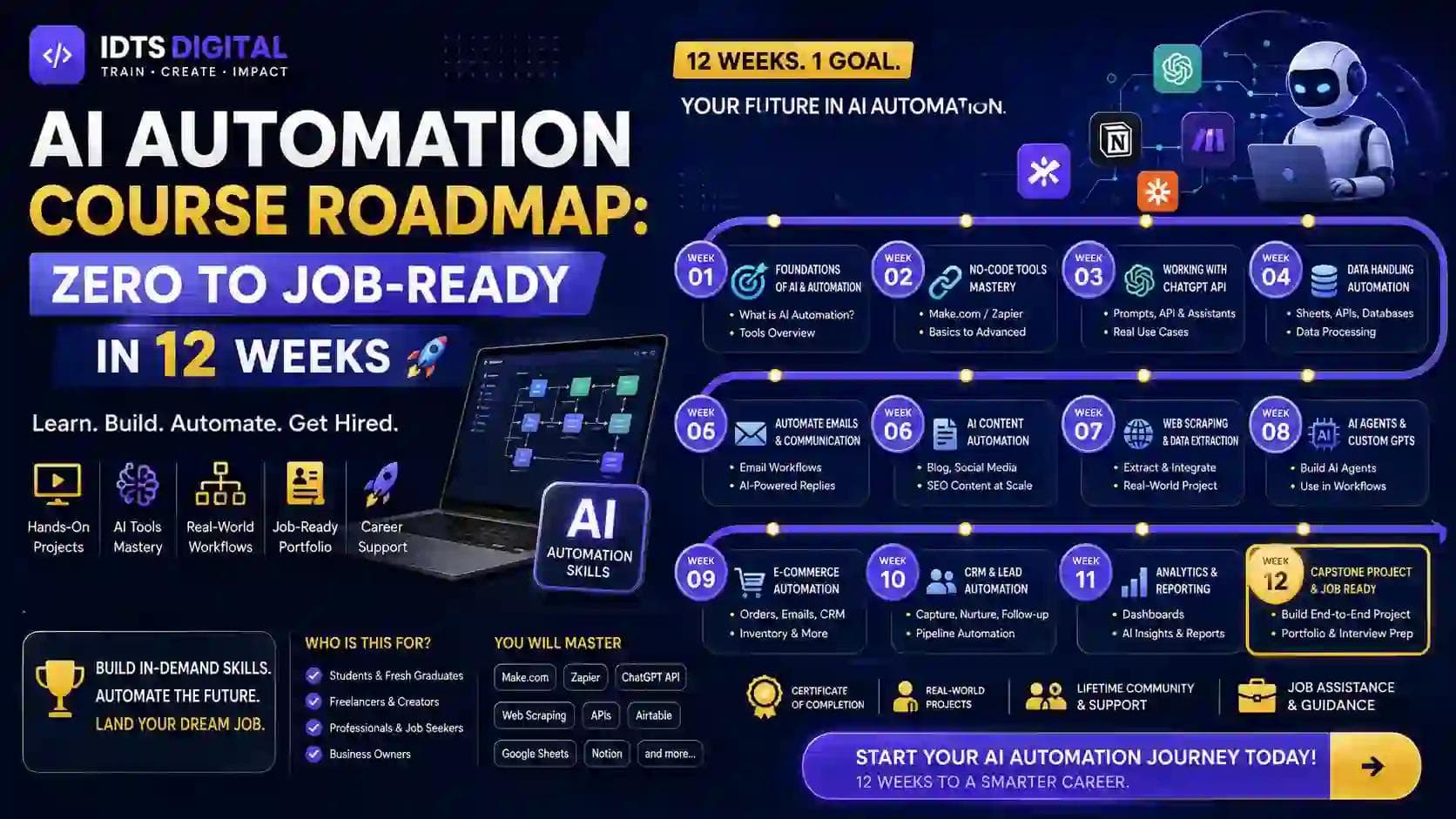
The 12-Week AI Automation Roadmap (Week by Week)
This is the heart of the course roadmap. It's designed to move from fundamentals to freelance-ready or job-ready skills in a structured, realistic timeline.
Weeks 1–2: Foundations and Mindset
You'll start with the basics — what automation actually is, how businesses use it, and how to think in "workflows" instead of manual steps. You'll also get comfortable with no-code and low-code tools, since most beginners don't need to write code on day one.
Weeks 3–4: Mastering Automation Platforms
This phase is hands-on. You'll build real workflows in Zapier and Make.com, connecting apps like Gmail, Google Sheets, Slack, and CRMs. By the end of week four, you should be able to automate a simple business process from start to finish — for example, automatically capturing a lead and sending a personalized follow-up.
Weeks 5–6: Introducing AI Agents and Prompt Engineering
Here's where things get exciting. You'll learn how to add AI decision-making into your workflows using AI agents, and how to write prompts that consistently produce useful, accurate outputs. This is also when most students start experimenting with chatbot automation for customer service.
Weeks 7–8: APIs, Python Basics, and n8n
This stage introduces slightly more technical skills — API integration and basic Python for automation. You'll also explore n8n, which gives you far more flexibility than no-code tools alone. Don't worry if coding feels intimidating; the goal is functional understanding, not software engineering mastery.
Weeks 9–10: Business Process Automation Projects
Now you apply everything to real business scenarios: automating invoicing, WhatsApp Business automation, CRM automation, and data pipeline automation. These projects become the backbone of your portfolio and the proof employers or clients will actually want to see.
Weeks 11–12: Portfolio, Freelancing, and Job Readiness
The final stretch focuses on packaging your skills. You'll build a professional automation portfolio, learn how to pitch automation services to clients, and prepare for job interviews or freelance platforms like Upwork and Fiverr. By week 12, you're not just "learned" — you're job-ready and client-ready.
This roadmap works whether you're aiming for a full-time automation role, freelance work, or starting your own automation agency. If you want a more visual breakdown of how this compares to related fields, our guide on AI agents vs chatbots vs workflows explains the differences in plain language.
Job Scope, Salary, and Demand for AI Automation Specialists
Automation and AI-related roles are consistently ranked among the fastest-growing job categories globally, and demand shows no sign of slowing in 2026. Here's what the job market actually looks like:
- Job titles to search for: Automation Engineer, AI Automation Specialist, Workflow Automation Consultant, RPA Developer, Automation Freelancer
- Where the jobs are: In-house roles at tech companies and agencies, remote freelance contracts, and consulting work for small-to-medium businesses
- Freelance potential: Automation freelancing is one of the highest-paying freelance categories right now, since businesses see automation as a direct ROI investment, not just a service expense
- Local demand: Automation services in Islamabad and Rawalpindi are growing steadily as local businesses digitize operations, creating openings for automation consultants and agencies based in the twin cities
Salaries vary widely depending on experience, location, and whether you're freelancing or employed, but automation specialists consistently earn more than general virtual assistants or basic marketers, simply because the skill directly saves businesses time and money.
If you're comparing this path to other tech careers, our breakdown of data analytics careers in Pakistan is a useful side-by-side reference for salary and demand trends.
Why Choose Idts Digital for Your AI Automation Training
There's no shortage of online courses promising to teach automation — but most stop at theory. What makes a program actually worth your time is whether it produces job-ready skills, not just certificates.
The AI Automation & AI Agents course at Idts Digital is built specifically around this 12-week roadmap, combining hands-on projects, real client-style workflows, and mentorship from instructors who actively deliver automation services to real businesses — not just teach from slides.
Here's what sets it apart:
- Practical, project-based learning instead of passive video watching
- Real business use cases, including CRM, WhatsApp, and chatbot automation
- Portfolio-building support so you graduate with proof, not just a certificate
- Career and freelancing guidance tailored to the Pakistani and international market
Students who want to go further after mastering automation fundamentals can also explore advanced digital and freelancing courses at Idts Digital, including complementary skills like digital marketing and web development that pair well with automation expertise.
How to Learn AI Automation: Free and Paid Resources
You don't have to choose only one path — the smartest learners combine free foundational resources with a structured paid course for accountability and depth.
Free resources to explore:
- Google's free AI and automation learning resources for foundational concepts
- Coursera's AI and automation courses from universities and industry leaders
- IBM's automation and AI resources for understanding enterprise-level use cases
- YouTube tutorials for specific tools like Zapier, Make.com, and n8n
Paid, structured learning:
- A cohort-based or self-paced AI automation course with mentorship, like the one offered at Idts Digital
- LMS-based platforms offering certificates and structured curriculums
Free resources are great for exploring the field, but they tend to be scattered and inconsistent. A structured, project-based course closes the gap between "I understand automation" and "I can confidently deliver automation projects for real clients." For a deeper primer on the underlying concepts, our guide to machine learning basics for non-tech people is a helpful starting point before diving into AI agents.
Real-World Examples of AI Automation in Action
Automation sounds abstract until you see it solving an actual problem. Here are examples students build during the course:
Customer Support Automation A business connects an AI chatbot to its website and WhatsApp Business account, so common customer questions get instant, accurate answers — day or night. Learn more in our guide to WhatsApp Business automation.
Lead Capture and CRM Automation When someone fills out a form, an automated workflow instantly adds them to a CRM, sends a welcome email, and notifies the sales team — no manual data entry required. See our full CRM automation guide for a deeper breakdown.
Content and Marketing Automation Businesses use ChatGPT-powered workflows to draft social captions, summarize customer feedback, or generate first-draft blog content. Our article on using ChatGPT for business covers practical applications.
Invoice and Data Automation Instead of manually generating invoices, an automated pipeline pulls order data, creates the invoice, and emails it to the client automatically.
These aren't hypothetical — they're the exact type of projects that fill an automation portfolio and convince employers or clients you can deliver real value.
Future Career Opportunities in AI Automation
The skills you build in this 12-week roadmap open several career paths, not just one:
- In-house Automation Specialist — working within a company's operations or marketing team
- Freelance Automation Consultant — taking on client projects independently
- Automation Agency Owner — building a team and offering automation as a service, similar to how digital marketing agencies operate
- AI Workflow Developer — a more technical role focused on building complex, multi-step automations using APIs and Python
- Automation Trainer or Educator — teaching others as the field continues to grow
Because automation touches nearly every department — sales, marketing, customer support, finance — the career ceiling is high, and the skill stays relevant even as specific tools change.
Automation Services in Islamabad and Rawalpindi: A Growing Local Market
The twin cities are becoming a genuine hub for digital services, and automation is one of the fastest-growing categories within it. Local businesses — from real estate agencies to online retailers — are actively looking for automation help to:
- Reduce time spent on repetitive admin tasks
- Respond to customers faster via automated chat and WhatsApp
- Streamline lead follow-up so no potential customer is missed
- Automate reporting and data entry across sales and finance teams
If you're based in Islamabad or Rawalpindi and considering this career path, the local advantage is real: fewer trained automation specialists means less competition and stronger demand for your services, whether you work locally or take on remote clients globally.
Frequently Asked Questions
What is AI automation? AI automation combines artificial intelligence with automated workflows so systems can complete tasks that require both action and decision-making, such as replying to customer inquiries or routing data intelligently, without constant human involvement.
Is AI automation a good career in 2026? Yes. Demand for automation specialists is rising across industries as businesses look to cut costs and improve efficiency, and the skill applies to both full-time employment and freelance work.
Do I need coding skills for AI automation? Not necessarily. Many automation tools like Zapier and Make.com are no-code, though learning basic Python and API integration opens up more advanced, higher-paying opportunities.
How long does it take to learn AI automation? With a structured plan, most beginners can become job-ready in about 12 weeks, especially when learning includes hands-on projects rather than just video lessons.
What is the difference between RPA and AI automation? Robotic Process Automation (RPA) follows fixed, rule-based steps, while AI automation adds reasoning and language understanding, allowing systems to handle more complex or unpredictable tasks.
Is AI automation in demand in Pakistan? Yes, particularly in cities like Islamabad and Rawalpindi, where businesses are increasingly outsourcing automation services to local freelancers and agencies instead of relying on manual processes.
Conclusion: Your Next Step Toward an AI Automation Career
AI automation isn't a passing trend — it's quickly becoming a baseline expectation for how modern businesses operate. Whether your goal is a stable in-house role, a freelance career with global clients, or eventually running your own automation agency, this 12-week roadmap gives you a clear, realistic path from complete beginner to job-ready professional.
The tools are accessible, the demand is real, and the earning potential — especially for automation services in Islamabad and Rawalpindi — continues to grow. The only real barrier is getting started with the right structure and guidance.
If you're ready to stop researching and start building real skills, book a seat in the Advanced AI Automation Course at Idts Digital and take your first step toward a job-ready automation career.