If you have spent any time researching AI automation for your business, you have probably run into three terms that get thrown around interchangeably: AI agents, chatbots, and workflows. They sound similar, they often work together, and marketers love mixing them up in sales pitches. But they are not the same thing, and picking the wrong one can waste your budget, frustrate your customers, and slow your team down instead of speeding it up.
This guide breaks down the real difference between AI agents and chatbots, where workflow automation fits into the picture, and how to decide what your business actually needs in 2026. Whether you are a startup founder in Karachi, a marketing manager in Lahore, or someone exploring an AI automation course in Islamabad to build a new career, this article will give you a clear, practical answer.
What Is an AI Agent?
An AI agent is a software system built on large language models (LLMs) that can understand a goal, break it into steps, make decisions, and take action across multiple tools without constant human input. Unlike older automation tools, an agent does not just follow a fixed script — it reasons through a problem the way a junior employee might, then executes the task.
For example, an AI agent tasked with "find the best supplier for packaging materials" could search the web, compare prices, check reviews, draft an email to three vendors, and log the responses in a spreadsheet — all on its own, adjusting its approach if something doesn't go as planned. This is often called agentic AI, and it represents one of the biggest shifts in business technology since the introduction of cloud software.
Key traits of AI agents include:
- Autonomous decision-making based on real-time context
- Ability to use multiple tools, APIs, and data sources in one task
- Memory of previous steps and context-aware AI reasoning
- Self-correction when a step fails
- Multi-step task automation without a rigid, pre-written path
Companies like OpenAI, Anthropic, and Google are investing heavily in this space, with ChatGPT agents, Anthropic Claude agents, and Google Gemini automation all pushing toward the same goal: software that can actually get work done, not just answer questions.
What Is an AI Chatbot?
An AI chatbot is a conversational tool designed to answer questions, guide users, or hold a conversation — usually within a defined scope. Most chatbots today use natural language processing (NLP) and conversational AI to understand user intent and respond in a human-like way, but they are fundamentally reactive. They wait for input, respond, and stop.
There are two broad categories:
Rule-based chatbots follow decision trees. If a customer types "refund," the bot follows a pre-set path: ask for order number, check policy, respond with a scripted answer. These are cheap, predictable, and limited.
AI-powered chatbots (like those built on GPT models) use generative AI tools to produce more natural, flexible responses. They understand context better and can handle a wider range of questions, but they still generally operate within a single conversation and do not independently execute multi-step tasks across systems the way an agent does.
Think of a chatbot as a very good receptionist. It can answer, direct, and inform — but it is not going to go book the meeting room, update the CRM, and send a calendar invite unless it is specifically wired to do those narrow, predefined actions.
What Is Workflow Automation?
Workflow automation is the backbone that most people forget to mention when comparing AI agents and chatbots. It refers to connecting apps and processes so that once a trigger happens, a set sequence of actions runs automatically — no AI reasoning required.
Tools like Zapier automation, Make.com (Integromat), and n8n automation are built exactly for this. A classic example: "When a new lead fills out a form, add them to the CRM, send a welcome email, and notify the sales team on Slack." This is intelligent process automation (IPA) or business process automation (BPA) — reliable, repeatable, rule-based, and fast.
Workflow automation does not think. It executes. This is precisely why it is still one of the most cost-effective forms of AI automation services for repetitive, high-volume business processes like CRM automation, lead generation automation, and email automation workflows.
AI Agents vs Chatbots vs Workflows: The Core Difference
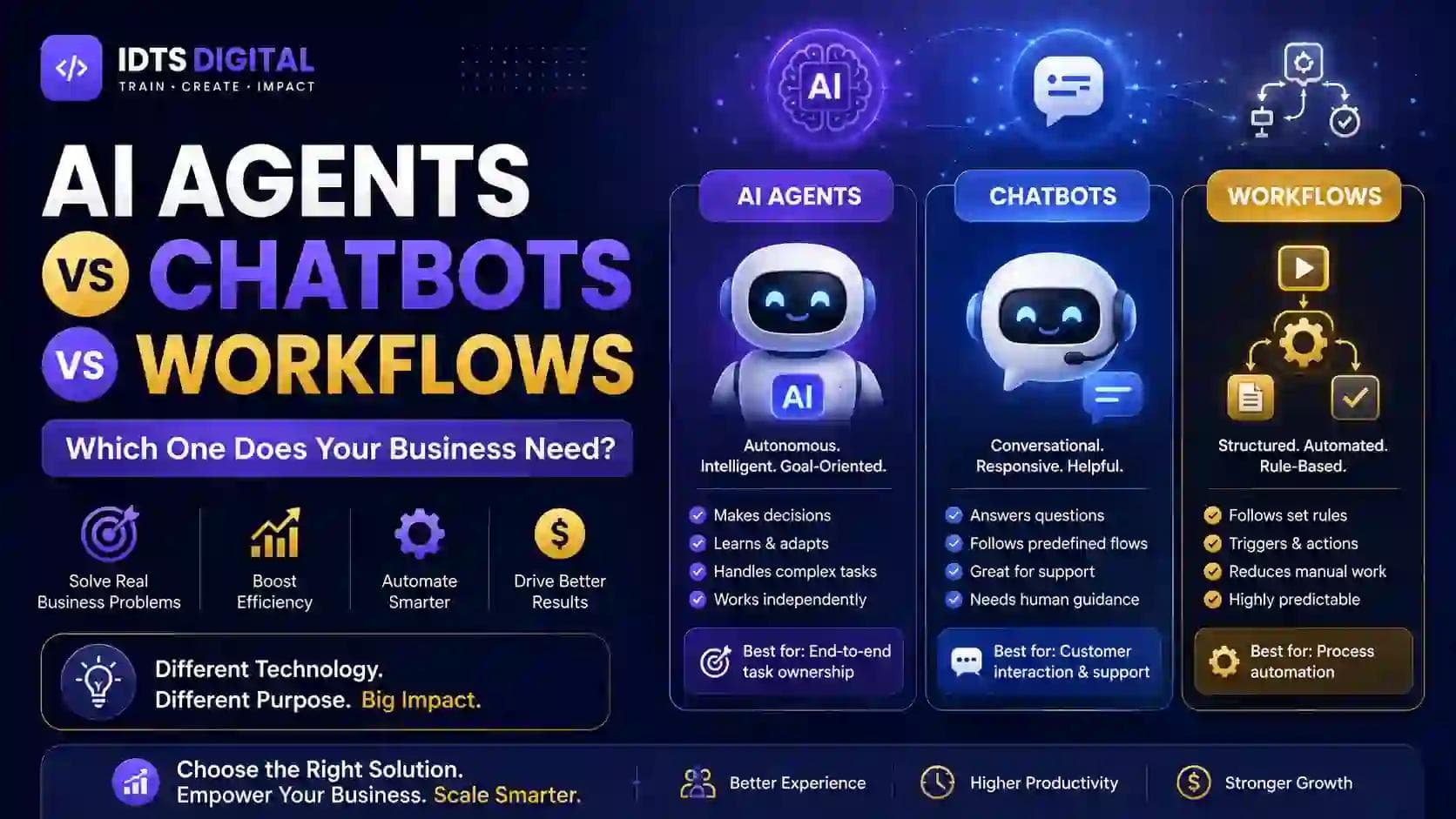
Here is the simplest way to understand AI agents vs chatbots vs workflows:
- Workflows follow a fixed path. Great for repetitive, rule-based tasks.
- Chatbots hold a conversation and answer questions. Great for support and engagement.
- AI agents reason, decide, and act across multiple steps and tools. Great for complex, judgment-based tasks.
A helpful analogy: a workflow is a train on fixed tracks — fast and reliable, but it can't leave the rails. A chatbot is a tour guide who answers your questions at a fixed exhibit. An AI agent is closer to a personal assistant who can plan the entire trip, adjust when plans change, and make decisions along the way.
According to research from IBM on AI agents, autonomous agents are increasingly being layered on top of both chatbots and workflow tools, creating hybrid systems where the agent acts as the "brain" coordinating simpler tools underneath it. This is the direction most serious businesses are heading in 2026 — not choosing one over the other, but combining them strategically.
AI Agent vs Automation: Are They the Same Thing?
Not quite. This is one of the most searched long-tail keywords in this space, and for good reason — the line is blurry.
Traditional automation (including robotic process automation or RPA) executes fixed rules. It cannot handle exceptions it wasn't programmed for. An AI agent, by contrast, can encounter an unexpected situation — a missing field, an ambiguous customer request, a broken link — and figure out a reasonable next step using its own reasoning, often with human-in-the-loop automation for approval on higher-risk actions.
In short: automation follows instructions. AI agents interpret goals.
Chatbot vs Virtual Assistant: Another Common Confusion
A virtual assistant (like Siri, Alexa, or a business-specific AI copilot) usually sits between a chatbot and a full AI agent. It can answer questions and, in more advanced versions, complete simple actions like setting reminders or checking a calendar. But most virtual assistants still lack the deep, autonomous, multi-tool reasoning that defines a true AI agent.
Which One Does Your Business Actually Need?
This is the question that matters most, and the honest answer is: it depends on the task, not the trend.
Choose a Chatbot If:
- You need 24/7 customer support for common questions
- Your queries are largely predictable (order status, pricing, hours, FAQs)
- You want to reduce response time without hiring more support staff
- Budget is limited and you need a fast, low-cost deployment
Choose Workflow Automation If:
- You have repetitive, multi-app processes (lead capture, invoicing, onboarding)
- The steps rarely change and don't require judgment calls
- You want to eliminate manual data entry and human error
- You need something reliable that runs the same way every single time
Choose an AI Agent If:
- Tasks require research, comparison, or decision-making
- You need something to operate across multiple tools and adapt in real time
- Your team spends hours on tasks that involve judgment (vendor sourcing, content research, complex scheduling, personalized outreach)
- You are ready to invest in a more advanced, forward-looking automation setup
Most growing businesses in Pakistan and globally are now using a hybrid model: workflows handle the repetitive backend tasks, chatbots manage front-line customer conversations, and AI agents oversee the more complex decision points connecting the two. If you want a deeper breakdown of how this hybrid approach works in practice, our guide on AI business automation walks through real implementation examples.
Why This Matters More in Pakistan Right Now
Pakistan's digital economy is growing fast, and businesses in Islamabad, Rawalpindi, Lahore, and Karachi are under real pressure to modernize customer service, marketing, and operations without massively increasing headcount. AI automation services are no longer a luxury reserved for large multinational companies — small and medium businesses are adopting them to compete.
A local retail brand in Lahore might use a chatbot for WhatsApp customer queries. A logistics company in Karachi might use workflow automation to sync orders between their website and delivery partners. A digital agency in Islamabad might deploy an AI agent to handle client research and reporting. The needs are different, but the underlying opportunity is the same: businesses that adopt the right automation tool at the right stage grow faster with fewer resources.
This is also why demand for a solid AI automation course has exploded across Pakistan. Employers are actively looking for people who understand how to build, configure, and manage these systems — not just use them.
Key Skills You Need to Work With AI Agents, Chatbots, and Automation
If you're considering a career in this field or want to upskill your team, here are the core competencies worth learning:
- Prompt engineering for LLMs and generative AI tools
- Understanding of APIs and API integrations for automation
- Hands-on experience with Zapier, Make.com, and n8n automation
- Basics of Python for custom automation scripts
- CRM and email automation workflow design
- Familiarity with Microsoft Copilot Studio and Google Gemini automation
- Prompt-based chatbot building and conversational AI design
- Data handling, logic building, and no-code automation tools
You don't need to be a full-stack developer to enter this field. Many of today's most in-demand automation specialists come from marketing, operations, or customer service backgrounds and simply added AI and automation skills on top of what they already knew.
Job Scope, Salary, and Demand in 2026
The demand for AI automation skills has grown rapidly across freelancing platforms and corporate job boards alike. Roles like AI automation engineer, automation specialist, chatbot developer, and prompt engineer are now regularly listed by companies across Pakistan and internationally on platforms like Upwork and Fiverr.
Freelancers offering AI automation services — building chatbots, setting up workflow systems, or configuring AI agents for international clients — are earning competitive rates compared to traditional digital marketing or web development freelancing, largely because the skill is still relatively new and in short supply. Local job listings for "AI automation jobs in Pakistan" have increased steadily as more companies realize the operational cost savings automation delivers.
Beyond freelancing, in-house roles are opening up too. Startups, digital agencies, e-commerce brands, and even traditional businesses moving online are hiring people who can set up their CRM automation, WhatsApp business automation, and internal AI workflows. If you want a practical look at how businesses are already using this technology to save time, our article on how ChatGPT can help businesses save hours is a good starting point.
Real-World Examples of AI Agents, Chatbots, and Workflows in Action
Chatbot example: An online clothing store in Karachi uses an AI chatbot on its website and WhatsApp to answer sizing questions, track orders, and recommend products based on customer replies — cutting support response time from hours to seconds.
Workflow automation example: A recruitment agency automates its hiring pipeline — every time a candidate applies, their resume is automatically scored, added to a spreadsheet, and a confirmation email is sent, with no manual intervention needed for routine applications.
AI agent example: A digital marketing agency deploys an AI agent that researches competitor ad campaigns, drafts a report comparing pricing and messaging strategies, and emails a summary to the account manager every Monday morning — a task that used to take a junior analyst several hours each week.
These aren't futuristic concepts. According to Coursera's overview of AI in business, organizations across every industry are already integrating these systems into daily operations, and the trend is accelerating heading into 2026 and beyond.
How to Learn AI Automation (Free and Paid Resources)
If this article has sparked your interest in learning how to build and manage these systems yourself, here's how to approach it:
Free resources:
- YouTube tutorials on Zapier, Make.com, and n8n basics
- Google's own documentation on AI and machine learning fundamentals
- Free introductory content on prompt engineering from OpenAI and Anthropic
- Our blog post on machine learning basics for non-tech professionals, which breaks down core AI concepts in plain language
Paid, structured learning: A structured AI automation course will save you significant time compared to piecing together free tutorials, especially if it includes hands-on projects, mentorship, and real client-style assignments. This is exactly why the AI Automation & AI Agents course at Idts Digital was built — to take students from zero knowledge to building functional chatbots, workflows, and AI agents they can actually use for freelancing or in-house roles.
Why Choose Idts Digital
If you're searching for an AI automation course in Islamabad, Rawalpindi, Lahore, or Karachi, Idts Digital stands out for a simple reason: the training is built around real business use cases, not just theory. Students don't just learn what an AI agent is — they build one, connect it to real tools, and learn how to package it as a service they can sell.
The institute also offers hands-on AI automation services for businesses that want to implement these systems directly rather than build them in-house, along with a wider range of digital skills courses covering everything from SEO to full-stack development — useful if you want to combine automation skills with a broader digital career path.
What makes the training genuinely useful is the focus on practical outcomes: portfolio-ready projects, mentorship from instructors with real agency experience, and guidance on how to position these new skills for freelancing or job applications. This aligns closely with EEAT principles that both Google and AI search engines now prioritize — real experience, real expertise, and real-world authority, not just recycled theory.
Automation Services in Islamabad, Lahore, Karachi, and Rawalpindi
Beyond training, many businesses simply want the automation built for them rather than learning to build it themselves. Whether you're running a retail store in Lahore, a service business in Rawalpindi, an e-commerce brand in Karachi, or a startup in Islamabad, automation services can be tailored to your specific operations:
- WhatsApp and website chatbot setup for customer support
- CRM and lead automation so no inquiry falls through the cracks
- Email marketing workflows that nurture leads without manual follow-up
- Custom AI agents for research, reporting, or content workflows
If you'd rather have this built for you than build it yourself, you can explore AI automation services here or reach out directly through the contact page to discuss what your business specifically needs.
The Future of AI Agents in Business
Analysts widely agree that agentic AI is the next major phase of business software. Rather than logging into ten different apps, business owners are expected to increasingly rely on AI agents that operate across systems on their behalf — checking inventory, negotiating with suppliers, managing schedules, and even handling first-pass customer service escalations before involving a human.
This doesn't mean chatbots and workflows are going away. If anything, they are becoming the "hands and ears" that AI agents coordinate. A well-built business automation stack in 2026 and beyond will likely include all three working together: workflows for repetitive backend tasks, chatbots for front-line conversations, and AI agents managing the more complex decision-making layered on top.
For businesses and professionals alike, the opportunity is clear: those who understand how to design, combine, and manage these systems — rather than treating them as separate, competing tools — will have a real competitive advantage.
Frequently Asked Questions
What is the difference between an AI agent and a chatbot? A chatbot responds to messages within a conversation, while an AI agent can reason through a goal, take multiple actions across different tools, and adapt when something changes — without needing a human to guide every step.
Are AI agents better than chatbots? Not necessarily — they solve different problems. Chatbots are better for simple, high-volume customer conversations, while AI agents are better for complex, multi-step tasks that require judgment and coordination across systems.
What is workflow automation in business? Workflow automation connects different apps and tasks so that a trigger (like a new form submission) automatically runs a fixed sequence of actions, such as updating a CRM or sending an email, without human involvement.
Do I need an AI agent or a chatbot for my business? If your main need is answering customer questions quickly, start with a chatbot. If you need something to research, decide, and execute multi-step tasks across tools, an AI agent is the better fit.
Is an AI agent the same as RPA? No. RPA (robotic process automation) follows fixed, pre-programmed rules and cannot handle exceptions. AI agents use reasoning to adapt to new or unexpected situations in real time.
Is an AI automation course worth it in 2026? Yes, given the rising demand for automation specialists across freelancing platforms and businesses in Pakistan and globally, a structured, hands-on course can significantly shorten the learning curve compared to self-teaching.
Final Thoughts and Next Steps
Choosing between AI agents vs chatbots vs workflows isn't about picking a winner — it's about matching the right tool to the right task. Chatbots handle conversations. Workflows handle repetition. AI agents handle complexity and judgment. The businesses that understand this distinction, and combine these tools strategically, are the ones pulling ahead in 2026.
If you're ready to move from reading about AI automation to actually building it — whether for your own business or as a new career path — the AI Automation & AI Agents course at Idts Digital is designed to take you there step by step, with real, practical projects along the way.
Book your seat in the Advance Digital Courses offered by Idts Digital today, and start building the skills that are already reshaping how businesses in Islamabad, Rawalpindi, Lahore, and Karachi operate.