





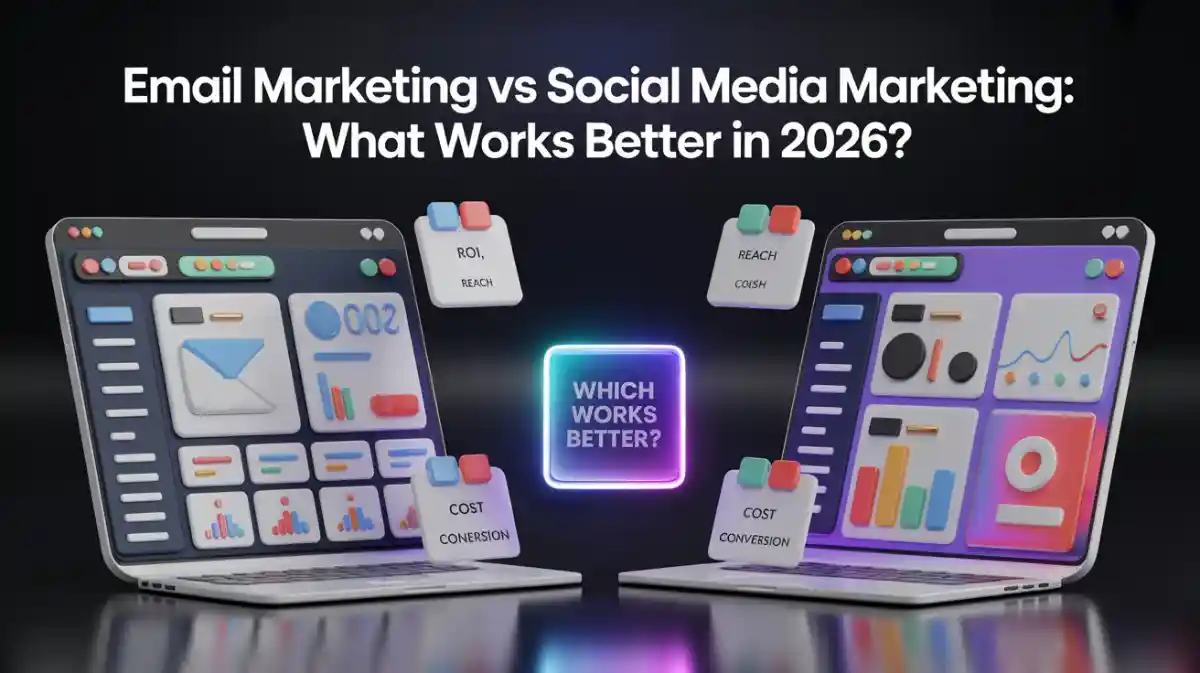
You’ve got a product to sell, a brand to build, and a limited amount of time and money. So the question hits you hard: should you pour your energy into growing an email list or building a social media following?
This isn’t a small decision. The marketing channel you prioritize will shape your revenue, your audience relationship, and your long-term business growth. And the honest answer — backed by real data — might surprise you.
In this complete pillar guide, we compare email marketing vs social media marketing across every metric that actually matters: ROI, reach, engagement, cost, conversions, and long-term sustainability. Whether you’re a small business owner in Pakistan, a freelancer, an ecommerce brand, or a B2B company, this guide will give you a clear, actionable answer.
What Is Email Marketing and Why Does It Still Matter?
Email marketing is a direct, permission-based communication channel where you send targeted messages to people who have voluntarily subscribed to hear from you. It’s one of the oldest digital marketing channels — and still one of the most powerful.
When someone gives you their email address, they’re saying: “I trust you enough to invite you into my inbox.” That’s a level of consent and intimacy that no social media platform can replicate.
Common email marketing formats include:
- Welcome email sequences for new subscribers
- Weekly or monthly newsletters with valuable content
- Promotional campaigns for sales, launches, and offers
- Drip campaigns — automated sequences that nurture leads over time
- Abandoned cart recovery emails for ecommerce stores
- Re-engagement campaigns for inactive subscribers
- Post-purchase follow-up and upsell sequences
The real power of email marketing lies in one critical concept: your email list is an owned media asset. You own it completely. No algorithm can limit who sees your message. No platform can suspend your account and wipe out years of audience building overnight. That’s the foundation of every serious digital marketing strategy.
For a broader understanding of how email fits into the full digital marketing landscape, read the complete Digital Marketing Guide for Pakistan 2026 — it covers every major channel and how they work together.
What Is Social Media Marketing and What Can It Actually Do?
Social media marketing is the practice of using platforms like Facebook, Instagram, TikTok, LinkedIn, YouTube, and X (formerly Twitter) to promote your brand, build an audience, and drive traffic or sales.
It covers everything from organic content and community engagement to paid social media advertising, influencer marketing partnerships, and real-time brand storytelling.
Social media marketing works brilliantly for:
- Building brand awareness at scale
- Community building and two-way engagement
- Visual storytelling through reels, stories, and short-form video
- Influencer marketing campaigns and user-generated content
- Viral marketing moments that can reach millions overnight
- Top-of-funnel lead generation and product discovery
- Driving traffic to landing pages, blog posts, or product pages
But here’s what most people don’t talk about openly: social media is built on rented land. Your followers on Instagram, TikTok, or Facebook don’t actually belong to you. They belong to the platform. One algorithm update — and these platforms change their algorithms constantly — can cut your organic reach by 80% in a single day.
This platform dependency risk is the most underrated threat in social media marketing, and it’s exactly why the smartest marketers use social media as a tool to build their email list, not as a replacement for it.
For a deep dive into how social media fits into a complete small business strategy, visit Social Media Marketing Strategies for Small Business — one of the most practical guides on the IDTS Digital blog.
Email Marketing vs Social Media Marketing: Head-to-Head Comparison
Let’s get into the real comparison. Here’s how these two channels stack up across every metric that matters.
ROI — Which Channel Actually Generates More Revenue?
ROI is the number that matters most to any business owner, and the data here is decisive.
Email marketing delivers an average return of $36 to $42 for every $1 spent, according to research from Litmus and the Data & Marketing Association. That makes it one of the highest ROI marketing channels available anywhere in digital marketing.
Social media marketing ROI varies enormously and is much harder to measure directly. It performs well for brand awareness and top-of-funnel traffic, but the conversion rates are typically lower than email. Paid social media ads can deliver strong ROI when optimized correctly — but costs are rising year over year on every major platform.
If your primary goal is direct revenue and measurable return on investment, email marketing wins decisively. If your goal is reach, awareness, and community, social media earns its place.
Reach — How Many People Actually See Your Message?
On the surface, social media looks like it wins on reach. There are nearly 5 billion social media users worldwide. But raw user numbers are misleading. What actually matters is how many of your own audience sees what you publish.
Here’s the reality in 2025:
- Average email open rate: 21–40% depending on your industry and list quality
- Average organic Facebook reach: approximately 2–5% of your page followers
- Average organic Instagram reach: approximately 3–6% of your followers
- Average organic TikTok reach: higher but highly unpredictable
If you have 10,000 email subscribers and 10,000 Instagram followers and you send a message to both groups, your email will reach 2,000 to 4,000 people. Your Instagram post will reach maybe 300 to 600 people organically.
Email wins on guaranteed, predictable reach. Social wins on potential viral reach — but that’s never guaranteed.
Engagement — Which Channel Gets More Attention?
Email marketing engagement is intimate and intent-driven. A person opens your email because they chose to. Average email click-through rates range from 2–5%, and those clicks represent people who are actively interested and moving through your marketing funnel.
Social media engagement is more public and community-oriented. Likes, comments, shares, and saves happen in a social environment where peer influence plays a major role. Engagement on social feels exciting — but most of it doesn’t translate directly into conversions.
The key difference is intent. Someone clicking a link in your email is usually closer to making a decision. Someone liking your Instagram post is often still in discovery mode.
Cost — Email Marketing vs Social Media for Small Business Budgets
For businesses watching their marketing spend carefully, email marketing is significantly more cost-effective.
A quality email marketing platform like Mailchimp, ConvertKit, Brevo, or ActiveCampaign costs between $20 and $150 per month for lists under 10,000 subscribers. You can send unlimited or near-unlimited emails to your list for a fixed monthly cost. As your list grows, your cost per conversion actually decreases.
Social media organic reach costs nothing upfront — but the time investment is enormous and the returns are unpredictable. Paid social media ads can be effective but costs per result on Facebook and Instagram have increased significantly, making them harder to justify for businesses with tight budgets.
For small business owners — whether in Pakistan, India, the UK, or the USA — email marketing gives more control and more consistent ROI per rupee or dollar spent.
Audience Ownership — The Most Important Difference Nobody Talks About
This is the factor that separates professional marketers from beginners.
Your email list is owned media. It’s your asset. You can export it, move it between platforms, and use it however you want for as long as you want. Nobody can take it from you.
Your social media following is rented media. You’re building your audience on someone else’s platform, under their rules, subject to their algorithm changes, their content policies, and their business decisions. Accounts get suspended. Platforms lose popularity. Algorithms get updated. Businesses that built their entire audience on Facebook in 2012 and ignored email found this out the hard way when organic reach collapsed.
The concept of platform dependency risk is real and it affects businesses of every size. Diversifying your marketing channels and owning your audience through an email list is the single smartest long-term marketing decision any business can make.
Email Marketing vs Social Media for Different Business Types
The right channel depends heavily on what kind of business you’re running and what your goals are. Here’s how the comparison breaks down by business type.
Email Marketing vs Social Media for Ecommerce
For ecommerce stores, email marketing is the dominant revenue driver. Abandoned cart email sequences alone recover an average of 5 to 15% of otherwise lost sales. Welcome sequences, product launch campaigns, post-purchase follow-ups, and seasonal promotional campaigns generate consistent, trackable revenue.
Social media plays an important role in product discovery — especially on visually-driven platforms like Instagram, TikTok, and Pinterest — but ecommerce businesses consistently find that email converts at a significantly higher rate than social traffic.
If you’re running an ecommerce business, a comparison of your platform options is essential. Read the Shopify vs WooCommerce Comparison 2026 to understand which platform gives you the best email marketing integration for your store.
Email Marketing vs Social Media for B2B
In B2B marketing, email marketing and LinkedIn are the two most important channels, and they work best when used together.
Cold email outreach, nurture sequences, and automated follow-up campaigns form the backbone of most B2B lead generation strategies. LinkedIn is ideal for thought leadership, professional relationship building, and reaching decision-makers organically.
For B2B companies, combining LinkedIn for awareness with email for nurturing and conversion is the proven formula. This is also why CRM integration matters so much — check out the CRM Automation Guide for Business 2026 to see how automating your email and CRM workflow can transform your B2B pipeline.
Email Marketing vs Social Media for Small Business in Pakistan
In Pakistan’s digital marketing landscape, social media — particularly Facebook, Instagram, TikTok, and WhatsApp — dominates consumer engagement. The platforms are highly active, CPMs are lower than Western markets, and users are deeply engaged.
However, email marketing in Pakistan is dramatically underutilized, which creates a significant competitive opportunity for businesses that start building their lists now. As Pakistan’s ecommerce and digital economy continues to grow, owned-media channels like email will become increasingly valuable.
The smart strategy for Pakistani small businesses: use social media for brand awareness and audience growth, then convert followers into email subscribers for long-term nurturing and revenue generation.
Email Marketing vs Social Media for SaaS
SaaS companies depend on email marketing for their entire customer lifecycle. Onboarding sequences, feature announcement emails, upgrade campaigns, trial expiration reminders, and churn prevention emails are all delivered via email. It’s not just a marketing tool for SaaS — it’s a core product experience.
Social media for SaaS is primarily a brand awareness and thought leadership play, with LinkedIn being the dominant platform for B2B SaaS and Twitter/X for developer-focused products.
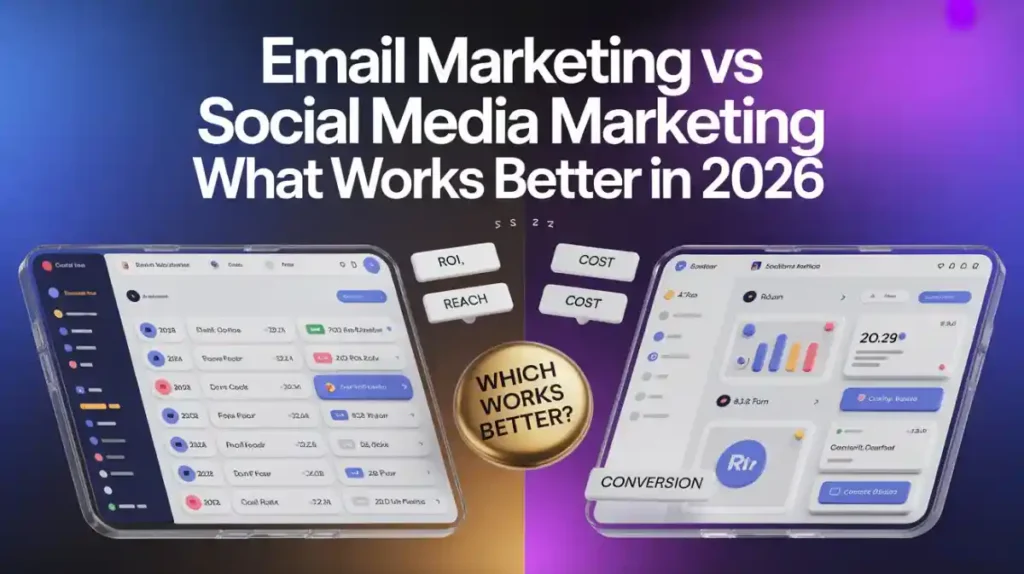
Email Marketing vs Social Media Marketing: Pros and Cons Side by Side
Understanding the advantages and disadvantages of both channels helps you make smarter decisions about where to invest your time and budget.
Email marketing advantages include the highest direct ROI of any digital channel, complete ownership of your audience, deep personalization through audience segmentation and email list segmentation, excellent customer retention capabilities, powerful marketing automation for scalable outreach, algorithm-independent reach that you control, and clear, measurable analytics including open rate, click-through rate, and conversion rate.
Email marketing disadvantages include the time required to build a quality subscriber list, the risk of emails landing in spam folders due to deliverability issues, the need for consistent high-quality content to keep unsubscribe rates low, and potential intrusiveness if campaigns are poorly executed.
Social media marketing advantages include massive potential reach and the possibility of viral marketing exposure, outstanding effectiveness for brand awareness and content discovery, powerful community building and social proof development, real-time marketing opportunities and trend participation, access to influencer marketing partnerships, user-generated content amplification, and rich visual storytelling through video, reels, and stories.
Social media marketing disadvantages include declining organic reach on most major platforms year over year, high platform dependency risk from algorithm changes and policy updates, the constant demand for fresh content creation and daily engagement, difficulty measuring direct ROI accurately, rising costs for paid social media advertising, and the absence of any guarantee that your content reaches your own followers.
How to Combine Email Marketing and Social Media for Maximum Results
The most important insight in this entire guide is this: the email marketing vs social media debate is a false choice. The most effective digital marketing strategy in 2025 uses both channels in an integrated, omnichannel marketing approach where each channel amplifies the other.
Here’s the framework that works:
Use social media to build your email list. Run lead generation campaigns on Facebook, Instagram, and TikTok. Offer a genuinely valuable lead magnet — a free guide, checklist, template, discount code, or mini-course — in exchange for an email address. This turns social media followers (rented audience) into email subscribers (owned audience).
Use email to nurture and convert. Once someone joins your list, you own that relationship. Send them valuable content, build trust through drip campaigns, and guide them toward becoming paying customers through a well-designed marketing funnel.
Use your email list for social media retargeting. Upload your subscriber list as a custom audience on Facebook and Instagram to run highly targeted remarketing campaigns to people who already know your brand. This is one of the most cost-effective paid advertising strategies available.
Repurpose your best email content on social media. Turn your most valuable email newsletters into LinkedIn articles, Instagram carousel posts, TikTok scripts, or YouTube video ideas. One great piece of content, distributed across multiple channels.
Use social listening to improve your email strategy. Pay attention to what your audience talks about, shares, and responds to on social media. Use those insights for better email list segmentation, more relevant personalization, and more engaging campaign ideas.
This multi-channel marketing approach consistently outperforms relying on either channel alone. For a complete look at how automation can power this entire system, the AI Business Automation Guide 2026 is required reading — it covers how modern businesses are automating both email sequences and social media workflows using AI tools.
Email Marketing vs Social Media: 2025 Statistics That Settle the Debate
Numbers cut through opinions. Here’s what the data actually shows:
Email marketing delivers $36 to $42 ROI per $1 spent according to Litmus 2024 industry research. There are over 4.37 billion email users globally in 2025. The average email open rate across industries sits between 21 and 35%. Email is approximately 40 times more effective at acquiring new customers than Facebook or Twitter according to McKinsey research. 99% of email users check their inbox at least once per day according to OptinMonster. Average organic Facebook reach has dropped to approximately 2 to 5% of page followers. 81% of B2B marketers report email newsletters as their most consistently used content marketing format. Abandoned cart email sequences recover between 5 and 15% of otherwise lost ecommerce revenue.
For context on how these metrics compare to paid advertising channels, the Google Ads vs Facebook Ads 2026 Comparison provides an excellent companion analysis.
Which Marketing Channel Has the Highest ROI in 2025?
When businesses ask which digital marketing channel delivers the best return on investment, here is what the data and industry consensus consistently shows:
Email marketing leads on direct conversion ROI. SEO and organic search leads on long-term compounding ROI — and if you haven’t read the SEO 2026 Google Ranking Guide yet, it’s an essential resource for understanding how search and email work together. Content marketing delivers strong long-term returns through compounding traffic. Paid search via Google Ads works well for high-intent, bottom-of-funnel traffic. Social media marketing excels at awareness and discovery but typically delivers lower direct conversion ROI. Display advertising generally produces the lowest direct ROI of the major channels.
Understanding ROI in digital marketing means looking beyond immediate returns to lifetime customer value, customer retention rates, and marketing cost per acquisition across the full customer journey. Tracking all of this properly requires solid analytics — the Google Analytics 4 Guide for Beginners 2026 walks you through exactly how to set up conversion tracking for both email and social campaigns.
How to Learn Email Marketing and Social Media Marketing in Pakistan
If you’re serious about building a career or a business around these skills, formal training makes an enormous difference. Understanding campaign strategy, email automation tools, social media advertising, audience segmentation, and marketing attribution is not something you pick up from YouTube videos alone.
IDTS Digital offers Pakistan’s most practical, career-focused Advanced Digital Marketing Course that covers email marketing campaigns, social media marketing strategy, content marketing, SEO, paid advertising, and marketing automation — all taught by working practitioners with real-world experience.
Whether you’re a student, a freelancer looking to expand your services, or a business owner who wants to run your own campaigns, the course at best digital marketing gives you the hands-on skills and the portfolio to compete in today’s market.
You can also explore the full range of digital marketing services available and see exactly how professional campaigns are structured and executed.
For those interested in how data and analytics drive smarter marketing decisions, the Data Analytics Career Pakistan 2026 Guide is an excellent next step — because the marketers who win in 2025 and beyond are the ones who understand their numbers.
Frequently Asked Questions
Is email marketing dead in 2025? No. Email marketing is not dead — it’s arguably stronger than ever. With over 4.3 billion daily email users and an average ROI of $36 to $42 per $1 spent, email remains the highest-converting owned marketing channel available to businesses of any size. It’s underused, not outdated.
Which is better — email marketing or social media marketing? For direct revenue, customer retention, and audience ownership, email marketing wins. For brand awareness, content discovery, and community building, social media marketing wins. The most effective strategy in 2025 uses both channels together in an omnichannel approach — with social media feeding your email list and email converting your audience into customers.
What is a good email marketing ROI? Industry benchmarks place average email marketing ROI at $36 to $42 per $1 spent. A well-optimized ecommerce email sequence can deliver 500 to 1000%+ ROI. Campaign-specific ROI of 300 to 500% is considered solid performance across most industries.
Does social media replace email marketing? No — and it never will. Social media is a rented channel where the platform controls your access to your audience. Your email list is owned media that no algorithm, policy change, or platform shutdown can take away. Smart marketers use social media to grow their email list, not replace it.
What is the average email open rate? The average email open rate across all industries in 2025 is approximately 21 to 35%, though it varies significantly by niche. B2B and educational content can achieve 30 to 45% open rates with well-segmented lists. Ecommerce typically sees 15 to 22%. Personalization and strong subject lines are the biggest drivers of open rate improvement.
How do I grow my email list using social media? Create a genuinely valuable lead magnet — a free guide, discount code, exclusive checklist, or mini-course. Promote it through your social media posts, stories, and paid lead generation ads. Send traffic to a dedicated landing page with a simple signup form. Once someone is on your list, deliver consistent value so they stay engaged and refer others.
Which is cheaper — email marketing or social media marketing? At scale, email marketing is consistently more cost-effective. A quality email platform costs $20 to $150 per month and lets you reach your full list directly. Social media organic reach requires constant unpaid effort and is declining. Paid social ads are effective but costs are rising — making email the better long-term investment for businesses with limited budgets.
Can email marketing and social media work together? Absolutely — and they should. Use social media to build your list, use email to convert and retain customers, use your email list as a custom audience for social retargeting, and repurpose your best email content across social platforms. This integrated multi-channel marketing strategy consistently outperforms either channel used in isolation.
Conclusion: Stop Choosing. Start Combining.
Here’s the direct answer to the question this entire guide set out to answer:
Email marketing wins on ROI, conversions, audience ownership, and long-term reliability. Social media marketing wins on reach, brand awareness, community, and content discovery. They are not competitors — they are complementary tools in a complete digital marketing strategy.
If you’re forced to choose just one because of budget or bandwidth: start with email marketing. Build your list. Own your audience. The returns compound over time and no algorithm can threaten what you’ve built.
If you have the capacity for both — and most businesses do once they build the right systems — use social media to grow your email list and use email to convert that audience into loyal, paying customers. That’s the omnichannel marketing approach that successful digital businesses run in 2025.
The businesses that will dominate in the next five years are the ones building owned media assets today. Your email list is the most valuable, most protected, most profitable owned asset in digital marketing. Start building it now.
And if you want to learn how to do all of this professionally — from email campaign strategy and automation to social media advertising and analytics — book your seat in the Advanced Digital Marketing Course at IDTS Digital and build the skills that businesses are actively hiring and paying for right now.
Explore all courses and services and take the first real step toward building a digital marketing career or scaling your business online.

1 Comment
[…] Email Marketing Newsletter campaigns, automated drip sequences, and lead nurturing flows. For a strategic breakdown of how email compares to social media: Email vs Social Media Marketing — Complete 2026 Guide. […]