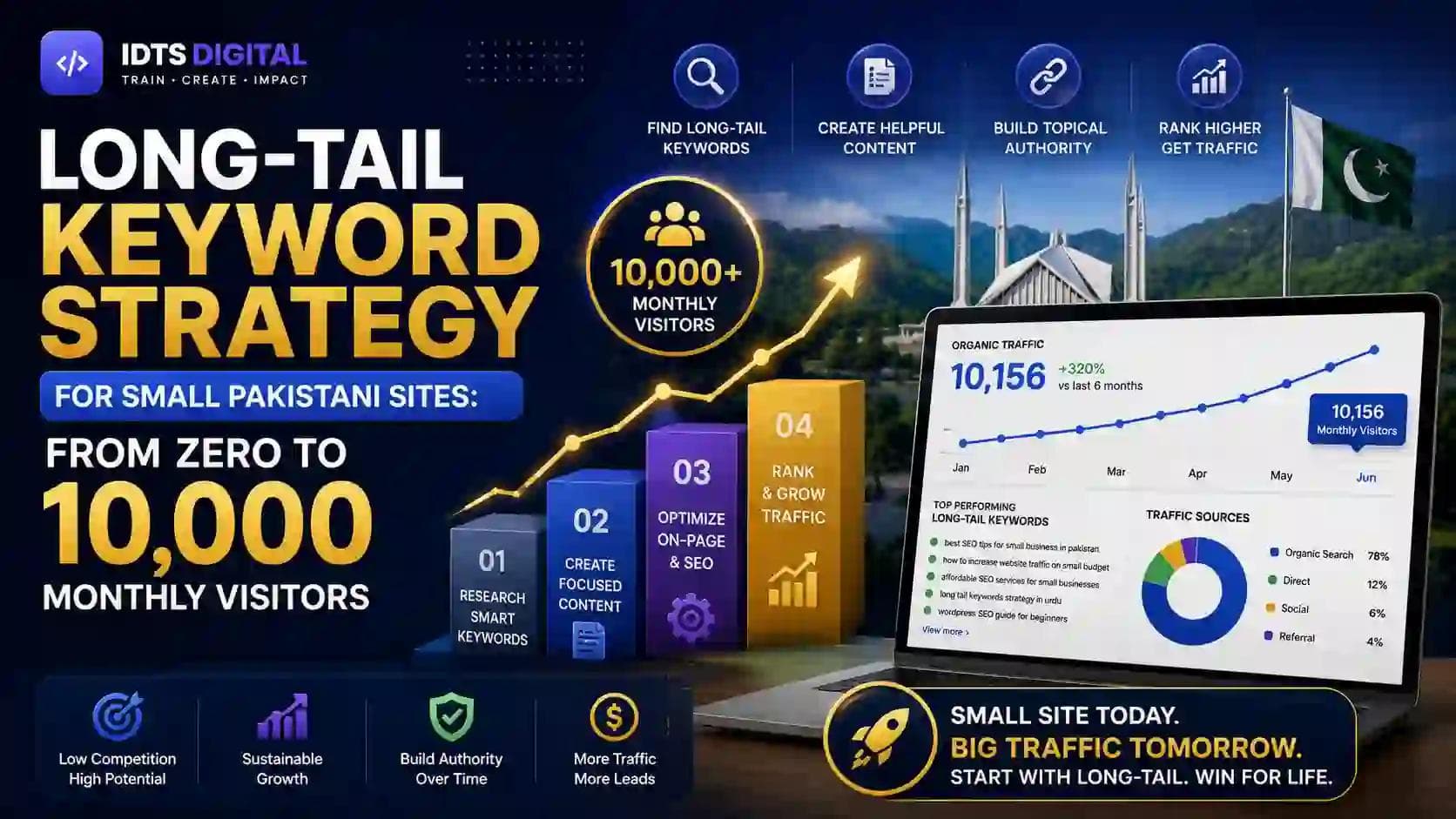
If you're running a small website in Pakistan and struggling to get past a handful of daily visitors, you're not alone. Most new sites chase big, competitive keywords like "SEO services" or "digital marketing" and wonder why nothing moves. The real growth engine for small and local Pakistani websites isn't the big keywords — it's the long tail.
This guide breaks down exactly how long-tail keywords work, why they're the fastest realistic path from zero traffic to 10,000 monthly visitors, and how to build a keyword strategy that works for Google's traditional rankings, AI Overviews, and answer engines like ChatGPT search. Whether you run a local service business in Islamabad, an online store, or a blog, this framework applies.
What Are Long-Tail Keywords (And Why They're Your Biggest Opportunity)
A long-tail keyword is a longer, more specific search phrase — usually three or more words — that has lower search volume but much higher intent. Instead of targeting "SEO services," a long-tail version would be "affordable SEO services in Rawalpindi for small business."
The term "long tail" comes from the shape of a search demand curve. A small number of short, generic keywords (the "head") get huge search volume, while thousands upon thousands of specific phrases (the "tail") each get smaller volume individually — but collectively add up to far more total search traffic than the head terms.
For a brand-new site with no domain authority, competing for "SEO services" against established agencies is nearly impossible. But ranking for "SEO services for dentists in Rawalpindi" or "how much do SEO services cost in Pakistan" is very achievable — and these searchers are often closer to taking action.
Why Long-Tail Keywords Matter More Than Ever in 2026
Search behavior has changed. People no longer type two-word queries into Google the way they did a decade ago. Voice search, mobile typing, and AI-powered search assistants have pushed users toward natural, conversational, question-based searches.
This shift benefits small Pakistani sites in three big ways:
Lower competition. Long-tail phrases like "best SEO course in Islamabad with job placement" have far fewer competing pages than "SEO course."
Higher conversion rates. Someone searching "hire SEO expert Islamabad" is much closer to buying than someone searching "SEO."
Better fit for AI Overviews and answer engines. Google's AI Overview, and tools built on generative engine optimization principles, favor content that directly answers specific, natural-language questions — which is exactly what long-tail keywords represent. You can read Google's own guidance on how it evaluates helpful, people-first content in its Search Central documentation, which remains the most authoritative source on what actually gets rewarded in rankings.
If you want a deeper breakdown of how AI Overviews select and rank sources, our guide on generative engine optimization walks through the mechanics in detail.
Long-Tail vs Short-Tail Keywords: Understanding the Difference
Short-tail keywords (also called head terms) are broad, one-to-two-word phrases — think "SEO," "SEO Pakistan," or "digital marketing." They carry high search volume but also high competition and vague intent. Someone searching just "SEO" could be a student, a business owner, or a researcher — you don't know what they actually want.
Long-tail keywords are longer, more specific phrases with clearer intent. "SEO services for real estate business Islamabad" tells you exactly who the searcher is and what they need.
A simple way to think about it: short-tail keywords bring volume, long-tail keywords bring qualified visitors. For a small site with limited authority, qualified visitors who convert matter far more than raw traffic numbers.
The 4 Types of Keywords Every Site Owner Should Know
Understanding keyword types helps you build a balanced content strategy instead of randomly picking phrases.
Head keywords — Very short, broad, high volume, high competition (e.g., "SEO Pakistan").
Body keywords — Medium-length phrases with moderate volume and competition (e.g., "SEO agency Islamabad").
Long-tail keywords — Highly specific, lower volume, lower competition, higher conversion (e.g., "best SEO agency near me Islamabad for small business").
Question keywords — Natural-language queries phrased as questions (e.g., "how much does SEO cost in Pakistan"). These are especially valuable for FAQ sections and AI Overview eligibility, since both Google and AI search tools prioritize content that directly answers a question in plain language.
A well-optimized page usually contains one head or body keyword as its main target, supported by dozens of long-tail and question variations woven naturally throughout the content.
How to Find Long-Tail Keywords for Local SEO in Pakistan
You don't need expensive tools to get started, though professional tools help scale the process. Here's a practical, step-by-step approach.
Step 1: Start with Google's own suggestions. Type your seed keyword — say, "SEO services Islamabad" — into Google and look at the autocomplete suggestions. These are real queries people are searching right now.
Step 2: Scroll to "People Also Ask" and "Related Searches." These sections are goldmines for long-tail and question-based keywords. Every question that appears here is a potential H2 or H3 subheading for your content.
Step 3: Use AlsoAsked or AnswerThePublic-style tools. These map out clusters of related questions people ask around a topic — extremely useful for building comprehensive, semantically rich articles that satisfy search intent completely.
Step 4: Use keyword research platforms for volume and difficulty data. If you have access to Ahrefs or SEMrush, filter for keywords with low keyword difficulty (under 20) and search volumes between 10–500 per month. These are your realistic ranking targets for a new site. If you don't have paid tools, Google Keyword Planner (free with a Google Ads account) still provides usable volume ranges.
Step 5: Mine your own competitors. Look at what's ranking for your target city or niche and identify gaps — questions they haven't answered, cities they haven't targeted, or industries they've ignored.
For a full breakdown of free and paid keyword tools suited to the Pakistani market, check our detailed guide on how to search keywords on a webpage and our roundup of SEO software for agencies.
Building Your Long-Tail Keyword Map
Once you've gathered raw keyword ideas, organize them into a structured map. This is what separates a randomly written blog post from a semantically optimized article that Google (and AI Overviews) can fully understand.
A solid keyword map has five layers:
Primary keyword — The one main phrase your page is built around, placed in your title and first paragraph.
Secondary keywords — Closely related variations that support the primary keyword (e.g., "affordable SEO services," "local SEO services").
LSI (semantically related) keywords — Terms Google associates with your topic even without exact matches, such as "keyword research," "backlink building," "domain authority," or "Core Web Vitals." These signal topical depth.
Long-tail and question keywords — Specific phrases and FAQs that capture real search intent.
Location-specific keywords — City, sector, or neighborhood-level terms like "SEO services Blue Area Islamabad" or "SEO agency near Saddar Rawalpindi," essential for local SEO.
When these five layers work together in one piece of content, you're not just targeting one keyword — you're covering an entire topic comprehensively, which is exactly what modern search algorithms and AI Overview systems reward.
The 0 to 10,000 Traffic Roadmap for Small Pakistani Sites
Here's a realistic, phase-based plan for growing a new site using a long-tail strategy.
Phase 1 (Months 1–2): Foundation and Low-Hanging Fruit
Focus entirely on long-tail and question keywords with almost no competition. Publish 8–10 articles targeting hyper-specific phrases like "SEO course fee in Pakistan" or "SEO services for medical clinics Pakistan." At this stage, don't chase volume — chase winnable rankings. Make sure technical basics are solid: fast loading speed, mobile-first design, clean site architecture, and a submitted XML sitemap through Google Search Console.
Phase 2 (Months 3–4): Local and Niche Expansion
Start layering in location-specific pages for each area you serve — Islamabad, Rawalpindi, and specific sectors within them. Claim and optimize your Google Business Profile, ensure NAP (Name, Address, Phone) consistency across directories, and begin collecting genuine customer reviews. Our guide on local SEO for Pakistani businesses covers this in depth.
Phase 3 (Months 5–7): Content Clusters and Internal Linking
Group related articles into topic clusters with a central "pillar" page linking out to supporting long-tail articles, and have those articles link back to the pillar. This structure builds topical authority — a major ranking factor Google uses to judge whether your site is a genuine expert on a subject. Review our on-page SEO checklist to make sure every published page follows current best practices.
Phase 4 (Months 8–12): Authority Building and Scaling to 10k
By this point you should have 40–60 published pages targeting a mix of long-tail, local, and body keywords. Begin targeted link building, guest contributions, and digital PR to boost domain authority. Start competing for slightly more competitive body keywords now that your site has topical proof behind it. This is also when AI Overview visibility tends to kick in, since Google has gathered enough signals about your site's expertise and reliability.
Realistically, a small Pakistani site following this roadmap with consistent publishing (2–3 quality articles per week) can reach 8,000–10,000 monthly organic visitors within 10–12 months, depending on niche competitiveness.
How to Use Long-Tail Keywords Without Keyword Stuffing
Keyword stuffing is one of the fastest ways to hurt both rankings and readability. Modern SEO rewards natural language, not repetition.
A few practical rules:
Write for the human first, and let keywords fit naturally into that writing rather than forcing sentences around them. Use variations and synonyms instead of repeating the exact phrase — Google understands semantic relationships between terms like "SEO services," "search engine optimization services," and "SEO help" as related concepts, not separate ones.
Place your primary keyword in the title, the first 100 words, at least one subheading, and the meta description — but nowhere else does it need to be forced. Use long-tail variations as subheadings themselves; this naturally distributes keywords throughout the page while directly answering the exact questions people are searching.
Keep paragraphs short (2–4 sentences), use bullet points for lists, and read your content aloud before publishing — if it sounds robotic, rewrite it.
Real-World Example: How This Works in Practice
Imagine a small digital agency in Islamabad launching a new website with zero authority. Instead of writing one generic page targeting "SEO services," they publish a cluster of ten articles:
One targeting "SEO services in Islamabad" as the pillar page, then supporting articles for "SEO services for dentists in Rawalpindi," "how much do SEO services cost in Pakistan," "SEO packages for small businesses in Pakistan," "SEO services near Blue Area Islamabad," and similar long-tail variations — each answering one specific question in depth.
Within a few months, several of these long-tail pages start ranking on page one because there's simply less competition for such specific phrases. As those pages accumulate traffic and backlinks, the pillar page's authority rises too, eventually helping it compete for the harder head term. This is the compounding effect of a proper long-tail strategy — small wins stacking into significant traffic.
Why Choose Idts Digital for Your SEO and Long-Tail Strategy
Building a long-tail keyword strategy that actually works takes more than a checklist — it takes experience with the Pakistani search landscape specifically, since local search behavior, language patterns (including Urdu-English mixed queries), and competition levels differ from Western markets.
At Idts Digital, our SEO and growth team specializes in exactly this kind of data-driven, long-tail-first strategy for small and growing businesses across Islamabad and Rawalpindi. Our SEO and growth services are built around realistic, phased roadmaps like the one outlined above — not vague promises of "guaranteed rankings." If you're evaluating agencies, our transparent breakdown of SEO packages and pricing in Pakistan and our guide on choosing the right SEO expert in Islamabad can help you understand what fair pricing and real deliverables look like before you sign a contract.
How to Learn Long-Tail Keyword Research Yourself (Free + Paid Resources)
If you want to build this skill yourself rather than outsourcing it, there are solid learning paths available at every budget level.
Free resources: Google's own Search Central training resources are free and directly from the source that decides your rankings. YouTube also has extensive free tutorials on keyword research fundamentals, and platforms like Coursera offer free-to-audit SEO courses from recognized universities and companies.
Paid, structured learning: If you want hands-on, practical training with mentorship and real client-style projects rather than scattered free videos, our SEO Mastery course at Idts Digital covers keyword research, on-page optimization, technical SEO, and long-tail content strategy from the ground up, with a strong focus on the Pakistani market. For those exploring career paths, our comparison of SEO courses in Islamabad and Rawalpindi breaks down what to look for before enrolling anywhere, and our article on how to start an SEO business is useful if freelancing or agency work is your end goal.
SEO and digital marketing skills remain in strong demand — both locally and internationally through freelance platforms — making this one of the more resilient skill investments available to Pakistani students and professionals right now.
Future Opportunities: AI Overviews, GEO, and What's Next for Search
Search is evolving quickly. Google's AI Overview now answers a significant share of queries directly in the search results, and tools like ChatGPT search are becoming genuine competitors to traditional search engines. This shift makes long-tail, question-based content more valuable, not less — because AI systems pull answers from content that clearly, directly, and specifically answers a question.
Going forward, sites that structure content around real questions, use clear headings, provide direct answers early in each section, and back claims with credible sourcing will have a meaningful advantage in both traditional rankings and AI-generated answers. This is the essence of generative engine optimization (GEO) and answer engine optimization (AEO) — writing content that's equally useful to a human reader and an AI system summarizing it.
For businesses and learners in Pakistan, this is genuinely good news: it rewards clear, honest, helpful writing over technical manipulation, which levels the playing field for smaller, newer sites willing to do the work properly.
Frequently Asked Questions
What is a long-tail keyword? A long-tail keyword is a specific, longer search phrase — typically three or more words — with lower search volume but higher intent and lower competition, such as "SEO services for dentists in Rawalpindi."
What are long-tail and short-tail keywords? Short-tail keywords are broad, one-to-two-word searches with high volume and high competition, like "SEO." Long-tail keywords are specific, longer phrases with lower volume but clearer intent and easier ranking potential.
How do I find long-tail keywords for local SEO? Use Google autocomplete, "People Also Ask" sections, and free tools like AlsoAsked to identify specific local queries, then combine them with city or neighborhood names relevant to your business.
How many keywords are in a long-tail keyword phrase? There's no fixed number, but most long-tail keywords contain three to seven words, making them specific enough to reflect clear searcher intent.
Is a long-tail keyword strategy better than targeting short-tail keywords for a new website? Yes, for new and small sites specifically. Long-tail keywords face far less competition, allowing new sites to rank faster and build authority before eventually competing for broader head terms.
How long does it take to see results from a long-tail keyword strategy? Most small sites in Pakistan start seeing measurable ranking improvements for long-tail keywords within 60–90 days of consistent, quality publishing, with more significant traffic growth compounding over 6–12 months.
Conclusion
A long-tail keyword strategy isn't a shortcut — it's simply the smartest way for a small Pakistani site to compete without wasting a year chasing keywords that established players already dominate. By mapping out primary, secondary, semantic, and location-specific keywords, answering real questions your audience is asking, and publishing consistently, the path from zero to 10,000 monthly visitors becomes a realistic, achievable roadmap rather than a guessing game.
If you'd rather have experienced hands guide this process — from keyword mapping to full content execution — get in touch with our team at Idts Digital, or if you want to build these skills yourself, book a seat in our Advanced SEO Mastery course and start turning search traffic into real business growth today.