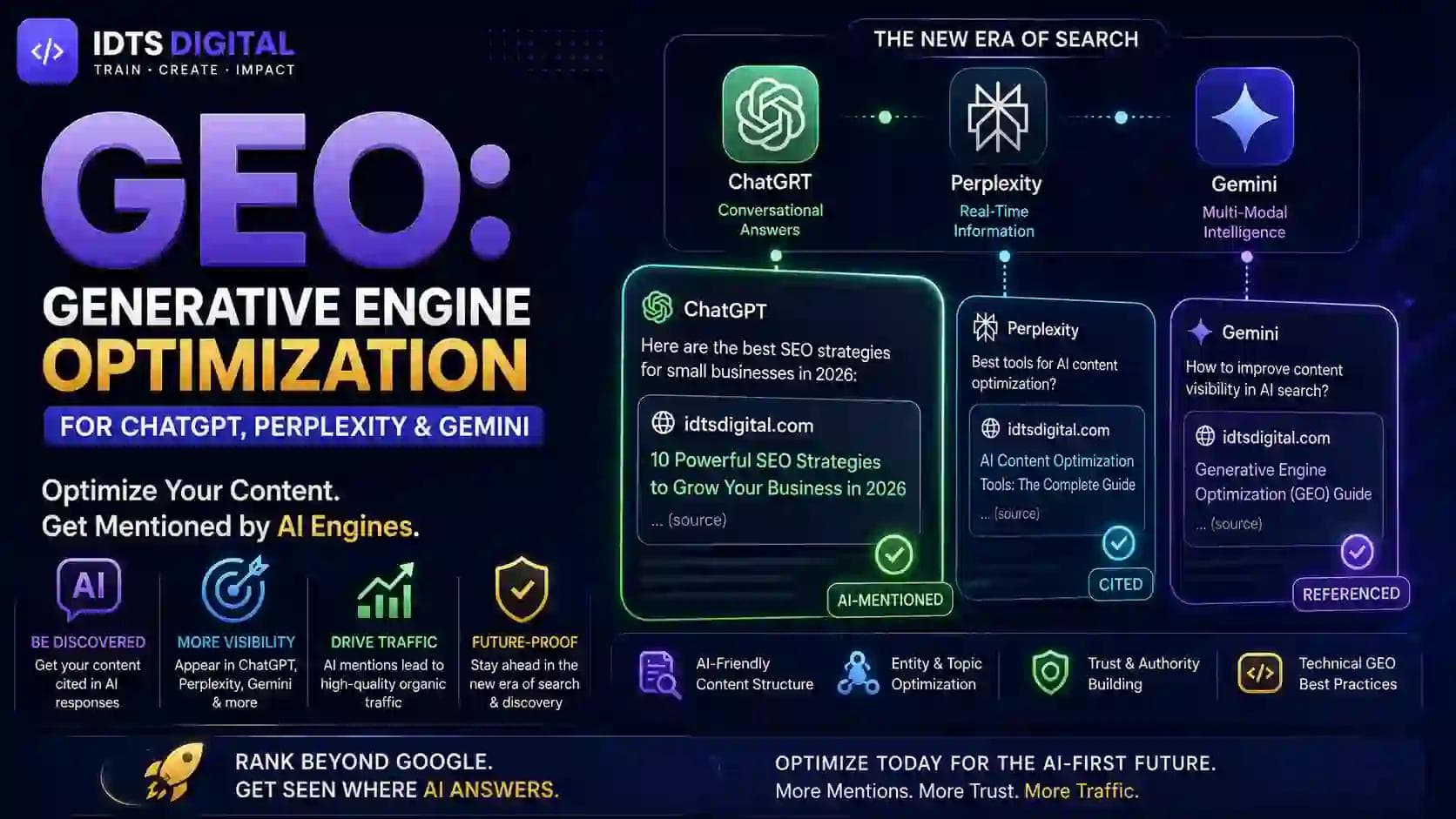
Search is changing faster than most businesses in Islamabad and Rawalpindi realize. People are no longer just typing keywords into Google and scrolling through ten blue links — they're asking ChatGPT, Perplexity, and Gemini direct questions and expecting direct answers. If your business isn't showing up inside those AI-generated answers, you're invisible to a growing chunk of your potential customers.
That's exactly what Generative Engine Optimization (GEO) solves.
In short: GEO is the practice of structuring your website content so AI search tools like ChatGPT, Perplexity, and Google Gemini can understand it, trust it, and quote it directly in their answers. It's the natural evolution of SEO for a world where AI answers questions instead of just listing links.
This guide covers what GEO actually means, how it's different from traditional SEO, how to do it step by step, and how a professional GEO company in Islamabad like IDTS Digital builds it into a complete digital strategy — alongside proven SEO services in Islamabad and Rawalpindi.
What Is Generative Engine Optimization (GEO)?
Generative Engine Optimization is the process of optimizing content so it gets cited, quoted, or recommended by AI-driven answer engines — ChatGPT, Perplexity, Google's Gemini, and Google AI Overviews — instead of only ranking in traditional search results.
Here's the core difference in plain terms: traditional SEO earns you a position on the results page. GEO earns you a mention inside the answer itself. When someone asks Perplexity "who offers the best GEO services in Islamabad," GEO determines whether your brand's name and expertise actually appear in that response.
This matters because AI Overviews, ChatGPT, and Perplexity are increasingly becoming the first stop for research, especially for commercial questions like "best SEO company in Islamabad" or "how much do SEO services cost in Pakistan." A business that ranks #3 on Google but gets zero mentions in AI answers is quietly losing an entire segment of potential customers who never click past the AI-generated summary.
Why GEO Exists — What Changed in Search
For two decades, ranking well meant matching keywords, earning backlinks, and satisfying Google's crawler. That playbook still works, but it's no longer the whole story.
Large language models like the ones powering ChatGPT and Gemini don't crawl and rank pages the same way Google's classic algorithm does. Instead, they synthesize information from multiple sources and generate a single, conversational answer. Perplexity, for instance, actively cites sources inline as it answers — meaning your content either gets picked as a cited source, or it gets skipped entirely.
Google's own AI Overviews work similarly, pulling snippets from pages that are structured clearly, answer questions directly, and demonstrate real expertise. This is why E-E-A-T (Experience, Expertise, Authoritativeness, Trustworthiness) — a concept Google formalized in its Search Quality Rater Guidelines — matters more now than ever. AI systems are explicitly trained to prefer content that demonstrates real, first-hand expertise over generic, thin, or repetitive text.
GEO vs SEO: What's Actually Different
People often ask whether GEO is replacing SEO, or whether SEO is "dead" now that AI search exists. It isn't. GEO and SEO share the same foundation — they just optimize for different destinations.
Traditional SEO focuses on ranking position, keyword targeting, and earning clicks from the search engine results page. Success is measured through rankings, organic traffic growth, and click-through rate.
GEO focuses on being quoted, cited, and referenced directly inside an AI-generated answer. Success is measured by whether your brand, data, or explanation shows up when someone asks an AI assistant a question related to your industry.
Is GEO going to replace SEO? Not likely, at least not in the near future. Google Search Console, Google Analytics (GA4), structured keyword research, and technical SEO fundamentals are still the backbone of visibility online. GEO simply adds a second destination for that same well-built content — AI answer boxes, alongside the traditional ten blue links.
Is SEO dead now with AI? No. If anything, well-optimized, well-structured content is more valuable now, because it's the same content that AI models pull from to build their answers. A site with weak SEO fundamentals — slow load times, thin content, no schema markup — will struggle in both traditional rankings and AI citations.
How AI Search Engines Actually Choose What to Cite
Understanding this is the difference between guessing at GEO and doing it properly. AI answer engines generally favor content that:
- Answers a specific question directly and early in the text
- Uses clear, quotable, fact-based statements rather than vague marketing language
- Comes from a source with demonstrated topical authority (multiple relevant pages, consistent expertise)
- Is well-structured with proper headings, so the model can isolate the exact answer
- Includes up-to-date statistics, data, or original insight rather than recycled generic advice
- Uses schema markup (Schema.org structured data) that helps machines parse the page's meaning
This is essentially the same checklist Google has pushed since its Helpful Content Update — reward content built for people, not just for algorithms. GEO doesn't reinvent SEO; it raises the bar on the same principles.
Step-by-Step: How to Do Generative Engine Optimization
If you're wondering how to do SEO for generative AI specifically, here's the practical, step-by-step process we follow for clients at IDTS Digital.
Step 1: Structure content around direct answers. Every important question your audience might ask should have a clear, standalone answer within the first two or three sentences of its section — not buried under three paragraphs of introduction. AI models extract concise answers, so give them one to extract.
Step 2: Build topical authority, not just single pages. A lone blog post rarely earns AI citations. Sites with multiple, interlinked pages covering a topic in depth — service pages, guides, FAQs — signal genuine expertise. This is why internal linking, like connecting this article to our dedicated SEO growth services page, matters for GEO just as much as for classic SEO.
Step 3: Use schema markup. FAQPage schema, Article schema, and Organization schema all help AI crawlers and Google's systems understand exactly what your content is and who's behind it. This is a technical step best handled by an experienced GEO expert in Islamabad who understands both the coding and the strategy side.
Step 4: Demonstrate real experience. AI systems are increasingly trained to detect and prefer first-hand expertise — case studies, specific numbers, named examples — over generic filler content. If you've run 50 SEO campaigns in Islamabad, say so, and back it with specifics.
Step 5: Keep information current. AI Overviews and Perplexity strongly favor recently updated, dated content. Stale pages with outdated statistics get skipped in favor of fresher sources.
Step 6: Monitor citations, not just rankings. Traditional rank trackers won't tell you if ChatGPT is citing your site. Track brand mentions across AI platforms manually or with emerging GEO monitoring tools, alongside your usual Google Search Console and Google Analytics (GA4) reporting.
Can You Give Me an Example of Generative Engine Optimization?
Sure — here's a concrete one. Say a Rawalpindi-based furniture business wants to appear when someone asks ChatGPT, "what should I look for when buying handmade furniture in Pakistan?" Instead of a generic product page, they publish a detailed guide answering that exact question in the first two sentences, backed by specific details about wood types, finishing techniques, and delivery timelines. That page also carries FAQPage schema and links to related guides on care and maintenance. That's GEO in action — content built to be the answer, not just to rank near it.
What Are the Best Tools for Generative Engine Optimization?
While the GEO tooling space is still young compared to established SEO software, a solid workflow currently combines:
- Google Search Console and Google Analytics (GA4) for baseline visibility and traffic data
- Ahrefs, SEMrush, or Ubersuggest for keyword and competitor research
- Schema markup generators for structured data implementation
- Manual testing — regularly asking ChatGPT, Perplexity, and Gemini your target questions to see who gets cited
- Core Web Vitals monitoring, since page experience still affects how much AI crawlers can access and trust your content
There isn't yet a single dominant "GEO platform" the way Ahrefs dominates SEO — most agencies, including ours, combine traditional SEO tools with manual AI-answer auditing.
Is AI SEO Called GEO? And Other Common Terminology Questions
Yes — AI search optimization is generally referred to as GEO (Generative Engine Optimization), though you'll also see it called AEO (Answer Engine Optimization) or occasionally "AI engine optimization." These terms overlap heavily and are often used interchangeably in the industry, though some practitioners draw a subtle distinction: AEO focuses specifically on featured snippets and direct-answer boxes, while GEO focuses more broadly on generative AI platforms like ChatGPT and Gemini. For practical purposes, a strong content and technical SEO foundation serves both goals simultaneously.
Why Choose IDTS Digital for GEO and SEO Services in Islamabad
We combine two decades of collective SEO experience with hands-on knowledge of how AI search actually behaves — not theory, but tested strategy across real client sites in Islamabad, Rawalpindi, and beyond.
Here's what sets our approach apart:
- We treat GEO and SEO as one integrated strategy, not two separate services, since they share the same technical and content foundation
- Every campaign starts with a full technical audit covering Core Web Vitals, mobile-friendly website SEO, and crawlability
- We build content around real search intent and direct-answer formatting, optimized for both Google rankings and AI citation
- Transparent reporting through Google Search Console and Google Analytics (GA4), so you see exactly what's working
- Local expertise in the Islamabad and Rawalpindi markets, including Bahria Town, DHA Islamabad, F-10, Blue Area, G-9, and Saddar Rawalpindi
If you'd like the full breakdown of our broader service stack, visit our SEO services page for Islamabad or our Rawalpindi-specific SEO services page.
GEO and SEO Packages & Pricing
Pricing for GEO and SEO services in Islamabad varies depending on scope, competition level, and how much technical work your site needs upfront. Generally, packages fall into a few tiers:
Starter packages suit small businesses and local service providers focused primarily on local pack visibility and foundational on-page fixes. Growth packages add deeper content strategy, off-page link building, and GEO-specific structuring for businesses ready to compete more aggressively. Enterprise packages suit ecommerce sites or larger companies needing ongoing technical SEO, extensive content production, and dedicated AI-citation monitoring.
We break down real numbers and what affects them in our detailed SEO services in Islamabad cost guide and our broader SEO packages and pricing guide for Pakistan.
Learn GEO and SEO: Our Course Offering
If you'd rather build this skill in-house than outsource it, IDTS Digital also runs a hands-on SEO Mastery course that now includes a dedicated module on Generative Engine Optimization — covering AI Overview structuring, schema markup, and answer-first content writing, alongside classic on-page and off-page SEO training.
For learners who want the broader digital marketing picture alongside SEO fundamentals, our complete digital marketing course is worth exploring too. And if you're evaluating options beyond us, established platforms like Coursera and Google's own Search Central training resources are solid places to build foundational knowledge before specializing in GEO.
Is SEO difficult to learn? Not inherently — the core concepts (keyword intent, site structure, content quality) are logical and learnable within weeks. Mastery, especially of the newer GEO layer, takes longer because the field itself is still evolving month to month.
Frequently Asked Questions About GEO
What is generative engine optimization? Generative Engine Optimization (GEO) is the practice of structuring website content so AI-driven answer engines like ChatGPT, Perplexity, and Gemini can understand, trust, and cite it directly in their generated answers.
Is GEO replacing SEO? No. GEO builds on top of traditional SEO fundamentals — technical health, quality content, and authority signals — rather than replacing them. Both are needed for full search visibility today.
Which is better, SEO or GEO? Neither replaces the other; they serve different destinations. SEO earns rankings on the search results page, while GEO earns citations inside AI-generated answers. A complete strategy needs both.
Is SEO dead now with AI? No. AI answer engines rely on the same signals classic SEO builds — clear structure, authority, relevance, and trust — so strong SEO fundamentals remain essential.
How do I do generative engine optimization? Start by structuring content around direct, quotable answers to real questions, build topical authority across multiple pages, implement schema markup, demonstrate first-hand expertise, and keep content current.
What is the core concept of generative engine optimization? The core concept is making content easy for AI models to extract, trust, and quote — through clear structure, direct answers, and demonstrated expertise (E-E-A-T).
GEO and SEO Are Two Sides of the Same Strategy
The businesses that will win visibility over the next few years won't be choosing between SEO and GEO — they'll be doing both, because they're built on the same foundation of technical health, genuine expertise, and content that actually answers people's questions.
If you're ready to make sure your business shows up whether someone's searching on Google or asking ChatGPT, IDTS Digital can build that strategy for you — from technical audits to content built for AI citation.
Book a free consultation with our team, or explore our complete SEO services in Islamabad to get started today.