





Introduction: SEO in 2026 Is Not What You Think
If you still think SEO in 2026 means stuffing keywords into a blog post and waiting for Google to reward you — you are already behind.
Search engine optimization has entered a new era. Google now uses layered AI systems — RankBrain, BERT, MUM, and the Helpful Content System — to evaluate not just what you write, but why you wrote it, who wrote it, and whether it genuinely helps the person searching. On top of that, Google AI Overviews now appear in nearly 26% of all US searches, fundamentally changing how people consume search results.
The good news? SEO is not dead. It is more powerful and more strategic than ever. If you understand how Google thinks in 2026, you can rank on the first page, get cited in AI Overviews, and drive consistent organic traffic — even as a beginner.
This complete SEO guide 2026 will walk you through every ranking factor, every strategy, every tool, and every local opportunity you need — especially if you are in Pakistan, Islamabad, Lahore, Karachi, or Rawalpindi.
Let’s break it all down.
What is SEO in 2026? (And Why It Still Matters)
SEO (Search Engine Optimization) is the process of optimizing your website and content so that Google and other search engines rank it higher in organic (unpaid) search results. In 2026, search engine optimization goes far beyond keywords. It now includes:
- Proving your expertise and authority through E-E-A-T signals
- Matching searcher intent — not just search terms
- Building topical authority across content clusters
- Earning citations in Google AI Overviews and AI-powered search tools
- Technical performance including Core Web Vitals
- Local SEO signals for city and region-level rankings
According to recent industry data, zero-click searches now account for nearly 60% of all Google searches. That means SEO is not just about clicks anymore — it is about visibility, brand authority, and being the source Google trusts enough to cite in its AI-generated answers.
Is SEO still relevant in 2026? Absolutely. In fact, businesses with a strong SEO foundation are dominating both traditional rankings and AI Overview citations simultaneously.
Google Ranking Factors 2026: What Actually Moves the Needle
Google does not use a simple checklist. It uses layered systems that evaluate relevance, quality, experience, and trust together. Here are the most critical Google ranking factors in 2026:
1. Search Intent Optimization
The single most important factor in 2026 is matching search intent. Google wants to know: does your content fully satisfy what the user was looking for?
There are four types of intent:
- Informational — the user wants to learn (e.g., “what is technical SEO”)
- Navigational — the user wants a specific site (e.g., “IDTS Digital courses”)
- Transactional — the user wants to buy or act (e.g., “best SEO services in Islamabad”)
- Commercial — the user is comparing before buying (e.g., “SEO agency vs doing SEO yourself”)
Identify the intent behind every keyword before you write a single word. Then structure your content to deliver exactly what that intent demands.
2. E-E-A-T: Experience, Expertise, Authoritativeness, Trustworthiness
Google’s quality evaluators use E-E-A-T as a framework to judge whether a piece of content is trustworthy. In 2026, this is not optional.
- Experience: Have you personally done what you are writing about?
- Expertise: Do you have credentials, real knowledge, and demonstrated skill?
- Authoritativeness: Do credible sources cite you, link to you, or mention your brand?
- Trustworthiness: Is your site secure (HTTPS), transparent (About page, author bio), and accurate?
If you are offering SEO services in Pakistan or teaching an SEO course in Islamabad, make sure your author profiles are complete, your client results are visible, and your business is verifiable.
3. Topical Authority and Content Clusters
Google rewards websites that cover topics in depth. A single blog post on “keyword research” will not compete against a website that has 20 interconnected articles about keyword research, SEO tools, on-page optimization, and technical SEO.
This is called topical authority. Build it by creating topic clusters:
- A pillar page (like this article) covers the full topic broadly
- Cluster pages dive deep into sub-topics
- All pages are interlinked strategically with descriptive anchor text
For example, if you offer SEO services in Pakistan, your website should cover local SEO, technical SEO, link building, content strategy, and keyword research — not just a single homepage claiming you do SEO.
Pro tip: Link your cluster pages back to this pillar. You can see how IDTS Digital builds content authority across topics at their blog section.
4. Core Web Vitals and Technical SEO 2026
Technical SEO is the foundation that makes everything else work. If Google cannot crawl, index, and understand your site, it will not rank it — no matter how good your content is.
Core Web Vitals you must optimize:
- LCP (Largest Contentful Paint): How fast does your main content load? Aim for under 2.5 seconds
- INP (Interaction to Next Paint): How responsive is your page to user input? Target under 200ms
- CLS (Cumulative Layout Shift): Does your page content jump around? Keep CLS below 0.1
Beyond Core Web Vitals, your technical SEO checklist for 2026 should include:
- Mobile-first indexing compliance (your mobile site IS your site in Google’s eyes)
- Clean XML sitemap submitted to Google Search Console
- Canonical tags to prevent duplicate content issues
- HTTPS and SSL across all pages
- Structured data markup (Schema.org) for rich results
- Crawl budget optimization for large sites
- 301 redirects for any moved or deleted pages
- Robots.txt properly configured
- Image alt text optimization for every image
If your WordPress site is slow, check out the complete guide to WordPress Speed Optimization 2026 — a critical step before any SEO work begins.
5. Backlink Strategy and Link Building 2026
Backlinks are still one of Google’s top three ranking factors. But in 2026, one high-quality backlink from an authoritative source is worth more than 100 low-quality links.
What works in link building 2026:
- Digital PR: Get featured in news articles, industry publications, and authoritative blogs
- Guest posting on relevant, high-DA websites
- Broken link building: Find dead links on authority sites and suggest your content as a replacement
- Resource page link building
- Original research, statistics, and data people naturally want to cite
- HARO (Help a Reporter Out) responses for media citations
What will hurt you in 2026:
- Buying links from link farms
- Private Blog Networks (PBNs)
- Irrelevant directory submissions
- Exact-match anchor text overuse
Google’s SpamBrain system is now highly effective at detecting unnatural link patterns. Focus on earning links through genuine expertise and valuable content.
On-Page SEO Optimization 2026: The Complete Checklist
On-page SEO is what you control directly on each page of your website. Here is exactly what to optimize:
Title Tag: Include your primary keyword naturally. Keep it under 60 characters. Make it compelling enough to earn a click.
Meta Description: Write a 150–160 character summary that includes your main keyword and a clear reason to click. Google often pulls this for AI Overviews, so make it answer a question directly.
H1 Tag: One per page. Contains your primary keyword. Tells Google (and humans) exactly what the page is about.
H2 and H3 Subheadings: Break your content into logical sections. Include secondary keywords and LSI terms naturally. Write subheadings as questions when possible — these are what Google pulls for “People Also Ask.”
Keyword Placement: Include your primary keyword in the first 100 words, naturally in the body, and in at least one subheading. Never stuff — use synonyms and related terms throughout.
Internal Linking: Connect related pages on your site. This distributes page authority and helps Google understand your content structure. For instance, if your article mentions digital marketing, link to your digital marketing services page.
Image Optimization: Compress all images, use descriptive file names, and add alt text that describes the image using relevant keywords.
Content Length: There is no magic word count, but comprehensive content that fully answers a topic tends to outperform thin pages. For competitive keywords in 2026, aim for 2,000–5,000 words on pillar pages.
Schema Markup: Add FAQ schema, Article schema, and LocalBusiness schema (for local SEO). This dramatically increases your chances of appearing in rich results and AI Overviews.
How to Get Featured in Google AI Overviews in 2026
Google AI Overviews appear in 25.8% of US searches as of early 2026, and informational queries trigger them 39.4% of the time. Being cited in an AI Overview is the new “position zero” — it is the most visible spot in search.
How to optimize for Google AI Overview:
- Answer questions directly and immediately. In the first two sentences of every section, give a clear, direct answer. Google pulls these for AI summaries.
- Use structured content. Numbered lists, bullet points, definition-style paragraphs, and FAQs are all AI Overview-friendly formats.
- Add FAQ schema markup. This signals to Google that your content is structured as a question-and-answer resource.
- Build brand authority signals. AI Overviews tend to cite brands that have consistent online presence, reviews, mentions, and backlinks.
- Write at the right reading level. Clear, concise writing without jargon — like you are explaining to a smart friend — performs better in AI citations.
- Cover topics comprehensively. Google does not just pull from position #1. Pages ranked between positions 11 and 20 are regularly featured in AI Overviews when they have the clearest, most direct answers.
This is why Generative Engine Optimization (GEO) is the new evolution of traditional SEO. It is not enough to rank — you need to be cited, mentioned, and trusted by AI systems including Google, ChatGPT, and Perplexity.
Keyword Research for SEO in 2026: Step-by-Step
Keyword research is the process of finding the exact words and phrases your target audience types into Google. In 2026, it is less about finding high-volume terms and more about finding high-intent terms you can actually rank for.
Step 1: Start with seed keywords. Write down 5–10 broad terms related to your topic. For an SEO agency in Pakistan, these might be: “SEO services Pakistan,” “SEO course Islamabad,” “digital marketing Lahore.”
Step 2: Use keyword research tools. The best tools in 2026 include:
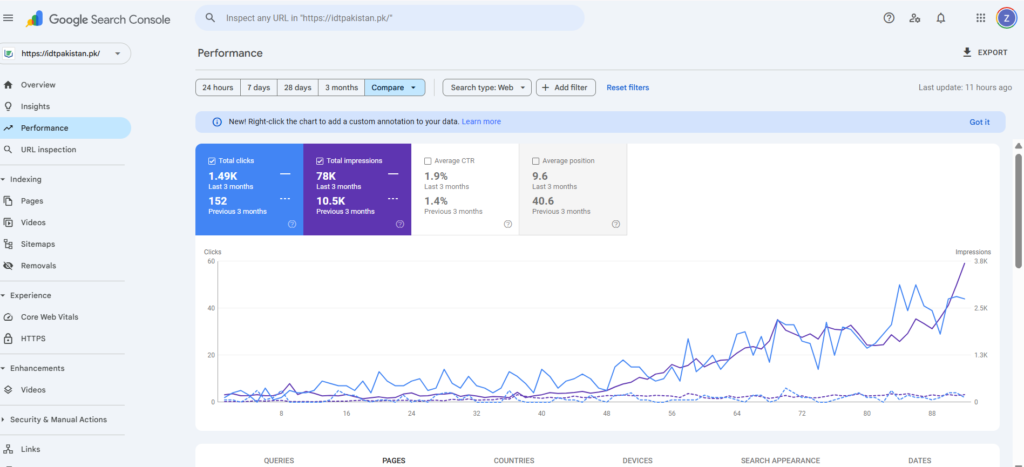
- Google Search Console — free, shows exactly what you already rank for
- Ahrefs — best for competitive analysis and backlink research
- SEMrush — excellent for keyword gap analysis and site audits
- Ubersuggest — affordable, great for beginners
- Google Keyword Planner — free, official Google data
Step 3: Analyze search intent. Before targeting any keyword, search it yourself. What type of content ranks on page one? Articles? Product pages? Videos? Your content format must match what Google is already rewarding.
Step 4: Prioritize by difficulty and opportunity. As a new website, go after long-tail keywords with lower competition first. “SEO course in Rawalpindi” will rank faster than “SEO course” because it is more specific and less competitive.
Step 5: Map keywords to pages. One primary keyword per page. Group related secondary and LSI keywords naturally into the same piece. Never target the same keyword on two different pages (keyword cannibalization).
Local SEO in Pakistan: Rank in Islamabad, Lahore, Karachi & Rawalpindi
Local SEO is one of the fastest-growing opportunities for Pakistani businesses in 2026. Whether you are offering SEO services in Islamabad, running a digital marketing course in Lahore, or building websites in Karachi — local SEO puts you in front of customers in your city.
How local SEO works:
Google has a separate algorithm for local results — the “Local Pack” (the map results with three listings). It is driven by three factors:
- Relevance — Does your business match what the user is searching for?
- Distance — How close is your business to the searcher?
- Prominence — How well-known and reviewed is your business?
Local SEO checklist for Pakistani businesses:
- Create and fully optimize your Google Business Profile — this is the single most important local SEO action you can take
- Add your business name, address, phone number (NAP) consistently across all directories
- Collect genuine Google reviews from real clients
- Add location-specific pages on your website (e.g., “SEO Services in Islamabad,” “SEO Services in Lahore”)
- Include city names naturally in your title tags and meta descriptions
- Build local citations on Pakistani business directories
- Create locally relevant content (e.g., “How Pakistani Businesses Can Use Local SEO to Grow in 2026”)
For a deeper dive, read the complete Local SEO for Small Business 2026 Guide — covering everything from Google Business Profile to citation building.
Location pages to consider for your SEO business in Pakistan:
- SEO services in Islamabad
- SEO course in Lahore
- Digital marketing Karachi
- SEO training Rawalpindi
- Best SEO agency Pakistan
Content SEO Strategy 2026: Write for Humans, Optimize for Google
Content is still king — but in 2026, only content that genuinely serves the reader earns consistent rankings.
Google’s Helpful Content System penalizes content that feels written for search engines. If your article is full of awkward keyword phrases, adds no real insight, and could have been written about any topic in any niche — it will not rank.
What makes content rank in 2026:
- Original insights and perspectives. Bring something new — a personal example, a case study, an analysis your competitors have not done.
- Comprehensive coverage. Answer not just the main question, but every related question the user might have next.
- Structured formatting. Short paragraphs, clear subheadings, bullet points, and numbered lists make content easy to scan and AI-friendly.
- Updated regularly. Content freshness is a ranking signal. Revisit and update your most important pages at least once a year.
- Multimedia. Include images, infographics, and videos where relevant. Video SEO on Google and YouTube is growing rapidly in 2026.
Semantic SEO tip: Do not just use your exact keyword phrase repeatedly. Use related terms, synonyms, and entity-based language. Google understands that “search engine rankings,” “organic visibility,” and “SERP position” all relate to the same concept.
Want to understand how content and strategy intersect with broader digital marketing? See how Digital Marketing vs Traditional Marketing in 2026 shapes the decision for Pakistani businesses.
Technical SEO Audit: How to Check Your Website’s Health
A technical SEO audit is a systematic review of your website to find and fix issues that prevent Google from crawling, indexing, or ranking your pages.
How to do a technical SEO audit step by step:
- Crawl your website using Screaming Frog or Ahrefs Site Audit. This identifies broken links, missing title tags, duplicate content, and crawl errors.
- Check Google Search Console for any Manual Actions, Coverage errors, Core Web Vitals failures, or mobile usability issues.
- Test page speed using Google PageSpeed Insights or GTmetrix. Fix anything below 80/100 on mobile.
- Verify your XML sitemap is submitted to Google Search Console and contains only indexable pages.
- Check your robots.txt file. Make sure you are not accidentally blocking Google from crawling important pages.
- Audit your internal linking structure. Every important page should be reachable within 3 clicks from the homepage.
- Check for duplicate content using canonical tags. Every page must have a single authoritative URL.
- Verify HTTPS is active on all pages. Mixed content (HTTP images on HTTPS pages) is a ranking issue.
- Test mobile usability. Use Google’s Mobile-Friendly Test tool. In 2026, mobile-first indexing means your mobile version is what Google actually indexes.
- Review structured data using Google’s Rich Results Test. Make sure your schema markup is error-free.
SEO Tools You Need in 2026
You cannot do professional SEO without the right tools. Here are the most important ones:
Free Tools:
- Google Search Console — essential for monitoring rankings, indexing, and errors
- Google Analytics 4 (GA4) — tracks traffic, user behavior, and conversions
- Google PageSpeed Insights — tests Core Web Vitals
- Google Keyword Planner — free keyword data
- Screaming Frog SEO Spider (free up to 500 URLs) — technical SEO crawling
- Ubersuggest — keyword research with a generous free tier
Paid Tools (Worth the Investment):
- Ahrefs — best overall SEO suite for backlink analysis and keyword research
- SEMrush — excellent for competitor analysis, site audits, and rank tracking
- Moz Pro — domain authority tracking and link analysis
- Surfer SEO — content optimization for on-page SEO
- RankMath or Yoast — WordPress SEO plugins for on-page optimization
If you are just starting out in Pakistan and budget is tight, start with Google Search Console, Google Analytics 4, and the free version of Ubersuggest. These three alone will give you enough data to make smart SEO decisions.
SEO vs Paid Ads: Which is Better in 2026?
This is one of the most asked questions from business owners in Pakistan. The honest answer is: both have their place, but SEO offers better long-term ROI.
For a full comparison, read Google Ads vs Facebook Ads 2026 Comparison — and apply the same logic to organic vs paid search.
| Factor | SEO | Paid Ads |
|---|---|---|
| Cost | Low ongoing (time investment) | Pay per click, ongoing spend |
| Speed | 3–12 months to see results | Immediate |
| Longevity | Rankings last long-term | Stops when you stop paying |
| Trust | Higher — organic results trusted more | Lower — users know it is an ad |
| AI Overview eligibility | Yes | No |
For Pakistani startups with limited budgets, SEO is the smarter long-term investment. Combine it with a small paid budget for fast early results while your SEO builds momentum.
How Long Does SEO Take to Show Results in 2026?
This depends on your domain authority, competition level, and content quality. Here is a realistic timeline:
- 0–3 months: Technical fixes, content publishing, keyword research setup. Little to no ranking movement yet.
- 3–6 months: Long-tail keywords start ranking. Google begins recognizing your topical authority.
- 6–12 months: Significant ranking improvements on competitive terms. Organic traffic grows noticeably.
- 12+ months: Compounding results. Strong backlink profile. Possible AI Overview citations. Consistent first-page rankings on core keywords.
SEO is a long-term game. Businesses that commit to it consistently for 12 months almost always see transformational results. The ones who quit after 90 days never find out what they were building.
Is SEO a Good Career in Pakistan in 2026?
Yes — without question. The demand for SEO experts in Pakistan has grown enormously in 2026. Here is why:
- Pakistani freelancers are earning $500–$5,000+ per month serving international clients on platforms like Fiverr and Upwork
- Local businesses in Islamabad, Lahore, and Karachi are investing heavily in digital marketing after seeing competitors win with SEO
- The e-commerce boom in Pakistan has created massive demand for SEO services for online stores
- Remote work culture means Pakistani SEO professionals can work for UK, US, and UAE agencies without leaving home
Average earnings for SEO professionals in Pakistan (2026):
- Entry-level SEO executive: PKR 40,000–70,000/month
- Mid-level SEO specialist: PKR 80,000–150,000/month
- Senior SEO consultant: PKR 150,000–400,000/month
- Freelance SEO (international clients): $500–$5,000/month
If you want to get started in this career, the best path is structured training. Check out the Best Digital Marketing Course in Pakistan to understand your options.
Learn SEO in Pakistan: Courses in Islamabad, Lahore, Karachi & Rawalpindi
Whether you are in Islamabad, Lahore, Karachi, or Rawalpindi — structured SEO training will get you to results 10x faster than self-study alone.
What to look for in an SEO course in Pakistan:
- Covers both theory and hands-on practice
- Includes real client projects or case studies
- Teaches current 2026 strategies (AI SEO, GEO, E-E-A-T)
- Provides certification for your portfolio
- Offers career support and job placement assistance
IDTS Digital (Institute of Digital Training and Services) offers comprehensive digital courses covering SEO, digital marketing, web development, AI tools, and more — designed specifically for Pakistani learners who want practical, job-ready skills.
Their SEO training covers everything in this guide — from keyword research and on-page optimization to technical SEO audits, link building, and AI Overview optimization — all taught in a hands-on, project-based format.
👉 Explore all available courses at IDTS Digital and enroll in the program that matches your career goals.
You can also explore the range of professional SEO services and digital marketing services that IDTS Digital offers to businesses across Pakistan.
Future of SEO: What’s Coming After 2026
The trajectory of SEO is clear. Here is where it is heading:
Multimodal Search: Google is increasingly indexing images, videos, and audio. Optimizing for visual search and YouTube SEO will become as important as text SEO.
AI-First Indexing: As AI Overviews expand, being cited by AI systems (Google, ChatGPT, Perplexity) will become a primary SEO metric alongside traditional rankings.
Voice Search Growth: Smart speakers and mobile voice search will continue growing. Content that answers conversational questions directly will dominate voice results.
Semantic Search Dominance: Keywords alone will matter even less. Entity relationships, topic coverage, and contextual authority will drive rankings.
Zero-Click Economy: More searches will be answered without a click. The new SEO goal is visibility — being the cited source — not just ranking.
Brand as a Ranking Factor: Google is increasingly using brand signals (searches for your brand name, mentions across the web, reviews) as trust indicators. Building your brand is now an SEO strategy.
If you want to understand the broader data landscape fueling these changes, see how data analytics is shaping business decisions in Pakistan.
FAQs: SEO in 2026 (People Also Ask)
What is SEO in 2026? SEO in 2026 is the process of optimizing your website to rank in Google search results and earn citations in AI-generated answers (Google AI Overviews). It combines technical optimization, high-quality content, E-E-A-T signals, topical authority, and link building.
How does Google rank websites in 2026? Google uses layered AI systems including RankBrain, BERT, and MUM to evaluate content relevance, quality, and user experience. Key ranking factors include search intent match, E-E-A-T, Core Web Vitals, backlinks, and topical authority.
How do I get featured in Google AI Overviews? Write direct, structured answers to common questions in the first two sentences of each section. Use FAQ schema markup, build brand authority, and cover topics comprehensively. Google pulls AI Overview citations from pages across the top 20 results — not just position #1.
What is E-E-A-T in SEO? E-E-A-T stands for Experience, Expertise, Authoritativeness, and Trustworthiness. It is Google’s framework for evaluating content quality and credibility. To improve E-E-A-T, add verified author bios, earn quality backlinks, show real client results, and keep your site secure and transparent.
What is topical authority in SEO? Topical authority is when Google recognizes your website as a trusted, comprehensive source on a specific subject. You build it by creating interconnected content clusters that cover every aspect of a topic in depth.
How long does SEO take to show results in 2026? Typically 3–6 months for long-tail keywords and 6–12 months for competitive terms. Results compound over time — websites with 12+ months of consistent SEO work see the strongest returns.
What is the best SEO course in Pakistan? IDTS Digital offers one of the most comprehensive and up-to-date SEO training programs in Pakistan, covering technical SEO, content strategy, local SEO, AI optimization, and freelancing — practical skills for real-world results.
How much do SEO services cost in Pakistan? SEO services in Pakistan range from PKR 20,000–200,000+ per month depending on the scope, competition, and agency. IDTS Digital offers both affordable SEO packages and full-service campaigns for businesses across Islamabad, Lahore, Karachi, and Rawalpindi.
Is SEO still relevant in 2026? Yes — more than ever. While AI Overviews reduce some organic clicks, SEO remains the most cost-effective long-term digital strategy. Businesses that invest in SEO now are building assets that compound in value for years.
What are the best free SEO tools for beginners in 2026? Google Search Console, Google Analytics 4, Google PageSpeed Insights, Ubersuggest (free tier), and Screaming Frog (free up to 500 URLs) are the best free starting points for anyone learning SEO in Pakistan.
Conclusion: Your SEO Journey Starts Now
SEO in 2026 rewards those who commit to it with consistency, expertise, and genuine value. There is no shortcut that survives long-term. But for those who understand the game — intent-matching content, solid technical foundations, real E-E-A-T, smart link building, and local optimization — Google remains one of the most powerful free traffic channels in the world.
Whether you are a business owner in Karachi wanting more website traffic, a student in Islamabad exploring SEO as a career, or a freelancer in Lahore building client skills — the opportunity is real and it is growing.
The businesses and professionals who start building their SEO foundation today will be the ones dominating search results in 2027 and beyond.
📌 Ready to master SEO and rank on Google?
🎓 Book a seat in the Advanced Digital Marketing & SEO Course at IDTS Digital — Pakistan’s most practical digital training institute.
👉 Explore All Courses | 👉 SEO Services for Your Business | 👉 Contact IDTS Digital
Also explore: How to Start Freelancing in Pakistan 2026 | Social Media Marketing for Small Business | AI Chatbot Services for Pakistani Businesses
External Authority Reference: For official Google SEO guidance, visit Google’s Search Central Documentation — the most authoritative source for understanding how Google evaluates and ranks web content.
6 Comments
[…] Digital Marketing ML powers programmatic advertising, customer segmentation, predictive analytics, and chatbots. For marketing professionals, understanding AI is no longer optional. Learn more: SEO 2026 Google Ranking Guide […]
[…] SEO using Rank Math or Yoast gives you far more granular control. Check out our complete guide on SEO in 2026: The Ultimate Google Ranking Guide to understand how to combine platform choice with a winning SEO […]
[…] Search Engine Optimization (SEO) On-page SEO, off-page SEO, technical SEO, local SEO, link building, and keyword research. This drives free, long-term organic traffic from Google. For a deep dive into what works right now, explore this up-to-date guide: SEO in 2026 — Complete Google Ranking Guide. […]
[…] content. For example, a pillar page on on-page SEO should connect to related guides like your SEO 2026 Google Ranking Guide, creating a cluster that signals deep topical authority to […]
[…] to see how a well-written About section pairs with strong SEO strategy? Read the full SEO 2026 Guide on IDTS Digital for a deeper look at on-page optimization across […]
[…] a deeper look at keyword strategy in general, our SEO and Google ranking guide 2026 covers keyword intent in […]