





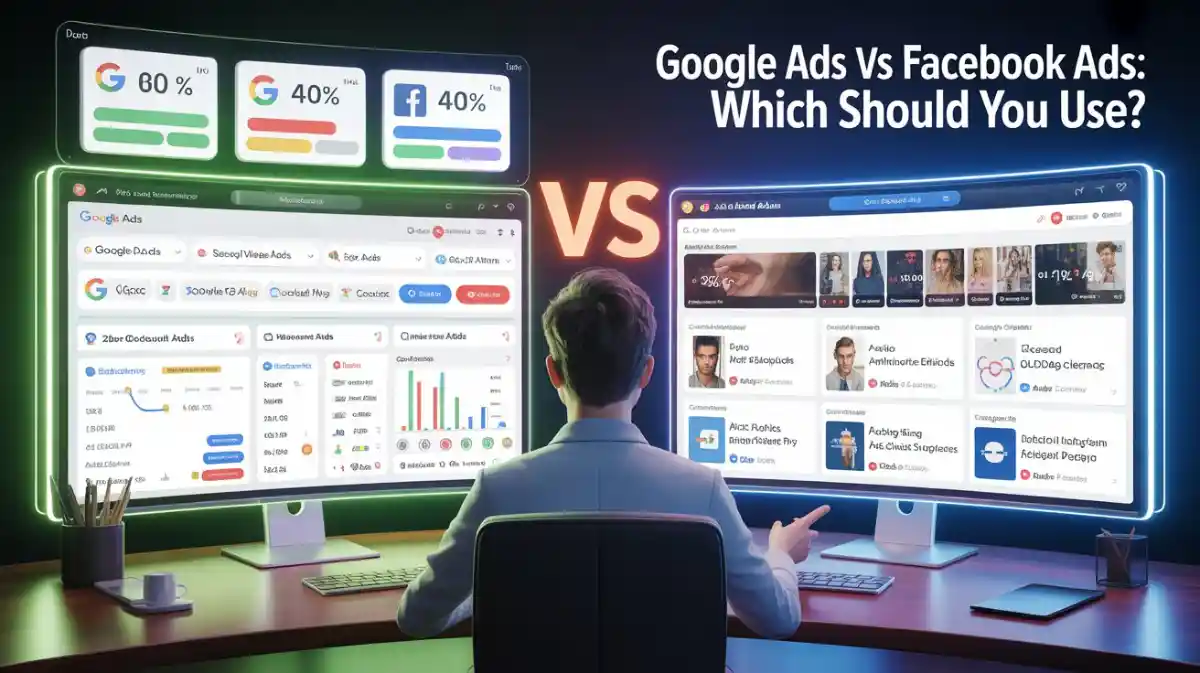
If you’ve ever sat down with a marketing budget and wondered where to actually spend it, you’re not alone. The Google Ads vs Facebook Ads debate is one of the most common questions business owners, marketers, and entrepreneurs face today. Both platforms are powerful. Both can deliver real results. But they work very differently — and choosing the wrong one can drain your budget fast.
In this guide, we’ll break down everything you need to know about Google Ads and Facebook Ads, compare their costs, targeting, ROI, and help you decide which platform is right for your business goals in 2025.
What Are Google Ads and Facebook Ads?
Before diving into the comparison, let’s quickly define both platforms.
Google Ads (formerly Google AdWords) is a pay-per-click advertising platform built on search engine marketing. When someone types a query into Google, your ad can appear at the top of the results. This is intent-based advertising at its finest — you’re reaching people who are already searching for what you offer.
Facebook Ads (now part of Meta Ads) is a social media advertising platform that lets you show ads to users based on their interests, behaviors, demographics, and life events. It’s not search-based — it’s discovery-based. You’re reaching people before they even know they need you.
Both are forms of paid advertising, but they serve different purposes in your digital marketing strategy.
Google Ads vs Facebook Ads: The Core Difference
The single biggest difference between the two platforms comes down to intent.
Google Ads targets purchase intent. A person searching “best running shoes under $100” is ready to buy. Your ad meets them exactly at that moment.
Facebook Ads targets audience interests. A person scrolling their feed hasn’t decided to buy anything yet. You’re interrupting their experience with something relevant enough to make them stop and click.
Think of it this way: Google Ads is like a salesperson standing at the door when a customer walks in. Facebook Ads is like a billboard on the highway — you’re planting the seed before they even start the journey.
Google Ads vs Facebook Ads: Cost Comparison 2025
One of the most searched questions online is about cost. Here’s a realistic breakdown:
Google Ads Cost:
- Average cost per click (CPC) ranges from $1 to $10+ depending on industry
- Competitive industries like law, finance, and insurance can see CPCs of $20–$50
- Monthly budgets for small businesses typically range from $500 to $3,000+
- The ad auction system means you’re bidding against competitors for every keyword
Facebook Ads Cost:
- Average CPC is generally lower — around $0.50 to $3.00 for most industries
- Cost per thousand impressions (CPM) is often cheaper than Google Display
- Minimum daily budget can start as low as $1, making it accessible for micro-businesses
- Facebook Ads cost tends to increase during holidays and peak seasons
So Facebook Ads are cheaper — but cheaper doesn’t always mean better ROI. A $5 click from Google that converts into a $500 sale beats a $0.50 click from Facebook that never converts.
Ad Targeting Options: Where Each Platform Wins
This is where things get really interesting.
Google Ads Targeting:
- Keyword bidding — target exact search terms
- Location, device, and time-of-day targeting
- Remarketing / retargeting campaigns to past website visitors
- Customer match using email lists
- In-market audiences based on browsing behavior
Facebook Ads Targeting:
- Demographic targeting — age, gender, education, job title
- Interest and behavior-based targeting
- Lookalike audiences — find users similar to your best customers
- Custom audiences from your website (Facebook Pixel tracking)
- Life event targeting — people who just got engaged, moved, had a baby
Facebook wins on audience depth. Google wins on search intent. For a full-funnel strategy, you actually need both — but more on that later.
ROI of Google Ads vs ROI of Facebook Ads
Return on investment depends heavily on your industry, offer, and how well your campaigns are set up. That said, here are general patterns:
Google Ads ROI is typically stronger for:
- Local service businesses (plumbers, electricians, lawyers)
- Ecommerce stores with high-intent products
- B2B companies targeting specific buying keywords
- Healthcare and medical services
Facebook Ads ROI is typically stronger for:
- Brand awareness campaigns
- New product launches where you’re educating the market
- Fashion, lifestyle, and consumer goods
- Courses, coaching, and digital products
- Building email lists and lead generation funnels
According to data from WordStream, Google Ads delivers an average ROI of 200% — meaning businesses earn $2 for every $1 spent. Facebook Ads can match or exceed this in the right hands, especially for visual, consumer-facing brands.
Google Ads vs Facebook Ads for Small Business
If you’re a small business owner with a limited budget, which should you choose?
Choose Google Ads if:
- People are actively searching for your product or service
- You offer something with clear intent keywords (e.g., “plumber near me,” “best accountant in Lahore”)
- You want leads quickly and can afford a higher CPC
- You’re a local service business in the USA, UK, Pakistan, or any local market
Choose Facebook Ads if:
- Your product needs explanation or visual appeal
- You’re building a brand from scratch and need awareness
- Your audience is defined by interests, not search behavior
- Your budget is limited and you want cheaper impressions
For most small businesses, Google Ads for local service businesses delivers faster, more direct results. But Facebook Ads for brand awareness is unbeatable when you want to grow your audience over time.
Google Ads vs Facebook Ads for Ecommerce
Ecommerce is where this debate gets most heated.
Google Shopping Ads are incredibly powerful for ecommerce. When someone searches “buy Nike Air Max size 10,” a Google Shopping ad shows your product with a photo, price, and store name — right at the top of search results. The conversion rates are high because the intent is high.
Facebook, on the other hand, excels at retargeting for ecommerce. Someone visits your product page, leaves without buying, and then sees your ad on Facebook an hour later. That’s Facebook Pixel tracking at work — and it’s one of the most cost-effective strategies in ecommerce advertising.
The smartest ecommerce brands use both: Google to capture buyers, Facebook to win back the ones who got away.
Google Ads vs Facebook Ads for B2B Marketing
For B2B companies, the paid advertising comparison shifts significantly.
Google Ads for B2B works well when your buyers are actively searching for solutions — software, services, equipment, or consulting. If a procurement manager is Googling “cloud storage solutions for enterprise,” you want to be there.
Facebook Ads for B2B is trickier. Most business decision-makers aren’t scrolling Facebook looking for enterprise software. However, Facebook’s interest and job title targeting can work for awareness campaigns — especially in emerging markets.
If you’re doing B2B marketing, also consider LinkedIn Ads as part of your paid search vs paid social strategy. LinkedIn’s professional targeting is unmatched for reaching C-suite executives and industry professionals — making it a strong alternative when comparing Google Ads vs Facebook Ads vs LinkedIn Ads.
You can explore comprehensive digital marketing services at IDTS DIGITAL that cover multi-platform paid ad strategies tailored for both B2B and B2C businesses.
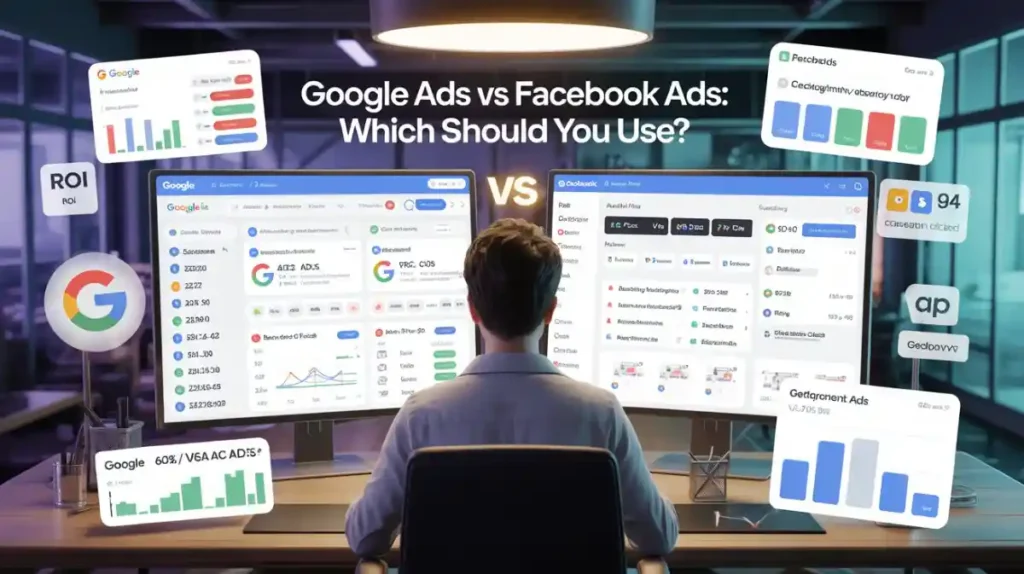
Can You Run Google Ads and Facebook Ads Together?
Absolutely — and in most cases, you should.
The most effective digital marketing strategy uses both platforms at different stages of the customer journey:
- Top of funnel — Use Facebook Ads for brand awareness. Reach cold audiences with engaging visuals and video content.
- Middle of funnel — Retarget Facebook visitors with more specific offers. Use Google Display Ads to stay top of mind.
- Bottom of funnel — Use Google Search Ads to capture high-intent buyers who are ready to purchase.
- Post-purchase — Use Facebook to build loyalty, get reviews, and upsell existing customers.
This customer journey mapping approach ensures no potential customer slips through the cracks. It’s not Google vs Facebook — it’s Google AND Facebook working together.
Which Platform Is Best for Beginners?
If you’re just starting with paid advertising, Facebook Ads has a slightly lower learning curve for campaign setup. The Meta Ads Manager is relatively beginner-friendly, and you can launch a campaign with a small budget to test.
Google Ads has more complexity — understanding the ad auction system, quality score, keyword match types, and negative keywords takes time. But Google provides excellent free resources and certifications to help beginners learn.
For complete hands-on training in both platforms, IDTS DIGITAL’s advanced digital marketing courses teach you everything from campaign setup to optimization — with real-world practice on live accounts.
How to Measure Google Ads vs Facebook Ads Success
Measuring performance is critical for ad spend efficiency. Here are the key metrics to track:
For Google Ads:
- Click-through rate (CTR)
- Quality Score
- Cost per click (CPC)
- Conversion rate
- Cost per acquisition (CPA)
- Return on ad spend (ROAS)
For Facebook Ads:
- Reach and impressions
- Ad relevance score
- Cost per result
- Frequency (how many times same person sees your ad)
- Cost per lead
- ROAS (for ecommerce)
Both platforms offer robust analytics dashboards. Connect them to Google Analytics for a unified view of your marketing budget optimization across channels.
Google Ads vs Facebook Ads: Quick Comparison Table
| Feature | Google Ads | Facebook Ads |
|---|---|---|
| Ad Type | Search + Display | Social + Display |
| Targeting | Keyword intent | Demographics + Interests |
| Average CPC | $1–$10+ | $0.50–$3 |
| Best For | High-intent buyers | Awareness + Retargeting |
| Minimum Budget | ~$10/day | $1/day |
| Learning Curve | Moderate–High | Low–Moderate |
| Best Industries | Services, Legal, Medical | Ecommerce, Lifestyle, Courses |
Why Pakistan Businesses Should Pay Attention
Digital advertising in Pakistan is growing rapidly. With increasing internet penetration and smartphone usage, both Google Ads and Facebook Ads offer massive reach for Pakistani businesses. Facebook remains one of the most used platforms in Pakistan, making Facebook Ads for local businesses in Pakistan extremely cost-effective.
Google Ads in Pakistan also delivers strong results for service businesses in Lahore, Karachi, Islamabad, and beyond — especially for local service queries. The cost-per-click is significantly lower than Western markets, meaning your budget goes further.
Whether you’re targeting local customers or international clients, IDTS DIGITAL helps Pakistani businesses build and scale paid advertising campaigns on both platforms. Our team of certified experts has helped dozens of local businesses achieve measurable results through professional SEO and paid advertising services.
FAQs: Google Ads vs Facebook Ads
Which is better — Google Ads or Facebook Ads? Neither is universally better. Google Ads is better for capturing high-intent buyers actively searching for your product. Facebook Ads is better for building awareness and reaching targeted audiences based on interests and behavior. The best strategy uses both together.
How much do Google Ads cost per month? For small businesses, a typical Google Ads monthly budget ranges from $300 to $3,000+. Costs vary by industry, competition, and location. Competitive sectors like law or finance can cost significantly more per click.
Are Facebook Ads worth it for small businesses? Yes — Facebook Ads are among the most cost-effective options for small businesses, especially for brand building, local promotion, and reaching specific demographics. With proper targeting and creative, even a $200/month budget can deliver solid results.
What is the minimum budget for Facebook Ads? Facebook allows you to start with as little as $1 per day, though $5–$10 per day is recommended for meaningful data and reach.
Can I run Google Ads and Facebook Ads at the same time? Yes, and it’s highly recommended. Running both platforms simultaneously covers your full marketing funnel — Google captures ready-to-buy searchers while Facebook builds awareness and retargets visitors.
Which platform has better ad targeting? Facebook has deeper audience targeting based on demographics, interests, behaviors, and lookalike audiences. Google excels at intent-based targeting through keyword bidding. Both are powerful in their own right.
Conclusion: Which Should You Use?
The Google Ads vs Facebook Ads decision isn’t a matter of one being better than the other — it’s about matching the right platform to your goal.
- Use Google Ads when people are already searching for what you sell.
- Use Facebook Ads when you need to build awareness, target specific audiences, or retarget website visitors.
- Use both when you’re serious about scaling your business with a full-funnel digital advertising strategy.
The key is understanding your customer journey, setting clear KPIs, and continuously optimizing your campaigns based on real data.
If you’re ready to stop guessing and start running ads that actually convert, book a seat in IDTS DIGITAL’s Advanced Digital Marketing Course — where you’ll learn Google Ads, Facebook Ads, SEO, and full-funnel strategy from certified professionals with real-world experience.
You can also explore all digital services offered by IDTS DIGITAL — from paid ads management to content writing, web development, and more — all under one roof.
For more expert insights on digital marketing, check out the IDTS DIGITAL blog where we regularly publish guides, tutorials, and industry updates to help you grow your business online.
Have questions? Contact the IDTS DIGITAL team and get expert guidance tailored to your business needs.
External Reference: For platform-specific documentation and best practices, visit Google Ads official help center and Meta Business Help Center for the latest updates on ad policies and features.
5 Comments
[…] whether to invest in Google Ads or Facebook Ads for your business? Read this in-depth Google Ads vs Facebook Ads 2026 comparison to make the right […]
[…] ready for paid advertising, choosing the right platform matters. Read our detailed comparison of Google Ads vs Facebook Ads in 2026 to make an informed […]
[…] GA4, linking the two accounts unlocks even more powerful data. IDTS Digital’s comparison of Google Ads vs Facebook Ads in 2026 explains exactly how paid and organic data work together in your analytics […]
[…] Pay-Per-Click Advertising (PPC) Google Ads management, Meta Ads (Facebook and Instagram), YouTube advertising, and display campaigns. PPC delivers fast results but requires expert management to avoid wasted ad spend. Before choosing between channels, read: Google Ads vs Facebook Ads — Which Is Right for Your Business in 2026. […]
[…] Pay-Per-Click Advertising (PPC) Google Ads management, Meta Ads (Facebook and Instagram), YouTube advertising, and display campaigns. PPC delivers fast results but requires expert management to avoid wasted ad spend. Before choosing between channels, read: Google Ads vs Facebook Ads — Which Is Right for Your Business in 2026. […]