





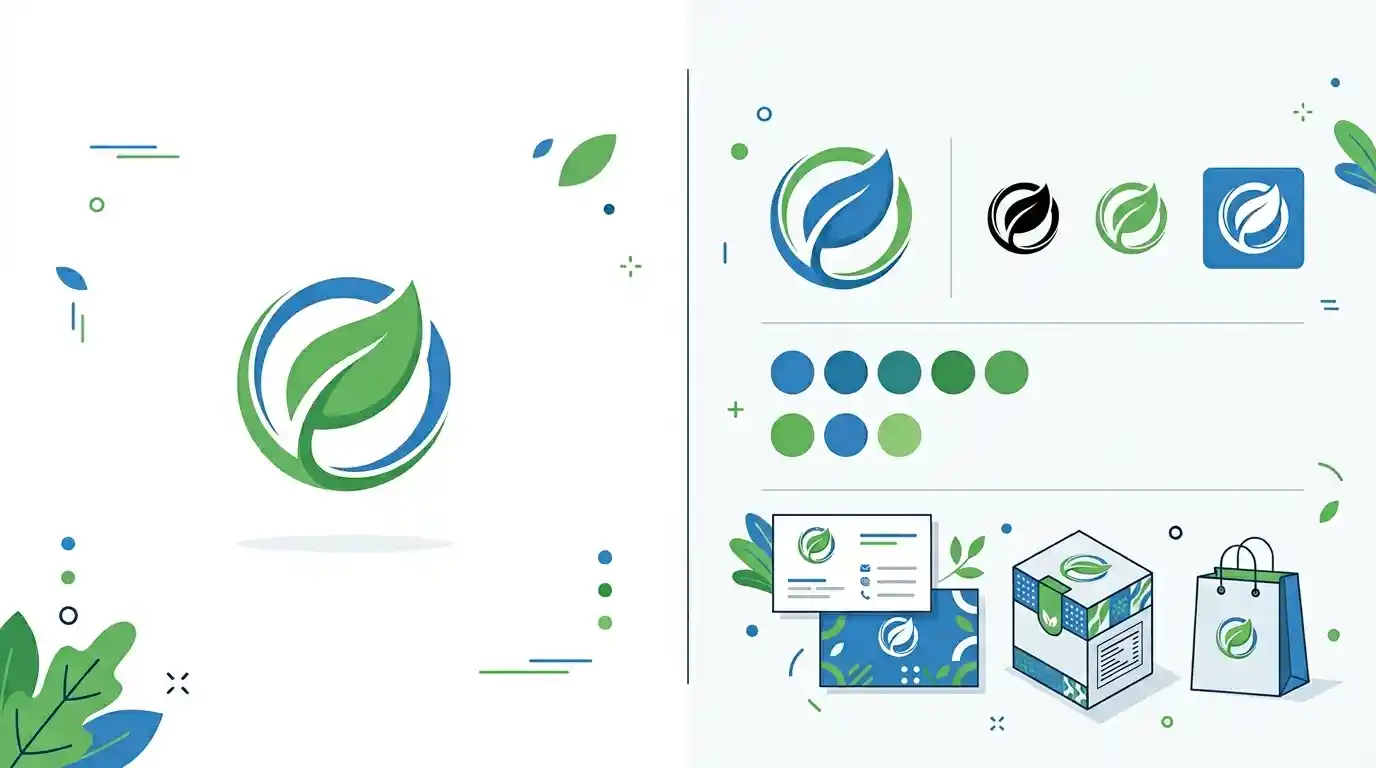
Your logo is not your brand. Your brand is everything your customer feels when they see your logo.
Most small business owners in Pakistan spend Rs. 5,000 on a logo from a random Facebook group and call it branding. Then they wonder why customers don’t take them seriously. The logo isn’t the problem. The missing brand identity system is.
This guide walks you through the complete brand identity design process, from picking your logo type to building a color palette that actually works, so your small business looks professional whether it’s on a business card in Karachi or a social media post in Lahore.
What is brand identity design?
Brand identity is the full visual system that makes your business recognizable. It’s your logo, yes. But it’s also your colors, your fonts, your icons, your tone, your business card, your Instagram grid, and your packaging.
Think of it this way: Coca-Cola’s red color is as recognizable as their logo. That’s brand identity working at full strength.
For a small business in Pakistan, brand identity design means building a consistent visual language that communicates who you are before you say a single word.
Why brand identity matters for small businesses in Pakistan
Pakistan’s small business market is competitive. Whether you run a clothing brand in Lahore, a food stall in Karachi, or a tech startup in Islamabad, your customers judge you visually in under 7 seconds.
A polished brand identity tells customers you’re serious. It builds trust before the conversation even starts.
And practically speaking: businesses with consistent brand presentation see up to 33% more revenue than those without, according to Lucidpress’s Brand Consistency Report. That’s not a small number for a small business.
If you’re also building a digital presence alongside your brand, check our guide on digital marketing strategies for Pakistani businesses to see how the two work together.
The 6 core elements of brand identity
1. Logo design
Your logo is the anchor of your entire brand identity system. Get this wrong and everything built on top of it looks unstable.
There are 5 main logo types:
- Wordmark: Your business name in a custom font (think Google, FedEx)
- Lettermark: Initials only (IBM, HBO)
- Brand mark: A symbol or icon with no text (Apple, Twitter/X)
- Combination mark: Icon plus wordmark together (most small businesses should start here)
- Emblem: Text inside a symbol, like a badge (Starbucks, Harley-Davidson)
For most Pakistani small businesses, a combination mark is the safest starting point. You get a recognizable icon and a readable name in one lockup.
Your logo also needs multiple versions: a primary version, a horizontal version, a stacked version, and a monochrome version. A logo that only works in one color on one background isn’t a complete logo.
Our graphic designing services team builds all of these as part of a complete brand identity package if you’d rather not do it yourself.
2. Color palette
Color does more work than people give it credit for. It triggers emotion, communicates positioning, and makes your brand instantly recognizable.
Your brand palette should have:
- 1 primary color (the one that defines you)
- 1 or 2 secondary colors (for support and variety)
- 1 neutral (white, black, or a soft gray/cream)
Color psychology basics for Pakistani brand design:
Green suggests trust, nature, and health. Blue communicates professionalism and reliability. Red feels urgent, energetic, and bold (great for food brands). Gold suggests premium and luxury. White signals cleanliness and simplicity.
Each color in your palette needs a defined hex code, RGB value, and CMYK value. This matters because a color that looks perfect on your phone screen can print completely differently if you haven’t specified your exact values.
Tools worth using: Adobe Color for building palettes, and Coolors for generating combinations quickly.
3. Typography
Your brand fonts carry as much personality as your logo. A serif font like Playfair Display signals tradition and authority. A clean sans-serif like Inter or Poppins signals modern and minimal. A display font signals creativity or personality.
You need 2 fonts: one for headings, one for body text. Occasionally a third accent font works, but most small businesses don’t need it.
Practical rule: your heading font can have personality, your body font should be easy to read at small sizes. Don’t flip this.
Google Fonts has hundreds of free options. Pair Inter with Playfair Display, or Montserrat with Lora, and you’ll have a professional-looking combination for zero cost.
4. Brand voice and tone
Visual identity gets the attention. Brand voice keeps it.
Your brand voice is how you write: formal or casual, playful or serious, technical or plain. For a Lahore-based fashion brand targeting Gen Z, you’d write differently than a corporate law firm in Islamabad.
Define 3 words that describe how your brand speaks. Write every caption, every product description, every email subject line through that filter.
5. Brand guidelines document
A brand guidelines document (sometimes called a brand style guide) locks in all of the above so nothing drifts.
It includes: logo usage rules, color hex codes, font names and hierarchy, spacing rules, what you can and can’t do with the logo, and tone examples.
You don’t need a 60-page document. A solid 8-10 page PDF covers everything a small business needs. And once you have it, every designer, content creator, or social media manager you work with can stay consistent without asking you the same questions 50 times.
6. Brand touchpoints
Brand touchpoints are every place a customer sees your brand: business card, packaging, social media profiles, website, email signature, signage, uniforms.
Each one should use your colors, fonts, and logo correctly. A business card using a slightly different blue than your website creates a subtle but real feeling of inconsistency.
How to create a brand identity for your small business in Pakistan, step by step
Step 1: Define your brand positioning. Who are you, who do you serve, and what do you stand for? Write 3 sentences. If you can’t do this clearly, the visual work will feel directionless.
Step 2: Build a mood board. Collect 15-20 images that represent how you want your brand to feel. Pull from Behance, Pinterest, and Instagram. Look for patterns in what you’re drawn to.
Step 3: Design your logo. Start with your logo type. Sketch it before you go digital. If you’re using a tool, Canva’s brand kit works for basic needs. Adobe Illustrator gives you full control. Figma is good for digital-first brands.
Step 4: Define your color palette. Pick your primary color first. Build everything else around it. Use Adobe Color to check contrast ratios and make sure your palette is accessible.
Step 5: Choose your fonts. Pick a heading font and a body font. Test them together in a mock layout before committing.
Step 6: Create your brand guidelines document. Document every decision. Even a simple Canva presentation works. The goal is one source of truth.
Step 7: Apply your identity to your touchpoints. Start with the ones your customers see most: social media profile images, business card, website header, packaging if relevant.
For help getting your website to match your new brand identity, our web development services team builds on WordPress and custom platforms.
Best tools for brand identity design in Pakistan
For logo design:
- Adobe Illustrator: professional standard, steep learning curve
- Canva Pro: easiest for non-designers, decent output for small businesses
- Figma: best for digital-first brands and teams that collaborate online
- Looka: AI-assisted logo generator, good for quick starting points
For color palettes:
- Adobe Color: most powerful, free to use
- Coolors: fast and easy palette generation
For fonts:
- Google Fonts: free, huge library, works everywhere
- Adobe Fonts: premium quality, included with Adobe Creative Cloud
For creating your brand style guide:
- Canva: easiest and most accessible
- Figma: better for design teams
- Adobe InDesign: most professional output
If you want a professional brand identity but don’t have the skills yet, our UI/UX designing services team handles the full visual identity process.
Common brand identity mistakes Pakistani small businesses make
Using too many colors. Pick a palette and stay there. I’ve seen small business social feeds that use a different color scheme every week. It looks like 5 different businesses ran the same account.
Logo inconsistency across platforms. Your Facebook profile picture uses the full logo with text. Your Instagram uses a cropped version that cuts off half the icon. Your WhatsApp Business profile has an old version from 2 years ago. This is fixable in an afternoon if you have all your logo files organized.
No brand guidelines. You brief a designer, they make something beautiful. Six months later you need a new flyer and you can’t remember the hex code for your brand green. You end up with a slightly different green. Then a slightly different one again. After a year, you have 6 versions of your own brand color.
Copying competitor branding. If every clothing brand in your niche uses black and gold, don’t automatically choose black and gold. Ask what would make you stand out.
Skipping the brand strategy step. Most people jump straight to logo design without defining who they are and who they’re for. A logo designed without a clear brief usually looks generic because the designer has no real direction.
Brand identity for specific industries in Pakistan
Restaurants and food businesses
Food brands in Pakistan respond well to warm colors: reds, oranges, and warm yellows trigger appetite. Bold, clean logos work better than delicate script logos when you’re printing on packaging, signage, and uniforms at different sizes.
Clothing and fashion brands
Fashion branding in Pakistan ranges from luxury to streetwear. Luxury brands typically use minimal palettes, elegant serif fonts, and lots of white space. Streetwear brands go bolder with color. Your price point and target customer should drive your visual decisions.
Tech startups
Islamabad and Karachi both have growing tech ecosystems. Tech brands here tend toward clean, modern sans-serif fonts and blue or green palettes communicating trust and capability. If you’re building an app or SaaS product, read our guide on validating your app idea before development alongside this one.
Freelancers and personal brands
Your personal brand is your professional reputation made visible. Freelancers on Fiverr and Upwork with a consistent, professional visual identity convert better on their profiles than those without. A clean logo, a consistent color on your portfolio, and a professional headshot are the minimum.
Brand identity across Pakistani cities
Karachi has Pakistan’s most competitive consumer market. Brands here need to communicate clearly and cut through real noise. Bold visual identity with clear differentiation works best.
Lahore has a strong cultural identity and consumers who respond to both traditional aesthetic references and modern design. Fashion and food brands in Lahore benefit from visual identities that feel local but look professional.
Islamabad is more corporate and government-oriented. Clean, professional branding signals competence to the Islamabad market.
Rawalpindi, Faisalabad, Multan: growing middle-class consumer bases that are increasingly brand-aware. Small businesses in these cities have a real opportunity to establish brand recognition early while local competition is still mostly unbranded.
For local digital visibility to go with your brand identity, our guide on local SEO for Pakistani businesses covers how to show up in Google searches for your city.
How brand identity connects to your digital presence
Your brand identity is the foundation. Your website, social media, and digital ads are built on top of it.
A website that doesn’t match your brand identity confuses visitors. They can’t tell if they’ve landed on the right page. Conversion rates drop when people feel uncertain.
If you’re running a Facebook Business page or building a social media strategy, your brand identity needs to be consistent across every profile image, cover photo, and visual template you post.
Our social media strategy guide for small businesses goes into the content side of this.
DIY branding vs. hiring a professional
You can absolutely build a brand identity yourself using Canva, Google Fonts, and Adobe Color. The tools are accessible. The knowledge is learnable.
The honest trade-off: DIY branding takes more time, and the results usually look like DIY branding unless you have some design instinct. That’s fine for many small businesses starting out with tight budgets.
A professional brand identity from a good designer in Pakistan costs anywhere from Rs. 25,000 to Rs. 150,000 depending on what’s included. For that you typically get a logo suite, color palette, font selection, brand guidelines, and social media kit.
If you’re serious about your business and competing in a market with established players, professional branding is worth the cost. A well-done brand identity pays for itself in credibility.
Our graphic designing services team builds complete brand identity packages for Pakistani small businesses. Check out our services page for details on what’s included.
FAQs
What is brand identity design? Brand identity design is the process of creating the complete visual system for a business: logo, color palette, typography, brand guidelines, and all the materials customers see. It’s everything that makes a business look consistent and recognizable.
What is the difference between a logo and brand identity? A logo is one element inside a brand identity system. Brand identity includes the logo plus colors, fonts, brand voice, guidelines, and all visual touchpoints. A logo without a brand identity system is just a graphic.
How do I choose colors for my brand? Start with your brand personality and target audience. Use color psychology as a guide: blue for trust, red for energy, green for health or nature. Pick 1 primary color, 1-2 secondary colors, and 1 neutral. Assign exact hex codes and document them.
How much does brand identity design cost in Pakistan? DIY using tools like Canva is free to minimal cost. Hiring a freelance designer on Fiverr or locally costs roughly Rs. 10,000 to Rs. 50,000 for a basic package. A professional agency or senior designer charges Rs. 50,000 to Rs. 150,000+ for a complete brand identity package.
What is a brand style guide? A brand style guide is a document that records all your brand identity rules: logo usage, colors with exact codes, fonts and how to use them, spacing rules, tone guidelines, and dos/don’ts. It keeps every designer, marketer, and team member consistent.
Can I create my own brand identity without a designer? Yes. Use Canva for the logo and brand kit, Google Fonts for typography, Adobe Color or Coolors for your palette, and a Canva presentation for your brand guidelines. The result won’t match professional design work, but it’s a real working brand identity that you can upgrade later.
Build your brand right, the first time
A brand identity built on guesswork costs you more in the long run than one built on a clear strategy. The inconsistency, the redesigns, the confusion you create in your customers’ minds, it all adds up.
Start with your brand positioning. Build your visual system on top of that. Document it. Apply it everywhere.
If you want professional help with your brand identity design in Pakistan, explore our graphic designing services or contact us to talk through what your business needs. And if you’re building digital skills alongside your business, our best IT courses in Pakistan for 2026 covers where to learn design, marketing, and development properly.