





If you’ve been tracking your Google rankings religiously but ignoring what Perplexity AI is saying about your brand, you’re already behind. In 2025, Perplexity AI crossed 780 million monthly queries and is now the second-largest referrer of AI-driven traffic on the internet, right after ChatGPT. The crazy part? Traffic from AI platforms like Perplexity converts at 1.66%, compared to just 0.15% from traditional Google search. That’s an 11x difference.
This means if your content isn’t being cited in Perplexity’s answers, you’re leaving massive business on the table. And no, your regular SEO tools aren’t going to tell you any of this.
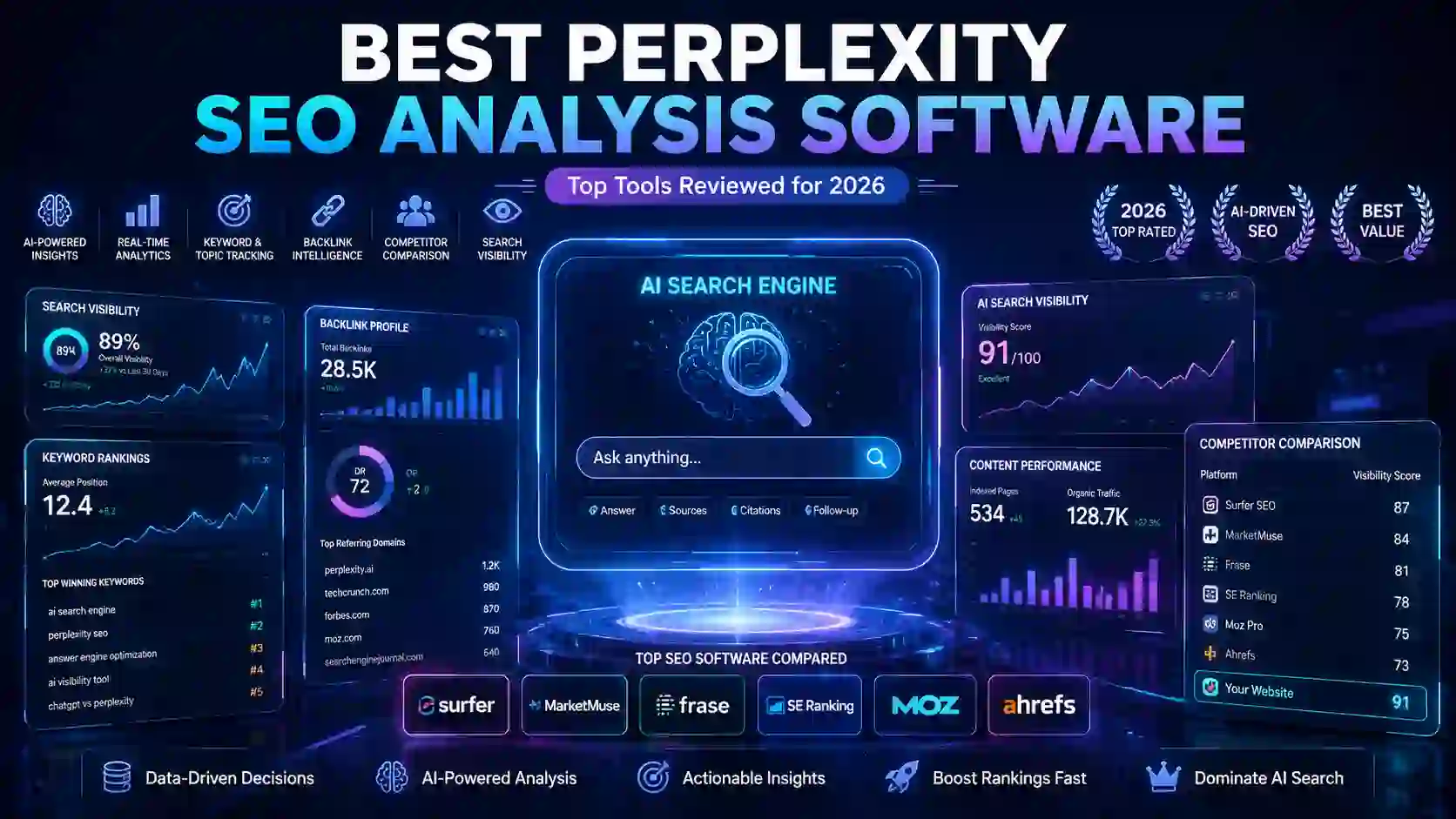
In this guide, we’re reviewing the best Perplexity SEO analysis software in 2025 — tools that actually show you where you stand in AI-generated search results, why you’re getting cited (or not), and how to fix it.
What Is Perplexity SEO and Why Does It Matter in 2025?
Perplexity AI is not a traditional search engine. It doesn’t show you a page of blue links. Instead, it reads thousands of sources, synthesizes an answer, and then cites a small set of trusted pages — much like a smart research assistant summarizing the web for you.
This is what makes Perplexity SEO fundamentally different from Google SEO. On Google, ranking on page one puts you in front of millions. On Perplexity, being one of three cited sources in an AI-generated answer is worth just as much, sometimes more.
Perplexity SEO (also called Generative Engine Optimization or GEO) focuses on helping your content become that trusted cited source. It involves:
- Optimizing content for semantic relevance, not just keywords
- Building topical authority so AI models trust your domain
- Using structured data to help LLMs parse and index your content
- Monitoring brand citations across AI-generated responses
- Tracking share of voice in AI search results
For businesses in Pakistan, India, the USA, UK, Dubai, and Australia — where digital competition is intensifying rapidly — understanding AI search visibility has become as essential as traditional SEO. If you’re working with a digital agency or freelancing, you need to understand GEO right now.
(If you want to understand the full picture of modern SEO, read our guide on SEO in 2026 at IDTS Digital — it covers everything from on-page basics to AI-era optimization.
What Is the Difference Between SEO and AEO?
SEO (Search Engine Optimization) is about ranking your page on Google. AEO (Answer Engine Optimization) is about getting your content cited inside AI-generated answers on Perplexity, ChatGPT, Gemini, and similar platforms.
The key difference is intent. SEO puts your link in front of a user. AEO makes your content part of the answer itself. Both matter in 2025 — but AEO is the faster-growing discipline and most brands are still sleeping on it.
Why You Need Dedicated Perplexity SEO Software
Here’s the honest truth: tools like SEMrush, Ahrefs, and Moz were built for Google. They show you keyword rankings, backlink profiles, and domain authority — none of which tells you whether Perplexity is recommending your brand or sending customers to your competitor.
Standard SEO tools don’t capture:
- Whether your URLs are being cited in AI answers
- Which competitor pages Perplexity prefers over yours
- How AI platforms describe your brand in natural language
- When your AI search visibility drops or spikes
- What prompts or questions trigger citations for your category
This is exactly why a new category of Perplexity SEO analysis software has emerged — and why choosing the right one could be the difference between being found and being invisible in AI search.
Best Perplexity SEO Analysis Software in 2025: Top Tools Reviewed
Let’s get into the tools. We’ve evaluated these based on analysis depth, ease of use, AI citation accuracy, reporting quality, and value for money.
- SE Ranking — Best All-in-One Perplexity SEO Tool
SE Ranking is one of the most committed platforms in this category when it comes to Perplexity visibility. Its dedicated Perplexity Visibility Tracker, part of the SE Visible suite, monitors both brand mentions and URL citations simultaneously, with daily data refresh.
What makes SE Ranking stand out is its “No Cited” feature — it flags every search prompt where your competitors are being cited but you’re not. That turns a vague visibility gap into a specific content task you can act on immediately.
Key features:
- Daily Perplexity rank tracking with average position scoring
- Brand mention and URL citation tracking in one dashboard
- Competitor citation gap analysis
- Full AI answer text extraction for context
- Traditional SEO tools included in the same platform
Best for: Agencies and small-to-medium businesses that want both Perplexity tracking and traditional SEO in a single affordable platform.
Starting price: ~$95/month (Pro plan includes Perplexity tracking at no extra cost)
- GEO-Lens — Best Dedicated Perplexity SEO Analysis Tool
If you want the deepest Perplexity-specific analysis available, GEO-Lens is purpose-built for AI search optimization. Unlike tools adapted from traditional SEO, GEO-Lens was designed from the ground up for how LLMs evaluate content.
It uses a proprietary CORE framework to analyze your pages:
- Context: Does your content provide the comprehensive context AI models need?
- Organization: Is your content structured in a way LLMs can parse cleanly?
- Reliability: Does your content demonstrate E-E-A-T signals AI models value?
- Exclusivity: Does your content offer something competitors don’t?
GEO-Lens achieves 94% accuracy on Perplexity-specific optimization scoring and offers competitor citation gap analysis across five or more AI platforms.
Best for: Content teams and SEO professionals who want actionable improvement recommendations, not just tracking data.
- SEMrush AI Visibility Toolkit — Best for Teams Already Using SEMrush
If your team lives inside SEMrush, you don’t need to switch tools. SEMrush’s AI Visibility Toolkit now tracks Perplexity alongside ChatGPT, Google AI, and Gemini in a unified dashboard.
The Brand Performance feature generates synthetic prompts and tracks weekly AI responses with Share of Voice and Sentiment analysis across all four platforms. The Prompt Research feature functions like keyword research — but for AI search — helping you find the high-volume prompts your audience uses when researching your category on Perplexity.
The AI Results Tracker shows you the exact URLs Perplexity cites for each tracked prompt, which turns abstract share-of-voice data into concrete competitor pages you need to outrank.
Best for: Marketing teams that want Perplexity SEO tools integrated with citation source mapping and GA4 revenue attribution.
Starting price: From $103.20/month (Core plan, billed annually)
- WorkDuo — Best for Agencies Needing Deep AI Visibility
WorkDuo is designed for agencies and brands that need more than basic mention tracking. It offers real-time browser monitoring, sentiment analysis, share of voice measurement, and product-level AI visibility insights.
What sets WorkDuo apart for agencies is its white-label reporting and structured data insights, making it easy to present AI visibility results to clients who may not yet understand what Perplexity SEO even is.
Best for: Agencies managing multiple clients who need deep AI visibility scoring and professional reporting.
- Peec AI — Best for Multi-Platform Brand Perception
Peec AI takes a unique angle: instead of just tracking where you’re cited, it analyzes how AI platforms describe your brand compared to competitors. This positioning analysis is genuinely different from anything else in this category.
It covers Perplexity, ChatGPT, Gemini, and Claude simultaneously, showing you how each AI perceives your brand’s expertise, authority, and trustworthiness.
Best for: Brand managers and marketing directors who want to understand and shape AI perception across multiple platforms.
- Ahrefs — Best for Combining Backlink Analysis With AI Visibility
Ahrefs has been adding AI search tracking capabilities and remains one of the most reliable platforms for understanding why certain pages get cited more than others. If your theory (which is correct) is that high-authority backlinks and topical depth drive LLM citations, Ahrefs gives you the data to test and prove it.
Best for: SEO teams that want to connect traditional link authority data with AI citation performance.
- AccuRanker — Best for Real-Time AI Rank Tracking
AccuRanker delivers on-demand rank tracking with some of the fastest data refresh rates in the industry. For teams that need real-time AI search visibility data — not weekly snapshots — AccuRanker is a strong choice.
Best for: SEO teams and agencies that prioritize speed and data freshness in their Perplexity rank tracking workflow.
- Nightwatch — Best Budget Option for AI SEO Tracking
Nightwatch offers competitive Perplexity SEO tracking at a lower price point, making it an attractive choice for freelancers and small businesses that need AI visibility data without enterprise-level pricing.
Best for: Freelancers, solopreneurs, and small business owners looking for affordable Perplexity rank tracking tools.
- Profound AI — Best for Enterprise Brand Monitoring
Profound AI targets Fortune 500 companies with comprehensive brand mention tracking and sentiment analysis across AI platforms. The feature set is extensive, and the price reflects that — but for large brands where AI search visibility is a competitive priority, it’s worth the investment.
Best for: Enterprise marketing teams and Fortune 500 brands that need comprehensive AI search visibility management.
- Geovate — Best for GEO and SEO Integration
Geovate positions itself at the intersection of generative engine optimization (GEO) and traditional SEO, helping teams understand how their content strategy needs to evolve for AI-era search. It’s particularly useful for teams building topic cluster strategies designed to earn AI citations.
Best for: Content strategists building long-term topical authority for both Google and AI search engines.
What Factors Affect Perplexity AI Citations?
Understanding what causes Perplexity to cite one page over another is the foundation of good Perplexity SEO. Based on current research and platform behavior, the main factors are:
Topical authority: Perplexity tends to cite pages from domains that demonstrate deep expertise in a topic, not just surface-level coverage.
Semantic completeness: Pages that answer questions comprehensively — including related questions, definitions, context, and examples — are favored over thin content.
Structured data: Schema markup, clear headings, and logically organized content help LLMs parse and understand your page more accurately.
Freshness: Perplexity AI gives weight to recently updated, accurate content, especially for topics where information changes frequently.
E-E-A-T signals: Experience, Expertise, Authoritativeness, and Trustworthiness signals — author credentials, citations, factual accuracy — all influence whether AI platforms treat your content as a reliable source.
Brand entity recognition: If your brand is a recognized entity in AI training data, you’re more likely to get cited consistently. This is why entity-based SEO and knowledge graph optimization matter now more than ever.
(To understand E-E-A-T optimization in depth and how it connects to AI visibility, explore our on-page SEO checklist at IDTS Digital.
How to Optimize Content for Perplexity AI in 2025
Choosing the right Perplexity SEO analysis software is step one. But you also need a content optimization strategy that makes your pages citation-worthy. Here’s a practical checklist:
Step 1 — Answer questions directly and completely Perplexity users ask conversational questions. Your content should have clear, direct answers to those questions near the top of the page — not buried in paragraph seven.
Step 2 — Use structured headings H2 and H3 headings that mirror the questions your audience asks on Perplexity make it much easier for LLMs to extract relevant answers from your page.
Step 3 — Build topical depth, not just breadth A single comprehensive guide that covers a topic from every angle is more citation-worthy than ten shallow posts. Invest in pillar content that establishes genuine expertise.
Step 4 — Add schema markup FAQ schema, HowTo schema, and Article schema help search engines and AI platforms understand your content’s structure and intent.
Step 5 — Build authoritative backlinks High-quality backlinks from authoritative domains still signal trust to AI models. Perplexity’s citation patterns consistently favor well-linked pages.
Step 6 — Update your content regularly Outdated information is a red flag for AI platforms. Set a content refresh schedule, especially for competitive topics.
Step 7 — Monitor and iterate with the right tools Use a Perplexity SEO tracking tool to monitor your citation performance, identify gaps, and measure the impact of content changes.
Perplexity SEO Tools for Different Markets and Use Cases
One thing worth noting is that Perplexity SEO isn’t a one-size-fits-all discipline. Depending on where you operate and what you’re optimizing for, different tools and strategies apply.
For Pakistan digital marketers and agencies: Tools like SE Ranking offer the most accessible price point with strong Perplexity tracking capabilities. Combined with a solid understanding of local SEO and content strategy, Pakistani agencies can build genuine AI search visibility for their clients. (Learn how IDTS Digital helps businesses with SEO services in Pakistan.
For USA and UK agencies: WorkDuo and SEMrush’s AI Visibility Toolkit offer the enterprise-grade reporting and multi-client management features that larger agencies need.
For Australian businesses: SE Ranking and Nightwatch both offer good regional support and are popular among Australian SEO professionals.
For Dubai and Southeast Asian agencies: Peec AI’s multi-platform brand perception analysis is particularly valuable in markets where brand trust signals vary across AI platforms.
For small business owners globally: Nightwatch and Geovate offer the best value for solo operators and small teams who want actionable Perplexity SEO data without the complexity of enterprise tools.
Perplexity vs. Google SEO: Key Differences to Understand
Many digital marketers ask whether Perplexity is replacing Google for SEO purposes. The honest answer: not replacing, but complementing.
Google remains the dominant search engine globally, and Google SEO is still essential for organic traffic at scale. However, Perplexity AI is changing how a growing segment of users — particularly tech-savvy, high-intent researchers — discover products, services, and information.
The difference in user behavior matters. A Google user often clicks through multiple results. A Perplexity user reads a synthesized answer and may only click one cited source. That cited source gets highly qualified, conversion-ready traffic — which explains that 11x difference in conversion rates.
The tools are different too. Google SEO uses keyword ranking trackers, backlink analyzers, and SERP monitoring tools. Perplexity SEO requires AI citation trackers, brand mention monitoring, share-of-voice analysis, and content optimization tools built specifically for LLM environments.
The smart strategy is to pursue both simultaneously — optimizing for Google rankings while building AI search visibility on Perplexity and other LLM-powered platforms.
Learn how to run both strategies efficiently in our digital marketing guide.
Frequently Asked Questions About Perplexity SEO Tools
What is Perplexity SEO? Perplexity SEO, also called Generative Engine Optimization (GEO), is the practice of optimizing your content so it gets cited in AI-generated answers on Perplexity AI and similar LLM-powered search engines. It focuses on topical authority, semantic relevance, structured data, and E-E-A-T signals.
How does Perplexity AI rank content? Perplexity AI doesn’t use a traditional ranking algorithm like Google’s PageRank. It evaluates content based on semantic relevance to the query, topical authority of the domain, content freshness, and reliability signals like citations, author expertise, and structured data.
What is the best free Perplexity SEO tool? Most dedicated Perplexity SEO tools are paid, but SE Ranking and AIclicks offer limited free tiers or free trials that let you test Perplexity citation tracking before committing. For teams on a tight budget, starting with a free trial of SE Ranking is the most practical option.
What is the CORE framework for Perplexity SEO? The CORE framework, developed by GEO-Lens, evaluates content on four dimensions: Context (semantic depth and completeness), Organization (structural clarity for LLMs), Reliability (E-E-A-T signals), and Exclusivity (unique insights competitors don’t offer). Pages that score well across all four dimensions are significantly more likely to earn Perplexity citations.
Is SE Ranking good for Perplexity tracking? Yes. SE Ranking’s dedicated Perplexity Visibility Tracker is one of the most robust in the market at its price point. It tracks brand mentions and URL citations daily, assigns average position scores, and flags prompts where competitors are cited but you’re not — making it an excellent choice for agencies and SMBs.
Can I use SEMrush for Perplexity SEO tracking? Yes. SEMrush’s AI Visibility Toolkit now includes Perplexity tracking alongside ChatGPT, Google AI, and Gemini. It’s an excellent option for teams already using SEMrush for traditional SEO who want to add AI search visibility monitoring without switching platforms.
What is share of voice in AI search? Share of voice in AI search measures what percentage of AI-generated answers in your topic category include citations to your content, compared to your competitors. It’s the AI equivalent of tracking how often your brand appears on Google’s first page.
Choosing the Right Perplexity SEO Software for Your Business
Here’s a simple decision guide based on your situation:
You’re an agency managing multiple clients → WorkDuo or SE Ranking You want the deepest citation analysis → GEO-Lens You’re already on SEMrush → SEMrush AI Visibility Toolkit You’re a freelancer or small business → Nightwatch or SE Ranking You want brand perception insights → Peec AI You’re an enterprise brand → Profound AI You want to combine GEO and traditional SEO → Geovate or Ahrefs
The key is to start tracking now, even with a basic tool, rather than waiting until AI search visibility becomes your biggest competitive blind spot.
Why IDTS Digital Can Help You Navigate AI SEO
Understanding Perplexity SEO tools is one thing. Actually implementing an AI search optimization strategy for your business is another. At IDTS Digital, we help businesses and agencies across Pakistan, the USA, UK, and beyond build comprehensive digital strategies that cover both traditional Google SEO and emerging AI search optimization.
Our team stays ahead of the curve on everything from GEO and AEO to on-page optimization and content strategy. Whether you need SEO services, digital marketing training, or hands-on support building your AI search visibility, IDTS Digital has the expertise to guide you.
Explore our SEO services here.
If you’re a marketer, freelancer, or business owner looking to build these skills for yourself, our advanced digital marketing courses cover AI SEO, GEO, content optimization, and much more.
You can also explore our full range of digital marketing services including content writing and blogging, web development, and AI chatbot integration.
Conclusion
Perplexity AI is no longer a niche experiment. It’s a mainstream answer engine with tens of millions of active users, growing at 50% year over year, and it’s sending conversion-ready traffic to brands that have earned its trust.
The best Perplexity SEO analysis software in 2025 — whether that’s SE Ranking, GEO-Lens, SEMrush’s AI Visibility Toolkit, or WorkDuo — gives you visibility into a traffic channel that your competitors are mostly ignoring. That’s a competitive advantage you should be taking right now.
The businesses that win in AI search over the next three years won’t necessarily be the ones with the biggest budgets. They’ll be the ones who understood the shift early, chose the right tools, built genuine topical authority, and optimised for how LLMs evaluate content.
Start tracking. Start optimizing. Start winning in AI search.
Ready to build your Perplexity SEO strategy from the ground up? Book a consultation with IDTS Digital or enrol in our Advanced Digital Marketing Course today.